
Why We Temperament Test and What it Means for You
Magical Matches - The Heart and Soul of Our Program
You know that rare moment when something doesn’t just meet expectations, but surpasses them—when it feels destined, effortless, and profoundly right. That is the experience we strive to create with every puppy we raise.
By placing temperament at the heart of our program, we ensure that the puppy you welcome into your home is more than a companion. It is the one—a dog who integrates seamlessly into your life, forms a deep emotional connection with your family, and leaves a lasting imprint on your heart.
Unlike programs that rely on guesswork or simple observation, our temperament testing is structured, repeatable, and designed to evaluate the full picture of each puppy — giving families clear insight into personality, trainability, and long-term potential.
While color, size, and shedding are important considerations, true fulfillment comes from temperament. When a puppy’s personality aligns beautifully with your lifestyle, appearance fades into the background. What remains is connection, harmony, and a bond that feels timeless—because when the match is right, love follows effortlessly.
This process works alongside our comprehensive health testing and thoughtful breeding decisions, ensuring each puppy is not only healthy, but mentally and emotionally suited for the life they are placed into.
At Oregon’s Legendary Goldendoodles, this is what sets our program apart. We don’t just raise puppies — we intentionally develop and evaluate each one to ensure they become confident, capable companions matched to the right home.
How Does the Testing Work?
Our Temperament Evaluation Process
We invite you to learn more about what we do—because this process is truly the heart and soul of our program, alongside our BAB Service Dog Curriculum outlined on our Badass Breeder page.
Rather than asking families to take our word for it, we believe in showing you. Our temperament evaluation is designed to help you understand who each puppy truly is, how they experience the world, and how those traits may impact your home, lifestyle, or future goals.
While energy level is often the only trait most buyers are familiar with, our evaluation goes far deeper—revealing the complete picture of each puppy as an individual.
👉 Families specifically seeking a working dog can learn more about our Service Dog Prospect Program
The Testing Environment
Temperament testing begins with the tester already present in the space—quiet, calm, and waiting. The testing room is new to the puppies, but the tester is familiar and trusted. This allows us to observe how each puppy behaves in an unfamiliar environment with someone they feel safe with.
We allow time for adjustment and carefully observe how each puppy initially engages with the tester. This first interaction reveals assertiveness, a steady trait that reflects who the puppy truly is.
We observe:
Calm, polite greetings
Overly assertive behaviors (jumping, mouthing, biting)
Submissive approaches (crawling, rolling, avoiding)
Assertiveness is a core, unchanging trait, and we continue to evaluate it throughout the entire test, noting whether a puppy becomes more assertive as comfort increases.
Bonding, Energy & Prey Drive
Next, we spend time building trust through gentle handling, affection, and play. During this phase, we observe energy level and prey drive—both steady traits.
Energy level is assessed through:
Activity versus rest patterns
Ability to settle
How quickly they move between stimuli
Because testing occurs in a new environment, puppies will often display less energy here than they will at home.
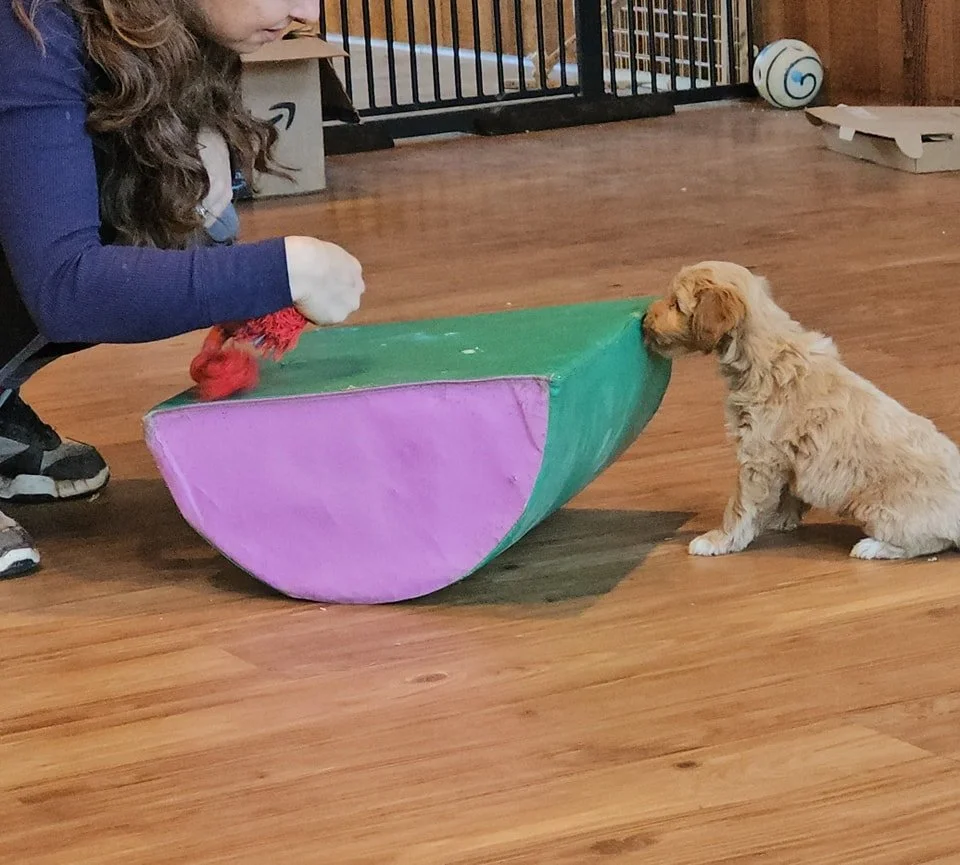
Prey drive is evaluated by how puppies interact with toys:
Are they motion-triggered?
Do they chase, tug, thrash, or retrieve?
This helps us understand how a puppy may enjoy activities like fetch, respond to fast-moving children, or coexist with small pets.
Human Focus
As the tester moves around the space, we observe how human-focused each puppy is:
Velcro-style puppies who stay close
Puppies who check in but confidently explore
Highly independent puppies
This trait is steady and does not change. However, focus itself can be trained and refined.
Workability & Confidence
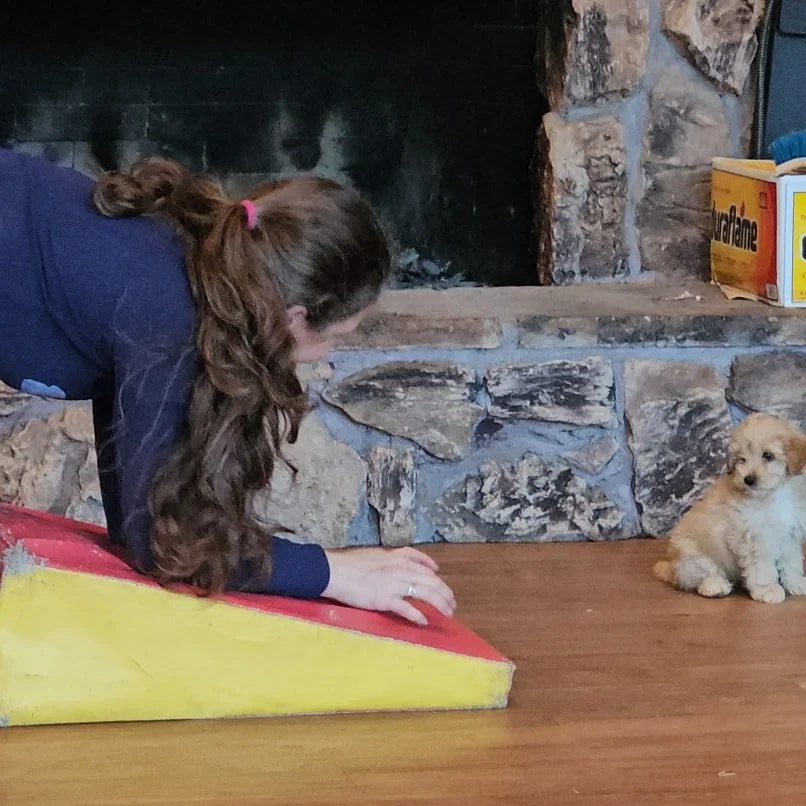
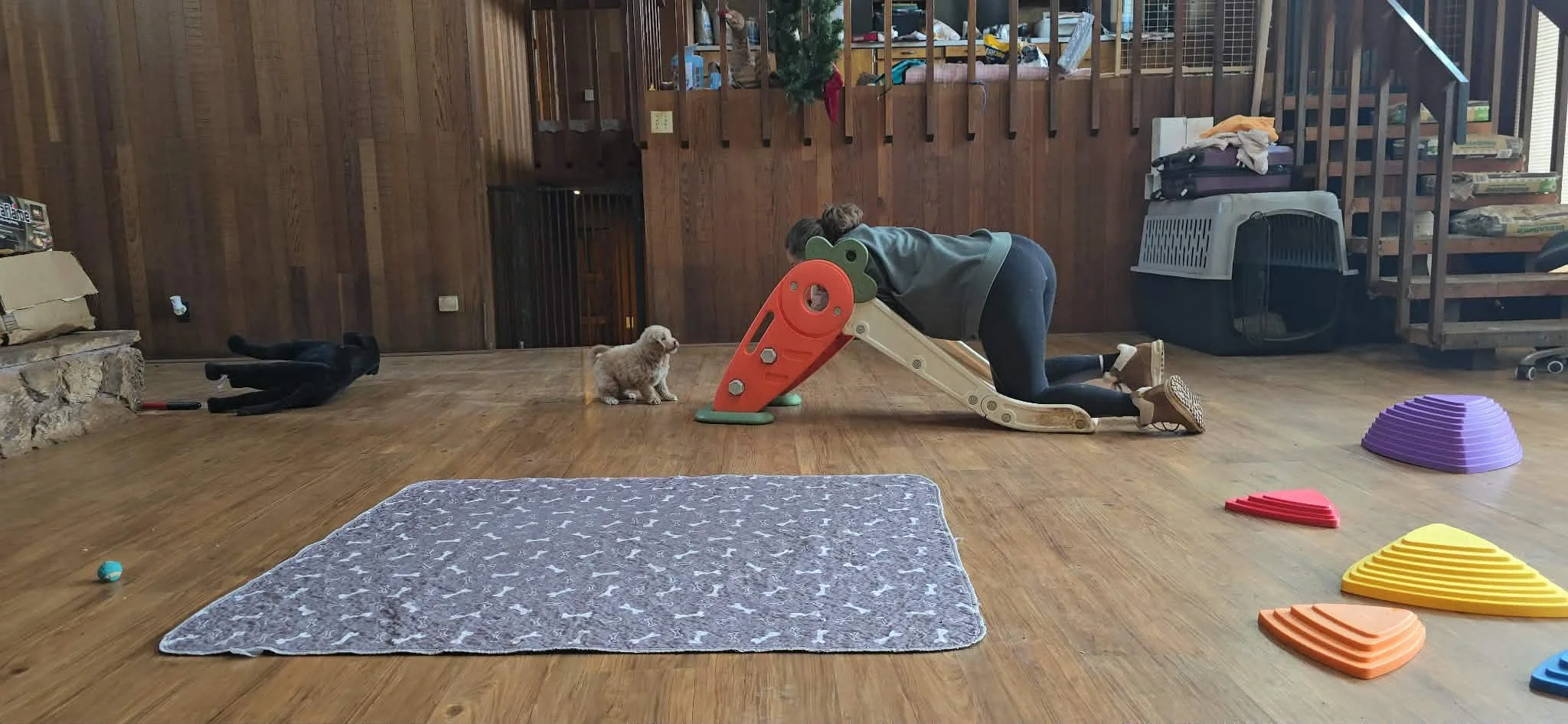
We then introduce a simple task—such as climbing an obstacle or retrieving a toy—to assess workability and confidence.
We evaluate:
Willingness to engage
Desire to please
Need for encouragement or bribery
Workability is a steady trait.
Confidence, however, is adjustable.
We observe body language to determine whether a puppy wants to succeed but doubts themselves, or simply lacks desire. Empowerment builds confidence; enabling diminishes it—an important focus of our curriculum.
Touch Tolerance & Compliance
We demonstrate touch tolerance through a gentle puppy massage, simulating handling that may feel “inappropriate” or unpredictable—such as a child might do.
We observe:
Enjoyment and relaxation
Passive tolerance
Stress signals
Touch tolerance is adjustable and shaped by experiences—both positive and negative. Puppies who genuinely enjoy handling score higher than those who simply tolerate it.
Sound, Sight & Environmental Sensitivity
We assess sensitivity through controlled exposure:
Sound: a popper toy
Sight: opening an umbrella
Combination: walking across a tarp
These experiences help us evaluate nerve strength, an adjustable trait. By stacking mild stressors, we observe whether a puppy continues working through challenges or needs time to decompress.
This is a major focus of our curriculum—empowering rather than enabling.
Nerve Strength & Stress Signals
As testing progresses, we continuously evaluate how puppies manage stress. Signs include:
Body posture and tail position
Yawning, lip licking, trembling
Whale eye, avoidance, whining
Scratching (this is often the most visible sign)
Nerve strength is revealed not by the presence of stress—but by how the puppy recovers and continues.
Tenderheartedness & Emotional Sensitivity
To assess emotional sensitivity, the tester may lie on the floor or create exaggerated, childlike commotion. This simulates real-life scenarios such as:
Loud children
Family arguments
Parties or sporting events
Intense emotions like anxiety or grief
Tenderheartedness is a steady trait.
High tenderheartedness: puppies may attempt to escape or “fix” emotions. These puppies require emotional boundaries and are not suited for intense therapy or ESA roles.
Medium tenderheartedness: puppies notice emotions but are not consumed by them. Ideal ESA candidates and excellent therapy dogs when paired with high touch tolerance.
Low tenderheartedness: puppies remain playful and unaffected, often redirecting their person away from emotional spirals—excellent psychological service dogs ESA candidates.
Dog Friendliness & Dog Focus
Finally, we assess dog interaction using a neutral, unmoving stuffed dog to ensure consistency.
We observe:
Assertiveness on approach (not aggression)
Politeness and body language
Dog focus versus human focus
This helps families with existing dogs understand compatibility. Dog friendliness is adjustable, while dog focus provides insight into how a puppy prioritizes relationships.
Honoring the Dog You Have
One of the most important lessons in dog ownership is learning to listen to what the dog is telling you.
Every dog has individual preferences, motivations, strengths, and limitations. While training can improve skills, confidence, manners, and communication, training does not fundamentally change who a dog is.
Many people bring home a dog and immediately begin imagining the future they hope to have together.
They picture hiking partners, dog parks, coffee shop outings, therapy work, agility competitions, cuddling on the couch, or a dog that loves every person and every animal they meet.
Sometimes those expectations align beautifully with the dog.
Sometimes they don't.
When they don't, the goal should not be to force the dog into the life we imagined.
The goal should be to listen to the dog and build a life that allows that dog to thrive.
A dog with strong prey drive may never be trustworthy around free-ranging rabbits.
A socially selective dog may never enjoy dog parks.
A dog with lower touch tolerance may never want to spend hours being hugged on the couch.
A highly sensitive dog may never be comfortable in a loud, chaotic household.
These are not flaws.
These are pieces of information.
Temperament testing helps us identify many of these tendencies early, not so families can change them, but so families can understand and respect them.
Some traits are highly trainable. Confidence can often be improved. Skills can be taught. Manners can be developed. Coping skills can be strengthened.
Other traits are much more deeply rooted. Social preferences, prey drive, sensitivity levels, independence, touch tolerance, and natural motivations often remain recognizable throughout a dog's life.
The happiest relationships tend to happen when families stop focusing on who they hope the dog will become and start appreciating who the dog already is.
Instead of imagining a future that may never exist, we encourage families to find a dog whose natural temperament already aligns with the life they hope to live.
When we honor the dog we have, rather than constantly asking them to become someone else, we give that dog a voice.
And dogs whose voices are heard tend to live happier, less stressful lives.
Why This Matters
Every puppy is evaluated as an individual—not labeled, not generalized. This process allows us to guide families with clarity and confidence, ensuring the puppy you welcome into your home is the right fit for your life, goals, and emotional landscape.
This is how we honor the puppy.
This is how we support the family.
And this is why temperament comes first.
Health Evaluations, Vaccinations, and Veterinary Care
Formal temperament testing is completed before families receive their puppy evaluations. Following temperament testing, each puppy receives an individual veterinary health examination.
Families receive both the temperament assessment and the veterinarian's findings before making their final puppy selection. If any health concern, abnormal finding, or developmental issue is identified during the examination, it is disclosed to families and discussed openly.
In addition to veterinary examinations, we follow a proactive vaccination protocol designed to provide puppies with as much protection as possible before they leave our care.
Because our dogs actively compete in dog sports and regularly attend events where dogs from many different locations gather, disease prevention is something we take seriously.
Puppies receive Bordetella beginning at approximately three weeks of age.
At four weeks of age, puppies receive Neopar, a vaccine specifically designed to provide early protection against parvovirus while still working in the presence of maternal antibodies.
Between six and seven weeks of age, puppies receive their first DHPP vaccination and permanent microchip identification.
We administer our own vaccinations and microchips. This allows us to carefully control vaccine storage, handling, administration, timing, and record keeping while minimizing unnecessary travel and stress during important developmental periods.
One of the most important things for families to understand is that puppies do not achieve full vaccine protection before going home.
Puppies leave us with an important foundation of protection, but maternal antibodies passed from their mother continue to interfere with vaccine effectiveness during early development. Because every puppy loses these maternal antibodies at a slightly different rate, no veterinarian can determine exactly when a puppy becomes fully capable of responding to vaccination.
For this reason, puppies must continue their vaccination series with their veterinarian after going home.
We strongly recommend that families follow their veterinarian's guidance regarding booster schedules. In most cases, puppies will receive additional DHPP vaccinations approximately every three weeks until at least sixteen weeks of age.
The final puppy vaccination at approximately sixteen weeks is considered the most important because it is the vaccine most likely to be administered after maternal antibodies have declined enough for full protection to develop.
Our goal is to provide puppies with as much protection as possible before they leave us while ensuring families understand that continued veterinary care and completion of the vaccination series remain essential.
What Our Families Experience When Temperament Comes First
Because every puppy in our program is intentionally evaluated and thoughtfully matched, our families experience smoother transitions, stronger bonds, and long-term success in their homes.
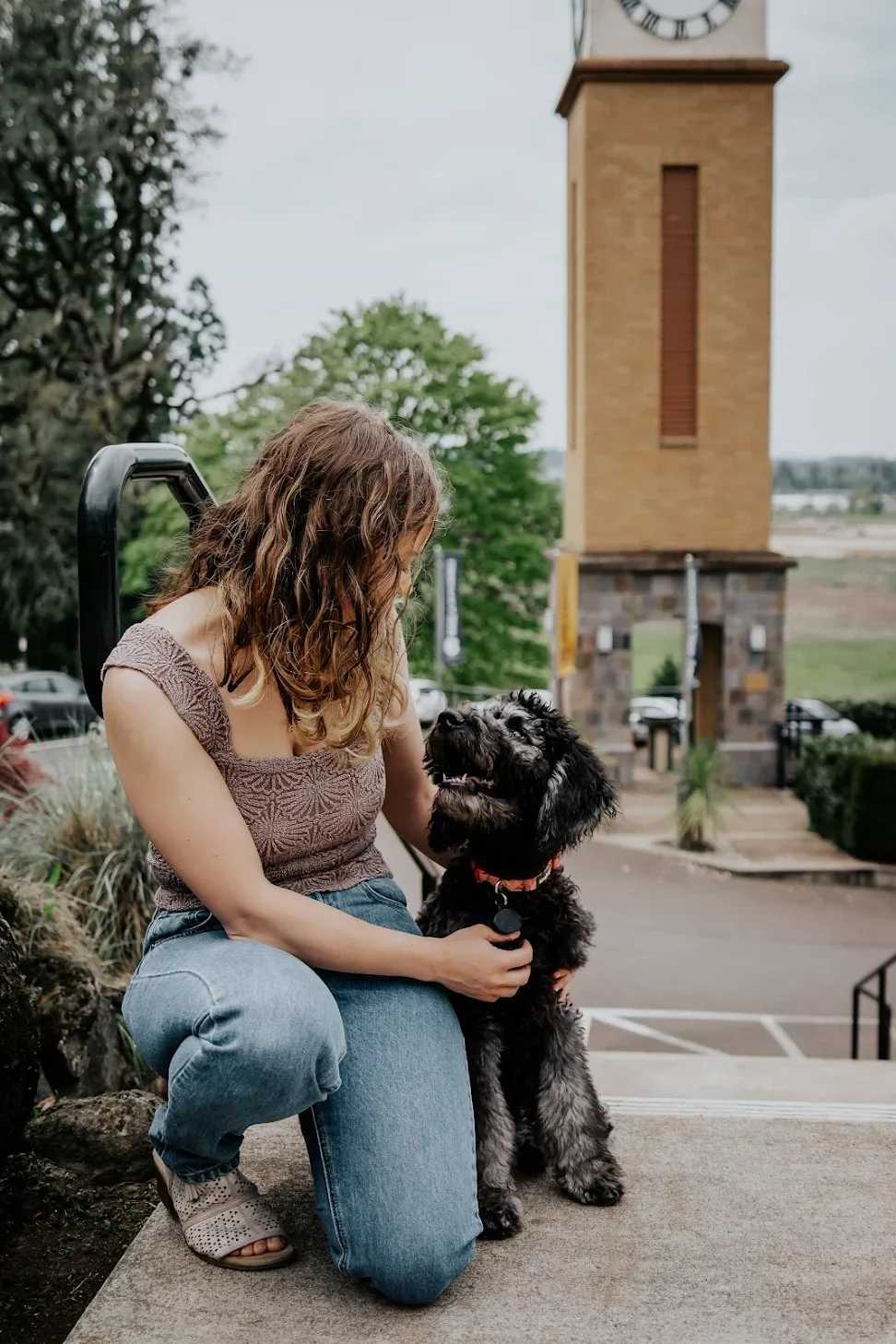
“We are so happy we chose Oregon’s Oodles of Poodles & Doodles for our Goldendoodle. We had never experienced a breeder who focuses on matching puppies to families, but it made complete sense—and it truly made all the difference.
We now have our perfect match, Kona (formerly Spark), and she has absolutely stolen our hearts. She is incredibly confident, loves adventures, and is such a fun, goofy girl. She’s very trainable, eager to learn, and loves to stay close to her people.
Kona has brought so much joy and emotional support into our lives. She transitions beautifully in different environments and gets along wonderfully with our older dog.
You can truly see the level of care, thought, and intention that goes into raising these puppies—it makes a difference in every way.”
Kona — thoughtfully matched based on temperament, confidence, and lifestyle compatibility
⭐ A True Match
“Lesli was wonderful to work with. She took the time to truly understand what we were looking for in a dog and matched us with a Goldendoodle who is just right for our family.
Her communication was excellent, and her knowledge and guidance made the entire process feel easy and well-supported. We had a great experience from start to finish.”
⭐ Perfect Fit for Our Family
“Lesli was easy to work with. She understood what we were looking for in a dog for our family and matched us with a Goldendoodle who is just right for us. Lesli’s communication was excellent and she is very knowledgeable. We had a great experience overall.”
⭐ Guidance You Can Trust
This is why we place temperament at the center of everything we do.
Why Families Choose Our Program
At Oregon’s Legendary Goldendoodles, we don’t simply raise puppies — we intentionally develop and match each dog to the life they are meant to live.
Our approach is built on a clear foundation:
Temperament Comes First
Every puppy is evaluated as an individual. We prioritize personality, confidence, and emotional stability to ensure each dog is placed where they will thrive.
Purposeful Early Development
From the earliest days, our puppies are raised with structured enrichment, exposure, and experiences designed to build resilience, adaptability, and trust.
Thoughtful Matching, Not Guesswork
We guide families through the placement process using temperament evaluations, helping ensure the right puppy is matched to the right home, lifestyle, and goals.
Proven Results in Real Homes
Our dogs are not only beloved family companions — many go on to excel as therapy dogs, service prospects, and deeply connected partners in everyday life.
Ongoing Support & Guidance
We remain a resource long after your puppy goes home, offering guidance and support as your dog grows and develops.
This is why our families don’t just bring home a puppy — they bring home the right one.
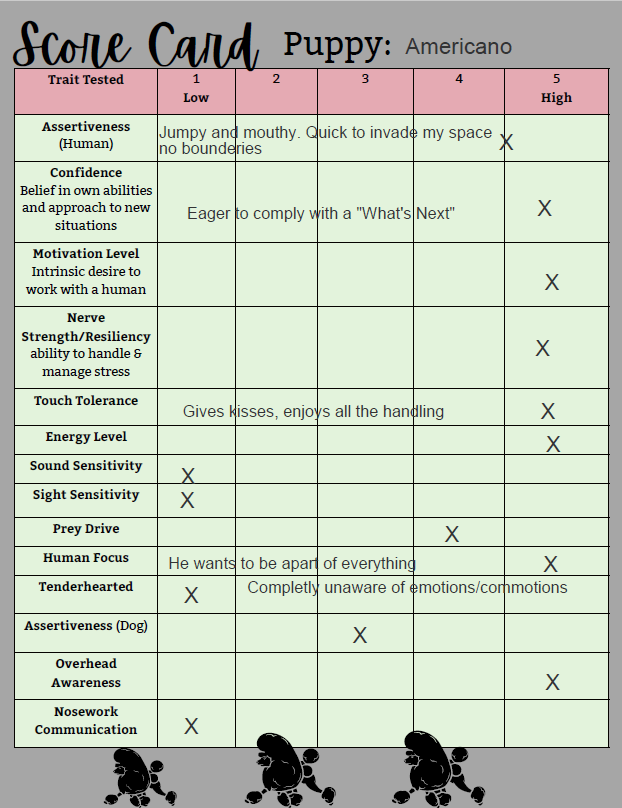
Temperament Testing Score Card & Sample Videos
Each family receives a full temperament evaluation, including a video, scorecard, and personalized guidance to help you confidently choose the right puppy.
Jackson was identified through temperament testing as a service prospect. He is currently undergoing extensive training with the Prison Pet Partnership as a donation.