
The Complete Guide to Goldendoodle Coat Genetics, Shedding & Allergies
If you're researching Goldendoodles because of shedding or allergies, you've probably encountered a lot of conflicting information.
You may have heard:
Goldendoodles are hypoallergenic.
F1Bs are best for allergies.
Curly coats don't shed.
Generation determines shedding.
Unfortunately, many of these statements oversimplify a much more complex topic.
The reality is that coat genetics play a significant role in shedding, and shedding can influence how allergens are distributed throughout a home.
Understanding those genetics can help families make more informed decisions.
The Most Important Allergy Question
Before discussing genetics, families should understand a simple truth:
Not all allergy sufferers react to the same things.
Some people react primarily to:
Hair distributed throughout the home
Airborne dander
Environmental allergen buildup
Others react strongly to:
Saliva
Direct contact
Skin oils
This distinction matters.
Because while coat genetics can influence shedding and allergen distribution, they cannot eliminate saliva proteins or predict how a specific immune system will respond.
This is one reason we strongly encourage controlled exposure before bringing home a puppy.
The One Concept That Makes Genetics Easier To Understand
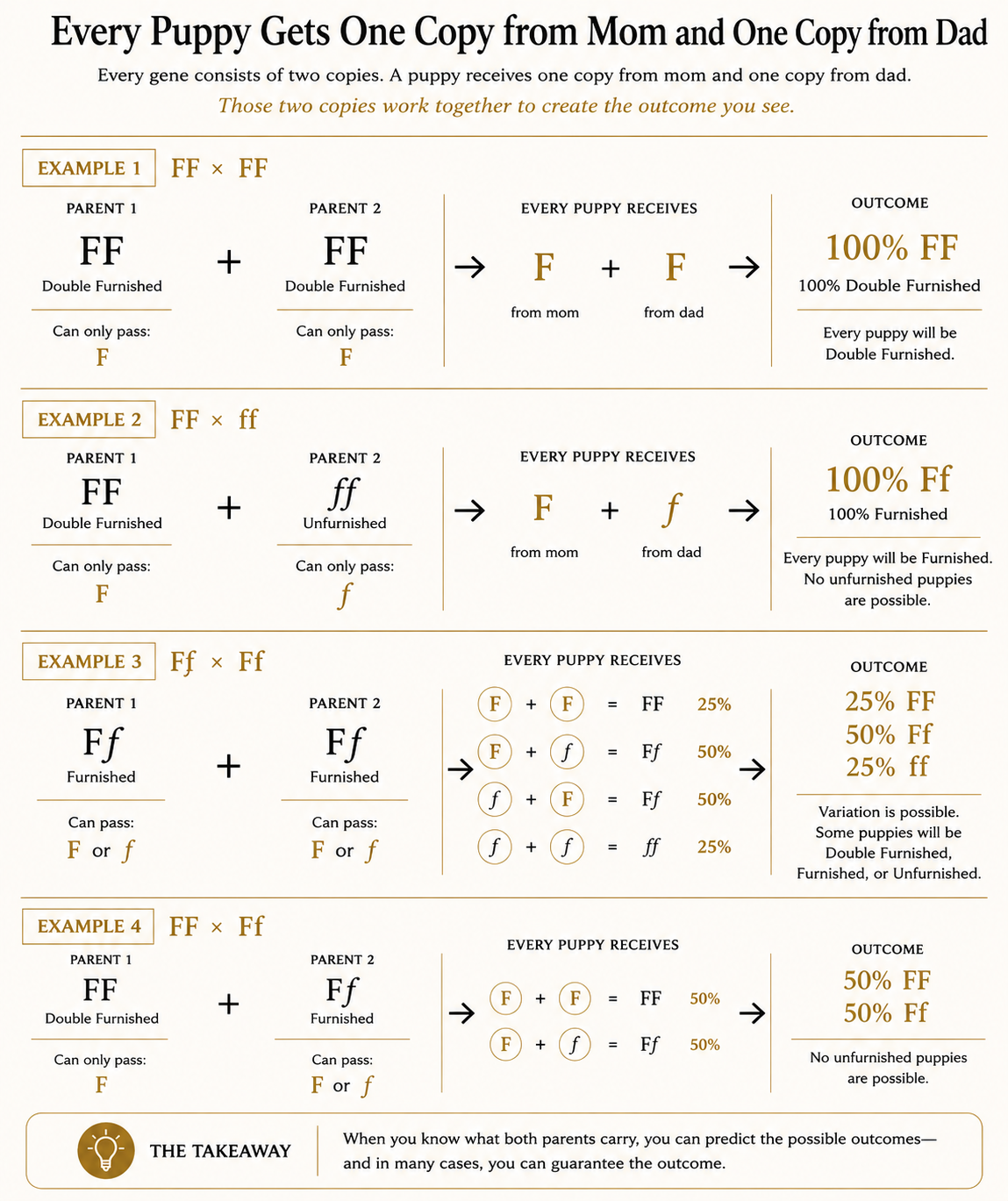
Every gene consists of two copies.
A puppy receives:
One copy from mom
One copy from dad
Those two copies work together to create the outcome you see.
This principle applies to:
Furnishings
Curl
Shedding
Coat color
Many health traits
If you know what both parents carry, you can often predict the possible outcomes their puppies may inherit.
In some situations, you can even guarantee the outcome.
This is why genetic testing matters.
A generation label tells us how a puppy was produced.
Genetic testing helps predict what a puppy can inherit.
Furnishings: The Most Important Coat Gene For Allergy-Conscious Families
If there is one coat trait every family should understand, it is furnishings.
Furnishings create the classic doodle appearance:
Beard
Mustache
Eyebrows
Teddy bear face
But furnishings do much more than affect appearance.
They are strongly associated with the low-shedding coat characteristics that made Goldendoodles popular in the first place.
Learn More About Goldendoodle Coat Types
Furnishing Genetics
FF = Double Furnished
Ff = Furnished
ff = Unfurnished
One important thing to understand:
FF and Ff often look nearly identical.
Both can have beautiful beards and eyebrows.
The difference usually becomes important when those dogs produce puppies.
How Furnishings Relate To Allergies
Furnishings themselves do not make a dog hypoallergenic.
What furnishings often do is reduce shedding.
Less shedding generally means:
Less hair released into the home
Less hair on furniture
Less hair on clothing
Less hair carrying allergens throughout the environment
For families whose symptoms worsen as allergens accumulate throughout the home, furnishings can make a significant difference.
However, furnishings cannot eliminate saliva proteins or guarantee that someone will not react.
Not All Furnishings Are Created Equal
For many years, breeders viewed furnishings as a simple yes-or-no trait.
Modern genetic testing has shown that the picture can be more complicated.
Some dogs carry what are commonly referred to as weak furnishings (Fw).
These dogs are still furnished, but the furnishings may not perform the same way as stronger furnishing genetics.
Why Weak Furnishings Matter
Weak furnishings may contribute to:
Less coat retention
Increased shedding
Greater variation in coat performance
More Golden-like coat behavior
This is one reason some families are surprised when a furnished Goldendoodle sheds more than expected.
A dog can be technically furnished while still producing a coat that behaves differently than a strongly furnished dog.
How Weak Furnishings Relate To Allergies
More shedding generally means more opportunities for allergens to spread throughout the home.
This does not create allergens.
It distributes them.
That distinction is important.
For families whose symptoms are triggered primarily by environmental exposure, furnishing strength can matter just as much as furnishing status.
Predictable Outcomes vs Variable Outcomes
One of the advantages of genetic testing is that some outcomes can be predicted with a high degree of confidence.
Sometimes they can even be guaranteed.
[Insert Graphic Series Here]
FF × FF
100% FF
FF × ff
100% Ff
FF × Ff
100% Furnished
Ff × Ff
Variable outcomes
This classic F2-style pairing is one of the least predictable furnishing combinations because every possible furnishing outcome exists.
Why Generation Labels Can Be Misleading
Many families are told that certain generations are automatically better for allergies.
The reality is more complicated.
An F1, F1B, F2, or Multigen label tells us how a puppy was produced.
It does not tell us what genes the puppy inherited.
An F1 from tested parents may be highly predictable.
An F1B from untested parents may be far less predictable.
A carefully planned multigenerational breeding may be more predictable than either.
This is why we focus on genetics rather than labels.
Learn More About Different Generations - What The F? Explaining F1, F1B, F2 & More
Curl Genetics
Curl is another important piece of the puzzle.
For simplicity, we use:
++ = Curly
+/- = Wavy
-- = Straight
Just like furnishings, puppies receive one copy from mom and one copy from dad.
How Curl Relates To Allergies
Curl does not make a dog allergy-friendly.
However, curl often changes how loose hair behaves.
A curlier coat tends to hold onto loose hair rather than allowing it to fall freely throughout the home.
This is one reason curly-coated dogs often appear to shed less visibly.
Can A Goldendoodle Have A Coat Similar To A Poodle?
Absolutely.
One common misconception is that a Goldendoodle coat must always fall somewhere between a Golden Retriever and a Poodle.
Coats do not work that way.
A puppy inherits individual genes from each parent, and certain genetic combinations can produce outcomes that strongly resemble one side of the pedigree.
When a Goldendoodle inherits:
Strong furnishings
Favorable furnishing strength
Significant curl
Low-shedding coat genetics
Appropriate coat texture
the resulting coat may perform very similarly to a Poodle coat from a shedding perspective.
In practical day-to-day life, some Goldendoodles shed so little that families experience them much like they would a Poodle.
This is one reason we focus so heavily on understanding genetics rather than relying on generation labels alone.
The goal is not simply to produce a dog that is "part Golden Retriever and part Poodle."
The goal is to understand which genetic combinations create the coat characteristics families are looking for.
Learn More About Our Poodle Program
Does That Mean Poodles Are Hypoallergenic?
No.
Just like Goldendoodles, Poodles are not truly hypoallergenic.
Poodles still produce:
Dander
Saliva
Skin oils
Urine proteins
These substances are responsible for most dog allergy reactions.
What makes Poodles different is not the absence of allergens.
It is the way their coats behave.
A properly coated Poodle is typically:
Double furnished
Curly coated
Very low shedding
Because less hair is released into the environment, fewer allergens are spread throughout the home.
The allergens still exist.
They are simply not being distributed as efficiently as they would be in a heavily shedding breed such as a Golden Retriever.
This distinction is important because many families believe they are searching for a dog that produces no allergens.
In reality, most allergy-sensitive families are searching for a dog that sheds less and distributes fewer allergens throughout their environment.
That is why understanding coat genetics matters.
The goal is not to create a hypoallergenic dog.
The goal is to understand which genetic combinations are most likely to produce the low-shedding coat characteristics many allergy-conscious families are seeking.
What About C2 Curl?
Some dogs carry an additional curl variant known as C2.
Most testing companies report C2 without offering much practical explanation.
In our experience, dogs carrying C2 often produce:
Tighter curls
Denser coats
Corkscrew-like ringlets
More Poodle-like coat presentation
Dixie and Fancy both carry C2 and consistently demonstrate stronger curl expression.
How C2 Relates To Allergies
The relationship is indirect.
C2 does not remove allergens.
However, tighter curls may further reduce how much loose hair is released into the environment.
For some allergy-sensitive families, that may contribute to a more manageable home environment.
The Shedding Gene
Many genetic tests also report a shedding result such as:
TT
CT
CC
This gene can influence shedding.
However, it should never be viewed in isolation.
How The Shedding Gene Relates To Allergies
When furnishings are weak or absent, the shedding gene often becomes much more important.
When furnishings are strong, furnishings frequently have a larger impact on real-world shedding than the shedding gene alone.
This is one reason we evaluate:
Furnishings
Furnishing strength
Curl
C2
Shedding genetics
Real-world coat performance
rather than focusing on a single result.
Why Some Goldendoodles Shed
When families are surprised by shedding, the explanation is often found in the genetics.
Possible contributors include:
Missing furnishings
Weak furnishings
Straight coats
Poor coat selection
Shedding genetics
Breeders not testing coat genetics
In many cases, the generation label itself is not the answer.
The genetics are.
Why Understanding Genetics Matters
Understanding coat genetics is not simply an academic exercise.
It directly influences the dogs we produce.
Our understanding of furnishings, furnishing strength, curl genetics, and shedding genetics has been instrumental in developing our Ultra Goldendoodle program.
Our goal was to retain more of the Golden Retriever's appearance, expression, and temperament while maintaining predictable low-shedding coat characteristics.
The result is what many families describe as the closest thing to a non-shedding Golden Retriever currently available.
Learn More About Our Ultra Goldendoodles →
Our Family's Journey With Dog Allergies
Long before we became breeders, we were simply a family trying to find a dog that could live comfortably in our home.
Our daughter Kate struggled with significant animal allergies growing up.
Dogs were not the only challenge.
Over the years, she reacted to horses, rabbits, cats, cows, and many other furry animals. Her reactions included both asthma and hives, making pet ownership far more complicated than it is for many families.
Ironically, chickens were one of the few animals she seemed to tolerate well, which is probably why she still enjoys keeping pet chickens today.
Before Kate was born, we owned a Labrador Retriever named Daisy.
Daisy was a wonderful dog and a beloved member of our family. As Kate grew older, however, it became increasingly difficult for them to have a normal relationship. Most of Kate's interactions with Daisy consisted of carefully avoiding contact because of the reactions that followed.
Eventually Daisy became primarily an outside dog.
We wanted more than that.
We wanted a dog that could truly be part of the family.
A dog that could live in the house.
A dog that could participate in everyday life.
And yes, I wanted my daughter to experience the relationship with a dog that most children take for granted.
Taking A Leap Of Faith
When we first discovered Goldendoodles, we knew almost nothing about coat genetics.
We weren't breeders.
We weren't studying furnishings, curl genes, or shedding genetics.
We were simply parents hoping we had finally found a dog that could work for our family.
Our first Goldendoodle was an F1 named Whisper.
We flew her home from Ohio.
Looking back, we probably did everything wrong.
We had no understanding of furnishings.
We had no understanding of curl genetics.
We had no understanding of shedding genes.
Most importantly, we had no backup plan if things didn't work out.
We simply took a leap of faith.
Thankfully, it worked.
"I Don't Know How To Play With Her"
One of my strongest memories from those early days happened shortly after Whisper came home.
Kate was seven years old.
After spending time with Whisper, she looked at me and said:
"I don't know how to play with her."
At first, the statement seemed strange.
Then I realized what she meant.
It wasn't that she didn't want a dog.
It wasn't that she didn't know how to play.
It was that she had never really had the opportunity to build that kind of relationship before.
For the first time, she had a dog she could interact with comfortably.
A dog that could be part of her daily life.
A dog that could be part of the family.
Whisper changed that.
The Beginning Of Our Interest In Coat Genetics
Whisper didn't just change our family.
She changed the direction of our lives.
As time passed, we became increasingly interested in understanding why some dogs seemed to work well for allergy-sensitive families while others did not.
That curiosity eventually led us into studying:
Furnishings
Furnishing strength
Curl genetics
C2 curl variants
Shedding genetics
Real-world coat performance
What started as a personal search for answers eventually became the foundation of Oregon's Legendary Goldendoodles.
Our interest in coat genetics did not begin as a breeding project.
It began as a family trying to understand why one dog succeeded where so many others had not.
What This Experience Taught Us
One of the biggest lessons we learned is that allergies are rarely as simple as people think.
Some people react primarily to environmental allergen buildup.
Others react more strongly to saliva.
Some do well around one dog and struggle around another.
Because of that, we are careful not to make promises.
No breeder can honestly guarantee that a specific person will not react to a specific dog.
What we can do is understand genetics, understand coat predictability, and help families make informed decisions.
That philosophy continues to guide our program today.
What We've Learned From Hosting Exposure Visits
Because of our family's experience with allergies, we spend a great deal of time talking with prospective families about shedding, coat genetics, and allergy considerations.
Over the years, we have hosted many visits specifically for families who want to evaluate how they or their children respond around our dogs before bringing home a puppy.
These visits are often some of the most rewarding conversations we have.
Many families arrive feeling discouraged.
Some have been told they can never own a dog.
Others have tried living with a dog before and struggled with allergies.
Many simply don't know where to begin.
The questions are usually the same:
Will I react?
Will my child react?
Are Goldendoodles really hypoallergenic?
How do I know if this will work for our family?
The honest answer is that no breeder can know for certain.
Every person's immune system is different.
What we can do is help families understand the factors that may influence the outcome.
What We See Again And Again
One of the patterns we have observed repeatedly is that many families who struggle around heavily shedding breeds often do surprisingly well around our Goldendoodles and Poodles.
That does not mean every person will have the same experience.
It does not mean allergies disappear.
And it certainly does not mean every dog will work for every individual.
What it does mean is that coat genetics matter.
The amount of hair released into a home matters.
The way allergens are distributed throughout the environment matters.
For some families, those differences can be significant.
Why Exposure Matters More Than Marketing Claims
One of the biggest mistakes families can make is relying on a breeder's marketing language instead of their own experience.
Terms such as:
Hypoallergenic
Allergy Friendly
Non-Shedding
are often used very loosely within the dog world.
Unfortunately, those labels do not guarantee how a specific person will respond.
A much better approach is controlled exposure.
Spend time around adult dogs.
Interact with them.
Hold them.
Pet them.
Spend time indoors where allergens naturally accumulate.
Then pay attention to how your body responds over the following hours and days.
That information is far more valuable than any marketing claim.
What We Encourage Families To Do
Whenever possible, we encourage families with allergy concerns to:
Spend time around adult dogs with similar coat genetics
Visit more than once if needed
Ask questions about furnishings and coat genetics
Evaluate their response honestly
Have a plan before bringing home a puppy
Our goal is not to convince families that every Goldendoodle will work.
Our goal is to help families make informed decisions based on education and real-world experience.
The Goal Is Confidence, Not Hope
When we brought Whisper home, we were operating mostly on hope.
Today, families have access to significantly more information than we did.
They can learn about:
Furnishings
Curl genetics
Shedding genetics
Coat predictability
Real-world coat performance
That knowledge doesn't eliminate uncertainty.
But it does allow families to move forward with far more confidence than we had all those years ago.
Another Family's Success Story: Roxie
One family we work closely with as part of our guardian program reminds us very much of our own story.
Like us, they were trying to navigate allergies while hoping to make dog ownership possible for their child.
Their son lives with allergies and, like many children, wants a dog he can truly call his own.
As we discussed coat genetics, shedding expectations, and allergy considerations, we worked together to determine whether Roxie might be a good fit for their family.
Like every allergy-sensitive placement, we approached the situation with realistic expectations.
No breeder can guarantee how an individual person will respond to a dog.
No breeder can honestly promise an allergy-free experience.
What we can do is evaluate coat genetics, discuss shedding expectations, and help families make informed decisions.
Today, Roxie is thriving in her guardian home and has become exactly what her family hoped for.
She is absolutely his dog.
He takes care of her, spends time with her every day, and has built the kind of relationship that every child dreams of having with their dog.
Watching that bond develop continues to be incredibly rewarding.
Stories like Roxie's are one of the reasons we are so passionate about educating families on coat genetics, shedding, and allergy considerations.
Behind every discussion about furnishings, curl genetics, and shedding expectations is usually something much bigger than genetics.
It is often a family hoping that dog ownership can become part of everyday life.
Meet Roxie
Roxie remains an active part of our program and the inspiration behind many of the conversations we have with allergy-conscious families.
Why Roxie's Story Matters
Roxie's story does not prove that Goldendoodles are hypoallergenic.
It does not guarantee that every allergy-sensitive family will have the same experience.
What it does reinforce is something we continue to observe:
When families understand coat genetics, understand shedding expectations, and take the time to evaluate their own responses through controlled exposure, they are often able to make far more informed decisions than families relying solely on marketing claims.
Knowledge does not eliminate uncertainty.
But it can dramatically improve predictability.
And for many families, that confidence makes all the difference.
What About Ultra Goldendoodles?
One of the most common requests we hear from families is surprisingly simple:
"I wish I could have a Golden Retriever that didn't shed."
That request is understandable.
Golden Retrievers are beloved for their temperament, trainability, family companionship, and overall versatility.
Unfortunately, they are also known for significant shedding.
For many allergy-sensitive families, or simply families who prefer a lower-shedding home, that can be a challenge.
The Challenge
Historically, breeders have often faced a tradeoff.
As dogs move closer to a Golden Retriever in appearance and overall type, shedding often increases.
As dogs move further toward a Poodle coat, shedding frequently decreases, but the dog may look and feel less like the Golden Retriever many families were originally drawn to.
Finding a balance between those two goals is not always easy.
How Genetics Help
Understanding coat genetics allows breeders to make more informed decisions.
By understanding:
Furnishings
Furnishing strength
Curl genetics
C2 curl variants
Shedding genetics
we can move beyond simply hoping for a particular outcome.
Instead, we can intentionally select for traits that help us move toward specific goals.
For us, one of those goals has been retaining more Golden Retriever characteristics while maintaining predictable low-shedding coat outcomes.
The Ultra Goldendoodle Goal
Our Ultra Goldendoodle program was developed with that objective in mind.
We wanted to preserve more of the characteristics that families love about Golden Retrievers, including:
Softer expressions
Golden-like temperaments
Retriever characteristics
Athleticism
Family companionship
while still maintaining the coat predictability that many families seek in a Goldendoodle.
The result is what many families describe as the closest thing to a non-shedding Golden Retriever currently available.
What We Are Still Learning
One of the interesting things we've observed in our Ultra program is that we have not yet identified a specific genetic marker that reliably predicts which puppies will develop the distinctive Ultra coat.
For example, Lady, Marci, and Enzo share the same parents and have identical results for several of the coat genetics we commonly evaluate.
Yet their coats developed differently.
This suggests that the Ultra coat is likely influenced by factors beyond the genetic markers currently reported by most commercial testing laboratories.
What this means for families is that we cannot simply run a DNA test and identify which puppies will develop the Ultra coat.
Instead, we evaluate puppies individually as they mature.
By the time puppies are old enough to go home, we are typically able to identify which puppies have inherited the coat characteristics we are selecting for and which puppies have developed a more traditional Goldendoodle coat.
This is one reason we continue to study these coats and collect real-world observations.
The genetics help us understand many aspects of coat prediction, but they do not yet explain everything we see in the Ultra program.
Lady And Allergy-Sensitive Families
Lady has participated in numerous exposure visits with families concerned about allergies.
So far, the feedback has been encouraging.
Many families who have spent time with Lady have done very well around her.
However, we are not comfortable making broad allergy-friendly claims regarding Ultra Goldendoodles as a group.
Every person's immune system is different.
Every family's situation is different.
And no breeder can honestly guarantee how a specific person will respond to a specific dog.
For that reason, we continue to recommend controlled exposure and thoughtful evaluation for every family, regardless of coat type or generation.
Meet Lady
Lady has played an important role in the development of our Ultra Goldendoodle program and continues to help us evaluate how these coats perform in real-world family environments.
→ Learn more about our Ultra Goldendoodle program
Why This Matters
Understanding genetics allows us to make better predictions.
It helps us understand which outcomes are likely, which outcomes are possible, and which outcomes can sometimes be guaranteed.
What it cannot do is guarantee how an individual's immune system will respond.
That is why education, exposure, and realistic expectations remain just as important as genetics.
Shedding, Dander & Allergen Distribution
One of the biggest misconceptions in the dog world is that people are allergic to dog hair.
In reality, most dog allergies are reactions to proteins found in:
Dander (dead skin cells)
Saliva
Skin oils
Urine
Hair itself is usually not the allergen.
Instead, hair often acts as the vehicle that spreads allergens throughout the environment.
Where Dander Comes From
All dogs produce dander.
Dander consists of microscopic skin particles that naturally shed from the body as the skin renews itself.
These particles are extremely small and often impossible to see with the naked eye.
Because dander is constantly being produced, there is no such thing as a completely dander-free dog.
Every dog produces it.
Golden Retriever.
Goldendoodle.
Poodle.
Every single one.
How Shedding Spreads Allergens
Dander doesn't simply float around on its own.
It attaches to:
Hair
Skin oils
Dust particles
As hair is released into the environment, it carries those allergens with it.
That hair eventually ends up on:
Furniture
Carpets
Bedding
Clothing
Vehicle interiors
The more hair a dog releases into the environment, the more opportunities exist for allergens to be distributed throughout the home.
Why Coat Genetics Matter
This is where the genetics we've discussed throughout this page become important.
Strong furnishings.
Curl.
Coat retention.
Reduced shedding.
All of these traits influence how much hair is released into the environment.
Less hair release generally means less allergen distribution.
That does not eliminate allergens.
It reduces how efficiently they are spread throughout the home.
For some allergy-sensitive families, that distinction can make a significant difference.
What Coat Genetics Cannot Do
While genetics can influence shedding, there are important limitations.
Coat genetics cannot:
Remove saliva proteins
Eliminate dander production
Change an individual's immune system
Guarantee that a person will not react
This is one reason two people with "dog allergies" can have completely different experiences with the same dog.
Understanding Your Own Triggers
One of the most important things an allergy-sensitive family can do is identify what actually triggers their symptoms.
For some people, environmental allergen buildup appears to be the primary issue.
These individuals may notice significant improvement around lower-shedding dogs.
For others, direct contact is the bigger challenge.
They may react when:
A dog licks them
Saliva contacts their skin
They touch their face after handling a dog
In these situations, coat genetics may have much less influence on the outcome.
This Is Why Exposure Matters
When families ask us:
"Do you think we'll be allergic?"
The honest answer is that we don't know.
No breeder does.
What we do know is that spending time around dogs before bringing a puppy home provides far more useful information than any marketing claim.
That's why we encourage controlled exposure whenever possible.
Spend time around adult dogs.
Interact with them.
Allow yourself time to evaluate your response.
Pay attention not only during the visit, but also in the hours that follow.
Your own experience is often the best predictor available.
What We've Learned
One of the biggest lessons we've learned through our own family, our guardian families, and countless conversations with prospective puppy owners is that allergy success is rarely determined by a single factor.
Instead, it is usually a combination of:
Coat genetics
Shedding behavior
Environmental exposure
Individual sensitivity
Household management
Understanding those factors allows families to make better decisions than simply relying on labels such as:
Hypoallergenic
Allergy Friendly
Non-Shedding
Because while those labels may sound reassuring, they often tell families very little about how a specific dog will perform in a specific home.
How To Evaluate Whether A Goldendoodle Is Right For Your Family
If allergies are a concern, the goal is not to find a breeder who promises a hypoallergenic puppy.
The goal is to gather enough information to make an informed decision.
No breeder can guarantee how a specific person will respond to a specific dog.
What families can do is reduce uncertainty and avoid making decisions based solely on hope.
Start With Controlled Exposure
Whenever possible, spend time around adult dogs before bringing home a puppy.
This is one of the most valuable tools available to allergy-sensitive families.
A short visit is often better than no visit at all, but longer interactions generally provide more useful information.
We encourage families to:
Pet the dogs
Hold the dogs
Sit with the dogs
Spend time indoors where allergens naturally accumulate
Pay attention to symptoms during and after the visit
Remember that reactions do not always happen immediately.
Some families notice symptoms hours later rather than during the visit itself.
More Than One Visit Is Okay
Many families feel pressure to make a quick decision.
There is nothing wrong with taking your time.
If allergies are a significant concern, a second visit may provide valuable information.
For some families, confidence comes from repeated exposure rather than a single interaction.
We would much rather see a family make a careful, informed decision than feel rushed into bringing home a puppy.
Talk To Your Physician
Every allergy situation is unique.
Your physician or allergist knows your medical history far better than any breeder ever will.
If allergies are significant, consider discussing:
Exposure plans
Allergy medications
Asthma management
Environmental controls
Long-term expectations
A breeder can provide information about coat genetics.
Medical advice should come from medical professionals.
Have A Plan Before The Puppy Comes Home
One of the most important conversations families can have is:
What is our plan if someone reacts?
This discussion should happen before bringing home a puppy.
Possible strategies may include:
HEPA air filtration
More frequent vacuuming
Grooming schedules
Designated dog-free sleeping areas
Physician-approved allergy medications
Every family is different.
The important thing is having a plan.
Hope Is Not A Plan
When Whisper came home, we were operating largely on hope.
Looking back, we were fortunate.
Today, families have access to far more information than we did.
You can learn about:
Furnishings
Furnishing strength
Curl genetics
Shedding genetics
Real-world coat performance
You can visit dogs.
You can ask questions.
You can evaluate your response.
Those steps don't eliminate uncertainty, but they do replace hope with information.
What If There Is Still A Reaction?
This is a question every family should consider before bringing home a puppy.
Even with genetic testing, careful planning, and controlled exposure, unexpected reactions can occur.
When they do, families generally have several options to explore:
Adjusting grooming schedules
Increasing environmental cleaning
Using air filtration systems
Working with their physician on symptom management
Restricting access to certain rooms
Many families successfully manage mild allergy symptoms through a combination of these strategies.
The key is recognizing that bringing home a puppy should not be the beginning of the conversation.
It should be the continuation of a plan that already exists.
Our Goal
Our goal is not to convince every allergy-sensitive family that a Goldendoodle will work.
Our goal is to provide honest information, explain the genetics behind the coat, and help families make the most informed decision possible.
Sometimes that decision is moving forward with confidence.
Sometimes that decision is taking more time.
Either outcome is far better than relying on marketing claims or assumptions.
Frequently Asked Questions About Goldendoodle Shedding & Allergies
-
No.
Despite how often the term is used, no dog is truly hypoallergenic.
All dogs produce allergens through:
Dander
Saliva
Skin oils
Urine
What varies is how those allergens are distributed throughout the environment.
Because Goldendoodles can inherit low-shedding coat genetics, many allergy-sensitive families find them easier to live with than heavily shedding breeds. However, no breeder can honestly guarantee that a specific person will not react to a specific dog.
-
No.
Like all dogs, Poodles still produce dander, saliva, skin oils, and other allergens.
What makes Poodles different is that they are typically:
Double furnished
Curly coated
Very low shedding
As a result, fewer hairs are released into the environment, which may reduce how widely allergens are distributed throughout the home.
This is one reason Poodles are often recommended for allergy-sensitive families and why many Goldendoodle breeders strive to retain similar coat characteristics through furnishings and curl genetics.
-
Some do. Some don't.
The answer depends primarily on genetics rather than generation labels.
Factors that influence shedding include:
Furnishings
Furnishing strength
Curl genetics
Shedding genetics
Coat texture
This is why two Goldendoodles that look similar can have very different shedding outcomes.
-
Absolutely.
When a Goldendoodle inherits:
Strong furnishings
Significant curl
Favorable coat texture
Low-shedding coat genetics
the resulting coat may perform very similarly to a Poodle coat from a shedding standpoint.
Some Goldendoodles shed so little that families experience them much like they would a Poodle.
This is one reason we focus on coat genetics rather than generation labels alone.
-
Generally speaking, strongly furnished dogs with curly or tightly wavy coats tend to have the lowest shedding expectations.
However, coat genetics are more complex than simply curly versus straight.
We evaluate:
Furnishings
Weak furnishings
Curl
C2 curl variants
Shedding genetics
when predicting coat outcomes.
-
Not necessarily.
This is one of the most common misconceptions in the doodle world.
An F1B describes how the puppy was produced.
It does not guarantee what coat genes the puppy inherited.
In many cases, a carefully planned multigenerational breeding with fully tested parents may be more predictable than an F1B breeding involving untested dogs.
When it comes to shedding expectations, genetics matter more than generation labels.
For a deeper explanation, visit our What The F? Explaining F1, F1B, F2 & More page.
-
Furnishings are the facial hair traits that create the classic Goldendoodle appearance.
These include:
Beards
Mustaches
Eyebrows
Furnishings originate from the Poodle side of the pedigree and are strongly associated with lower shedding coat behavior.
If there is one coat trait allergy-conscious families should understand, it is furnishings.
-
Weak furnishings (often reported as Fw) are furnishing genetics that may not perform as strongly as full furnishings.
A dog can still appear furnished while producing more shedding than families expect.
This is one reason responsible breeders evaluate furnishing strength rather than simply asking whether a dog is furnished or unfurnished.
-
C2 is a curl variant reported by some genetic testing laboratories.
Most testing companies provide little explanation regarding what families should expect from it.
In our experience, dogs carrying C2 often produce:
Tighter curls
Denser coats
More corkscrew-like ringlets
More Poodle-like coat presentation
Dixie and Fancy are examples from our own program that carry C2.
-
Absolutely.
This is one of the biggest misconceptions surrounding allergy-friendly breeds.
Many people assume they are allergic to dog hair.
Most allergy reactions are actually caused by proteins found in:
Dander
Saliva
Skin oils
A lower-shedding coat may reduce allergen distribution throughout the home, but it does not eliminate allergens themselves.
-
There are several possible reasons.
These may include:
Weak furnishings
Straight coat genetics
Shedding genetics
Coat texture differences
Variations in furnishing strength
This is one reason we evaluate the entire genetic picture rather than relying on a single test result.
-
No.
This is a common misconception.
The term Ultra Goldendoodle describes a breeding objective and genetic composition rather than a single coat type.
Within the same litter, puppies may inherit different combinations of:
Furnishings
Curl genetics
Coat texture
Shedding genetics
As a result, not every puppy will develop the same coat.
Some puppies may inherit the distinctive Ultra coat characteristics we are working toward, while others may develop coats that are more similar to what families would expect from a traditional Goldendoodle.
This is one reason we evaluate each puppy individually rather than making assumptions based solely on generation or breeding labels.
Understanding the genetics behind each puppy allows us to make more accurate predictions regarding coat type, shedding expectations, and long-term maintenance.
-
Yes.
In our opinion, controlled exposure is one of the most valuable tools available to allergy-sensitive families.
That exposure does not have to happen with us.
What matters most is spending meaningful time around dogs with coat genetics similar to the puppy you are considering bringing home.
Whenever possible:
Spend time around adult dogs.
Learn about the coat genetics behind those dogs.
Understand whether they are furnished, curly, wavy, or straight coated.
Pay attention to how your body responds during and after the visit.
For example, if you are considering a strongly furnished, curly Goldendoodle, spending time around a heavily shedding Labrador Retriever may not provide useful information.
Likewise, if you are considering a dog with a more Golden Retriever-like coat, spending time exclusively around Poodles may not tell you the whole story.
The goal is not simply exposure to dogs.
The goal is exposure to dogs with similar coat characteristics and shedding expectations.
If possible, spend time indoors where allergens naturally accumulate, interact with the dogs directly, and monitor your response over the following hours and days.
No breeder can predict exactly how a specific person will react.
Your own experience is often the most valuable information available.
-
This is a conversation every family should have before bringing home a dog.
Potential management strategies may include:
HEPA air filtration
Grooming schedules
More frequent cleaning
Dog-free sleeping areas
Physician-approved allergy medications
Every situation is unique.
Having a plan before bringing home a puppy is often just as important as choosing the right puppy.