
Merle Poodles in Oregon
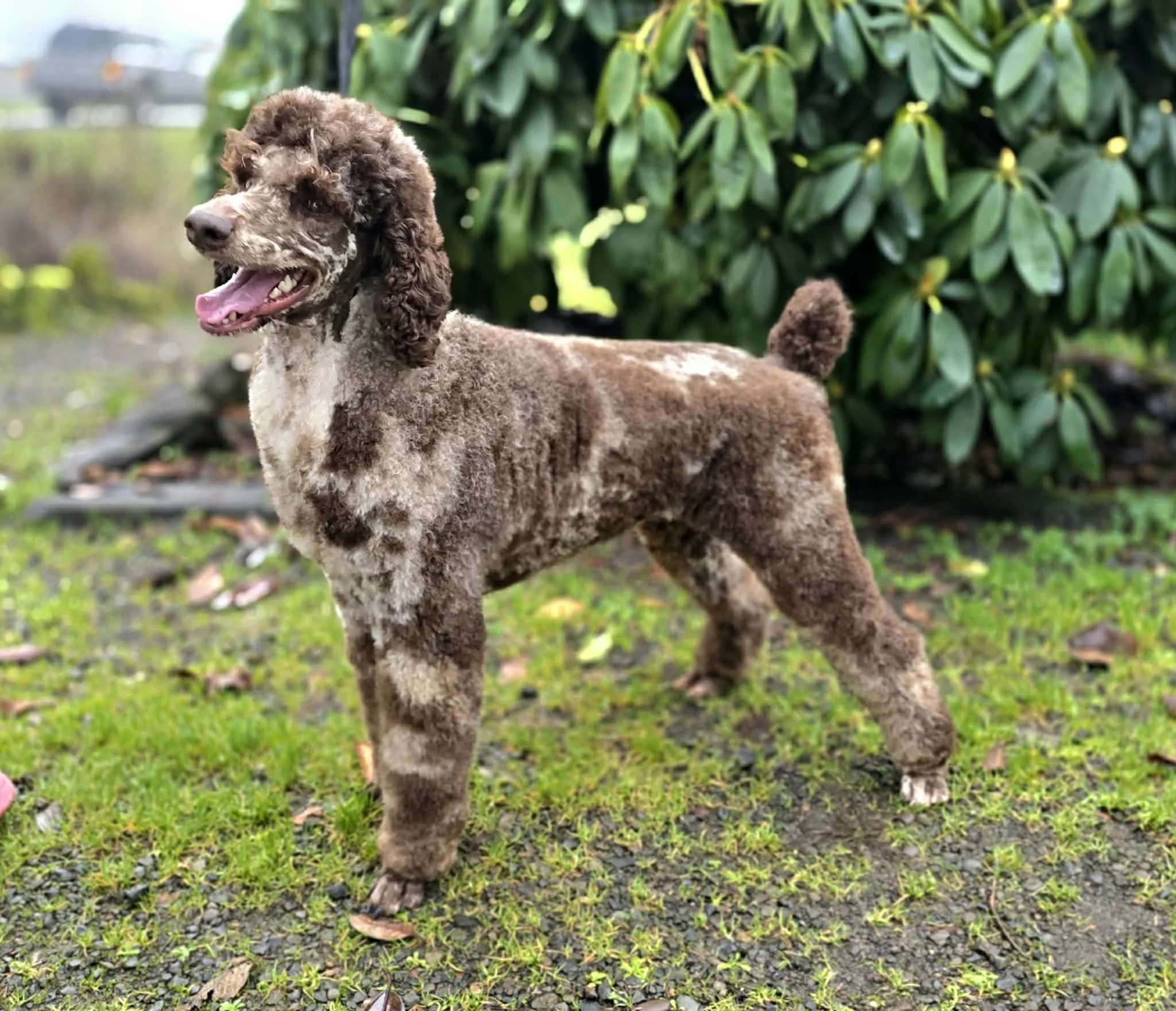
Genetics, Temperament, Health & Responsible Breeding
Merle poodles are among the most visually striking dogs in the poodle world.
Their unique coat patterns, expressive eyes, and wide variety of color combinations naturally attract attention. At the same time, merle is one of the most discussed and misunderstood topics in modern poodle breeding.
At Oregon's Legendary Goldendoodles & Poodles, we believe families deserve accurate information—not internet drama.
Whether you're researching merle genetics, trying to understand health considerations, or simply looking for a breeder who values temperament, structure, and trainability as much as appearance, our goal is to provide clear and honest information.
We love beautiful dogs.
We also believe beautiful dogs should be healthy, structurally sound, highly trainable, and enjoyable to live with.
That philosophy guides every breeding decision we make.
What Is a Merle Poodle?
Merle is a genetic pattern that creates areas of diluted pigment throughout a dog's coat.
Rather than producing a solid color, the merle gene creates a marbled appearance with lighter and darker patches distributed throughout the coat.
No two merle dogs look exactly alike.
Merle can appear in a variety of color combinations including:
Blue Merle
Chocolate Merle
Merle Phantom
Merle Parti
Merle Sable
Other multi-pattern combinations
The result is one of the most diverse and visually unique coat patterns found in dogs.
But merle is only one small part of what makes a dog special.
More Than a Color
One of the biggest misconceptions surrounding merle poodles is that color somehow determines the quality of the dog.
It does not.
Color does not determine:
Temperament
Intelligence
Trainability
Health
Confidence
Workability
Those traits come from generations of thoughtful breeding decisions and the individual dog itself.
A beautiful coat may catch someone's attention.
Temperament is what families live with every day.
Why Merle Is Part of Our Program
Our interest in merle poodles did not begin with color.
It began with the search for exceptional dogs.
Over time, we found ourselves drawn to several merle lines because of the qualities behind the dogs themselves.
We saw dogs with:
Strong structure
Stable temperaments
Excellent workability
Trainability
Social confidence
Family-friendly personalities
The more we learned, the more we realized that quality and color do not have to be mutually exclusive.
Today, our goal is not simply to produce merle puppies.
Our goal is to produce exceptional poodles that happen to come in a variety of beautiful colors and patterns.
Our Merle Program
Fancy
Fancy represents much of what we hope to continue building within our poodle program.
She was selected for her combination of structure, confidence, workability, and engaging personality.
She is social, outgoing, highly trainable, and genuinely enjoys interacting with people and the world around her.
As she continues to mature, we are actively pursuing performance titles that showcase the qualities we value most.
Fancy is far more than a beautiful merle poodle.
She is a dog we believe can contribute meaningfully to future generations.
Alastor
While Fancy brings workability and performance potential, Alastor's greatest contribution has been temperament.
He is the type of dog that reminds us why temperament matters so much.
Easy to live with.
Socially adaptable.
Stable.
Pleasant.
As he approaches retirement, his influence continues through the puppies he has produced.
Several of his offspring have gone on to become therapy dogs, service prospects, and highly trainable family companions.
Those outcomes matter far more to us than color.
Pippin
Pippin comes from merle lines but is not merle himself.
His presence within our program perfectly illustrates our philosophy.
We do not evaluate dogs solely based on color.
We evaluate the entire dog.
Temperament.
Structure.
Trainability.
Health.
Workability.
Overall quality.
Those are the traits that ultimately determine whether a dog deserves a place in a breeding program.
Looking Toward the Future
One of the things we enjoy most about breeding is building toward future generations.
We currently have a deposit placed with Pippin's breeder for a future merle puppy.
Several opportunities have already come and gone, yet we have chosen to wait.
Because we are not simply looking for a merle puppy.
We are looking for the right puppy.
We are also actively exploring future opportunities in Europe, where we have seen some truly impressive examples of the qualities we hope to continue developing.
The right dog is worth waiting for.
Why We Plan to Keep Two Boys
One of the litters we are most excited about combines Fancy and Pippin.
From that litter, we plan to retain two young males for evaluation.
One is merle.
One is not.
That decision reflects our philosophy perfectly.
When evaluating future breeding dogs, color is only one piece of the puzzle.
Temperament.
Structure.
Workability.
Health.
Trainability.
Those qualities matter regardless of whether the dog is merle, solid-colored, or multi-colored.
The future of our program will be built around quality first.
Appreciating Color Without Breeding For Color
We enjoy color genetics.
We enjoy studying them, understanding them, and thoughtfully incorporating them into our program.
Poodles offer an incredible variety of colors and patterns, including:
Merle
Parti
Phantom
Brindle
Sable
Roan
Silver
Multi-color combinations
Many of these dogs are absolutely stunning.
We appreciate beautiful dogs.
But we also recognize that color alone does not make a great dog.
The goal is not simply to produce unusual colors.
The goal is to produce healthy, structurally sound, temperamentally stable dogs that happen to come in a variety of beautiful colors.
A great dog comes first.
The color is simply the finishing touch.
One of the Most Versatile Breeds in the World
Poodles are among the most versatile breeds on the planet.
Historically, they worked as hunting and retrieving dogs.
Today, they excel in:
Service work
Therapy work
Conformation
Agility
Obedience
Rally
Scent work
Hunting
Family companionship
This versatility is one of the qualities we value most.
We believe poodles should be capable of doing far more than looking beautiful in photographs.
The History of Merle in Poodles
Merle is one of the most recognizable color patterns in the dog world, but its history within poodles is not nearly as straightforward as many people assume.
In fact, the history of merle poodles remains one of the most discussed and researched topics in the modern poodle community.
Unlike traditional poodle colors that have been documented for generations, the exact origins of merle in poodles are not universally agreed upon. While there are several widely discussed theories, many questions remain unanswered.
For families researching merle poodles, understanding the history can be both fascinating and helpful.
What We Know
The merle pattern itself is well understood genetically.
Modern DNA testing has identified the gene responsible for the merle pattern, and breeders today can test for merle with a high degree of accuracy.
We also know that merle was not historically recognized as a traditional poodle color in early breed standards and historical records.
Today, however, merle poodles exist throughout North America, Europe, and other parts of the world. Many have multi-generation poodle pedigrees, are registered as poodles, and test as 100% poodle through modern breed ancestry testing.
The exact path that led from the earliest merle poodles to the dogs we see today remains the subject of ongoing discussion.
The Leading Theories
Historical Outcrossing
The most commonly discussed theory is that the merle gene entered the poodle population through an outcross to another merle-carrying breed at some point in the past.
Over multiple generations, descendants would have been bred back to poodles until they were, for all practical purposes, poodles in appearance, temperament, structure, and ancestry.
While this theory is widely discussed, the exact details remain uncertain.
Questions such as:
Which breed was involved?
When did it occur?
How many times did it happen?
remain largely unanswered.
Multiple Independent Introductions
Another theory suggests that merle may have entered poodle populations more than once.
Rather than a single foundation dog, there may have been multiple unrelated introductions in different regions or breeding programs.
If true, today's merle poodles may trace back to several different foundation lines rather than a single origin.
Spontaneous Mutation
A less commonly discussed theory is that a spontaneous mutation may have produced the merle pattern within poodles.
While spontaneous mutations can occur in nature, most researchers consider this explanation less likely as the sole source of the widespread merle populations seen today.
How Long Have Merle Poodles Been Around?
One of the most common questions people ask is:
"When was the first merle poodle documented?"
The honest answer is that no universally accepted first merle poodle has been identified.
Merle poodles were present long before social media made them widely visible, and references to merle poodles can be found decades before they became widely known among the general public.
As interest in color genetics increased and DNA testing became more widely available, merle poodles became easier to identify, document, and track through pedigrees.
Today, merle poodles are found in Standard, Miniature, and Toy Poodles across numerous breeding programs around the world.
How Many Merle Lines Exist?
No one knows for certain.
Unlike traditional colors with centuries of documented history, there is no central record identifying every foundation merle line.
What we do know is that merle is now found in numerous unrelated programs throughout North America and Europe.
As breeders continue to exchange genetics internationally and develop new generations, the number of distinct merle families continues to grow.
Merle Today
Today, merle has become an established part of the modern poodle community.
Many merle poodles:
Have multi-generation poodle pedigrees
Are AKC registered
Participate in dog sports
Earn performance titles
Work as therapy dogs
Work as service dogs
Compete in conformation and performance events
Thrive as family companions
While discussions about history continue, most breeders and families are ultimately focused on the dogs themselves and the qualities they bring to everyday life.
What We Find Most Interesting
One of the things we find most interesting about the history of merle poodles is how much remains unknown.
The exact origin may never be fully documented.
The exact number of founding lines may never be known.
And while those questions are certainly interesting, they are not the questions that guide our breeding decisions.
When evaluating a dog, we are more interested in questions such as:
Is the dog healthy?
Is the dog structurally sound?
Is the dog trainable?
Is the dog enjoyable to live with?
Can the dog contribute positively to future generations?
History helps us understand where a breed has been.
Thoughtful breeding helps determine where it goes next.
That is the part that excites us most.
Are Merle Poodles Healthy?
One of the most common questions families ask is whether merle poodles are healthy.
The short answer is yes.
A properly bred merle poodle can be just as healthy as any other poodle.
The merle gene itself is a color pattern. It is not a disease, and it does not automatically make a dog unhealthy.
Like any breeding program, the health of the puppies depends far more on the quality of the breeding decisions than on coat color alone.
Understanding the Real Concern
When people hear warnings about merle dogs, they are usually hearing about something called a double merle.
A double merle occurs when two merle dogs are bred together and a puppy inherits two copies of the merle gene.
Double merles have an increased risk of:
Deafness
Hearing impairment
Vision abnormalities
Eye defects
This is why responsible breeders avoid merle-to-merle breedings.
The concern is not merle itself.
The concern is producing double merles.
Health Testing Matters More Than Color
When evaluating any breeder, color should never be the first question.
More important questions include:
Are the parent dogs health tested?
Are genetic screenings performed?
Are orthopedic evaluations completed?
Are temperaments carefully evaluated?
Are breeding decisions made with long-term health in mind?
A responsibly bred merle poodle from fully health-tested parents is generally a better indicator of quality than a dog selected solely because of its color.
Learn more about our Health Testing Program.
Our Approach to Health
Health begins long before a litter is planned.
Breeding dogs should be selected for far more than appearance alone.
Within our program, health, temperament, structure, and overall quality are considered together. We believe breeding decisions should support the long-term well-being of both the individual dogs and future generations.
Color may influence what a dog looks like.
Health influences how that dog lives.
That is why health will always remain one of the foundations of our program.
Learn more about our health testing standards on our Health Testing page.
Merle Genetics Explained
Merle is one of the most fascinating color patterns found in dogs.
While the appearance can seem complex, the basic concept is surprisingly simple.
The merle gene affects how pigment is distributed throughout the coat, creating the marbled or mottled pattern that makes each merle dog unique.
No two merle dogs look exactly alike.
Some have large areas of dilution.
Others display only small patches of merling.
Some have striking blue or partially blue eyes.
Others do not.
The amount of visible merling can vary dramatically from dog to dog.
Why Aren't All Puppies Merle?
A common misconception is that a merle parent automatically produces all merle puppies.
That is not how merle works.
When a merle dog is bred to a non-merle dog, some puppies may inherit the merle gene while others may not.
As a result, a single litter can include both merle and non-merle puppies.
This is one of the reasons we often say that a merle breeding produces far more than just merle puppies.
The same litter may include solid-colored puppies, multi-colored puppies, or puppies displaying a variety of different patterns depending on the genetics involved.
Merle Is Only One Piece of the Puzzle
The merle gene determines only one aspect of a dog's appearance.
Other genes influence:
Base color
Phantom markings
Parti patterns
Brindle patterns
Sable patterns
Roan patterns
Silvering and color progression
When these genes combine, the possible outcomes become incredibly diverse.
This is one of the reasons we enjoy studying color genetics so much. The combinations can be both beautiful and fascinating.
Understanding Color Expectations
Responsible breeders use genetic testing to better understand what traits may be passed to future generations.
While genetics can help predict possibilities, nature still enjoys surprises from time to time.
No breeder can guarantee that every puppy will inherit a particular color or pattern.
What we can do is make informed breeding decisions based on the genetics we understand and the goals we have for the program.
Color Should Never Be the Only Goal
Understanding color genetics is important.
Enjoying color genetics is perfectly reasonable.
But color should never become the sole focus of a breeding program.
A beautiful coat pattern cannot compensate for poor temperament, poor structure, or poor health.
Our goal has always been to combine the qualities that matter most:
Temperament
Health
Structure
Workability
Trainability
Beauty
We believe exceptional dogs can possess all of those qualities, regardless of whether they are merle, solid-colored, parti, phantom, sable, brindle, roan, silver, or any combination in between.
Merle Poodle Temperament: Does Color Affect Personality?
One of the most common misconceptions about merle poodles is that the merle pattern somehow influences temperament.
It does not.
Color and personality are not the same thing.
A dog's temperament is influenced by genetics, parent temperament, generations of selection, early development, socialization, training, and individual personality.
The merle gene simply affects coat color.
It does not determine whether a dog is:
Confident or timid
Social or reserved
Easy-going or intense
Trainable or independent
Suitable for service work or sports
Those traits come from the dog itself.
Temperament Starts With Selection
If a breeder consistently selects stable, confident, trainable dogs, those traits become more common within future generations.
Likewise, if breeders ignore temperament and focus primarily on appearance, those decisions can eventually influence the overall quality of the dogs being produced.
This is one of the reasons temperament remains one of the most important priorities in our program.
The qualities families live with every day are rarely visible in photographs.
A picture can show color.
A picture cannot show:
Confidence
Recovery from stress
Adaptability
Human focus
Trainability
Emotional stability
Those traits only become apparent when you spend time living with the dog.
Learn more about our Temperament Testing Process.
Alastor's Legacy
One of the dogs who has influenced our program most significantly is Alastor.
While many people notice appearance first, what we value most about Alastor is his temperament.
He is socially adaptable, stable, easy to live with, and consistently pleasant.
More importantly, he has demonstrated an ability to pass many of those qualities to his offspring.
Several of his descendants have gone on to become therapy dogs, service prospects, and highly trainable companions.
For us, those accomplishments matter far more than coat color.
They demonstrate that the traits we value are being successfully passed to future generations.
Learn more about the goals behind our Poodle Program Foundation.
Fancy and the Future
Fancy brings another dimension to our program.
In addition to her structure and appearance, she possesses the type of confidence, workability, and engagement that we believe can contribute positively to future generations.
She enjoys training.
She enjoys learning.
She enjoys working with people.
As we continue pursuing performance titles with her, we hope to further demonstrate the qualities that made her stand out to us in the first place.
We expect many of her descendants to be capable of excelling in activities such as:
Service work
Therapy work
Dog sports
Performance events
Conformation
Advanced companion training
Not because they are merle.
But because of the qualities behind the dogs.
Color Brings People In. Temperament Makes Them Stay.
Most families notice color first.
We understand that.
A beautiful merle coat may be what initially catches someone's attention.
Years later, however, families rarely talk about color.
They talk about the dog's personality.
They talk about how easy the dog is to live with.
They talk about how well the dog fits into their family.
They talk about the confidence, trainability, and companionship that make the dog special.
That is why temperament remains at the center of everything we do.
Color may open the door.
Temperament is what families remember.
Building a Better Merle Program
One of the reasons we became interested in merle poodles is because we saw an opportunity to contribute to the future of the merle community.
Like any niche within the dog world, there are exceptional examples and there are areas where improvement remains possible.
Over the years, we found ourselves searching for dogs that combined all of the qualities we value most:
Excellent temperament
Strong structure
Health testing
Trainability
Workability
Confidence
Beauty
Finding those dogs is not always easy.
In fact, one of the challenges within the merle poodle community is that many breeders who prioritize structure, performance, and long-term breed development choose to focus on more traditional colors.
As a result, finding merle dogs that meet high standards across multiple categories often requires patience and a willingness to wait for the right opportunity.
We believe those dogs exist.
And we believe they are worth searching for.
Why We Refuse to Settle
One of the philosophies that guides our program is that you should not have to choose between quality and beauty.
We believe that if you look carefully enough, study enough pedigrees, and are willing to wait long enough, you can find dogs that possess the complete package.
A dog can have:
Sound structure
Excellent temperament
Strong workability
Trainability
Health
Social confidence
A beautiful coat and color pattern
Too often, breeders are told they must compromise somewhere.
We disagree.
Finding those dogs may take years.
It may require passing on opportunities that do not fully align with our goals.
But we believe the right dog is worth waiting for.
Looking Worldwide for Quality
Our search for quality is not limited to our local area.
We regularly follow poodles from programs throughout North America and Europe, studying pedigrees, watching dogs mature, and paying attention to the qualities being produced generation after generation.
Some of the most impressive merle poodles we have encountered have come from European programs.
As our program continues to grow, importing a poodle from Europe remains one of our long-term goals.
Not because the dog is from Europe.
But because exceptional dogs can be found anywhere when breeders prioritize the qualities that truly matter.
Building for Future Generations
One of the most exciting parts of breeding is thinking beyond the next litter.
Every dog we add influences the generations that follow.
That is why we currently have a deposit placed with Pippin's breeder for a future merle puppy.
Several opportunities have already become available.
We have chosen to wait.
Because we are not simply looking for a merle puppy.
We are looking for the right puppy.
The puppy that possesses the temperament, structure, health, workability, and overall quality that aligns with our vision for the future.
The same philosophy guides our search for a future miniature poodle female.
We are in no hurry.
The goal is not to add another dog.
The goal is to add the right dog.
The Future of Our Program
One of the litters we are most excited about combines Fancy and Pippin.
From that litter, we plan to retain two young males for evaluation and future development within our program.
One is merle.
One is not.
That decision reflects our philosophy perfectly.
When we evaluate future breeding dogs, we are not choosing based solely on color.
We are evaluating temperament, structure, trainability, health, workability, and overall quality.
The future of our program may include merle, solid-colored, or multi-colored dogs.
What matters most is whether an individual dog contributes positively to future generations.
For us, color is part of the picture.
It is never the entire picture.
Common Merle Poodle Myths
Merle poodles are one of the most discussed topics in the poodle world. As a result, families researching merle often encounter conflicting information, strong opinions, and misconceptions.
Below are some of the most common myths we encounter.
Myth: Merle Determines Temperament
Reality
Color does not determine personality.
A dog's temperament is influenced by genetics, parent temperament, generations of selection, early development, socialization, training, and individual personality.
A confident, outgoing poodle is more likely to produce confident, outgoing offspring regardless of whether the dog is merle, solid, phantom, parti, sable, roan, silver, or brindle.
Temperament comes from the dog.
Not the color.
Myth: Merle Dogs Are Unhealthy
Reality
The merle pattern itself is not a disease.
A properly bred single-merle poodle can be just as healthy as any other poodle.
The concerns most people hear about are typically associated with double-merle breedings, which occur when a puppy inherits two copies of the merle gene.
Responsible breeders understand these risks and avoid merle-to-merle breedings.
Health testing, pedigree research, and thoughtful breeding decisions matter far more than coat color alone.
Myth: Merle Poodles Can't Be Working Dogs
Reality
The merle gene has no impact on a dog's ability to learn, train, compete, work, or perform.
Poodles have excelled as:
Hunting dogs
Service dogs
Therapy dogs
Performance dogs
Conformation dogs
Family companions
Within our own program, Alastor has already demonstrated an ability to produce service and therapy prospects. Fancy was selected specifically for her workability, trainability, confidence, and engagement.
Workability comes from the dog.
Not the color pattern.
Myth: Merle Programs Only Care About Color
Reality
Every breeding program is different.
Some breeders prioritize color.
Others prioritize performance.
Others focus heavily on temperament, health, or structure.
Our goal is to balance all of those categories.
When evaluating breeding dogs, we consider:
Temperament
Health
Structure
Workability
Trainability
Longevity
Overall quality
And yes, color is part of the picture as well.
We enjoy color genetics and appreciate beautiful dogs.
But color alone has never been enough reason for us to add a dog to our program.
Myth: You Have to Choose Between Quality and Color
Reality
This may be the myth we disagree with most.
We believe that if you look carefully enough, study enough pedigrees, and are willing to wait long enough, you can find dogs that possess the complete package.
A dog can be:
Structurally sound
Highly trainable
Socially stable
Enjoyable to live with
Capable of work
Beautifully colored
Finding those dogs is not always easy.
In fact, it is often the hardest part of breeding.
But we believe they exist.
And we believe they are worth waiting for.
Myth: Merle Poodles Are Just a Trend
Reality
Merle poodles have become an established part of the modern poodle community.
Today, DNA testing allows breeders to verify ancestry with remarkable accuracy, and many merle poodles test as 100% poodle across multiple generations.
Rather than focusing on debates about whether merle should exist, we prefer to focus on producing healthy, well-rounded dogs that enrich the lives of their families.
The future of merle poodles will be determined by the quality of the dogs breeders choose to produce moving forward.
Our goal is to help raise that standard.
Myth: A Merle Breeding Only Produces Merle Puppies
Reality
Many people are surprised to learn that merle breedings often produce a variety of colors and patterns.
Depending on the genetics involved, a litter may include:
Merle puppies
Solid-colored puppies
Multi-colored puppies
Parti puppies
Phantom puppies
Other pattern combinations
In fact, some of the most successful dogs from merle-focused programs are not merle themselves.
The same genetics responsible for temperament, structure, trainability, and overall quality are passed to all puppies in the litter, regardless of color.
Quality is not limited to a particular pattern.
Frequently Asked Questions About Merle Poodles
-
A merle poodle is a poodle that carries the merle gene, which creates a marbled or mottled pattern throughout the coat. Merle can appear in a variety of color combinations and no two merle dogs look exactly alike.
-
Yes. A properly bred single-merle poodle can be just as healthy as any other poodle. The greatest concerns involve double-merle breedings, which responsible breeders avoid.
-
No.
Temperament is influenced by genetics, parent temperament, breeding decisions, socialization, training, and individual personality—not coat color.
-
All of the merle poodles in our program are AKC registered poodles.
Modern DNA testing has also made it possible to verify ancestry with a level of accuracy that previous generations could only dream about. Many merle poodles today trace through multiple generations of documented poodle pedigrees and DNA testing routinely identifies them as 100% poodle.
While discussions about the historical origins of the merle gene continue within some circles of the dog world, our focus remains on the dogs themselves.
We are interested in producing poodles with excellent temperament, sound structure, strong workability, and appropriate health testing.
For most families, those qualities have a far greater impact on daily life than debates surrounding coat color.
-
The history of the merle gene in poodles has been debated within the dog community for years.
Rather than focusing on controversy, we prefer to focus on the qualities that directly impact dogs and their families: temperament, health, structure, trainability, and responsible breeding practices.
-
A double merle occurs when a puppy inherits two copies of the merle gene.
Double merles have an increased risk of hearing and vision abnormalities, which is why responsible breeders avoid merle-to-merle breedings.
-
Absolutely.
Service potential depends on the individual dog's temperament, trainability, confidence, and workability—not coat color.
-
Yes.
Many merle poodles and merle-line descendants have gone on to become successful therapy dogs, service dogs, and highly trainable companions.
-
Yes.
Merle poodles can participate in agility, obedience, rally, scent work, dock diving, barn hunt, tracking, and many other performance events.
-
Yes.
Poodles were originally developed as retrieving dogs and remain capable hunting companions today.
Their intelligence, trainability, athleticism, and retrieving instincts make them highly versatile working dogs.
-
Merle poodles are less common than many traditional poodle colors, but the merle pattern itself is no longer exceptionally rare.
What can be much harder to find is a well-bred merle poodle that combines all of the qualities many families and breeders are looking for.
Finding a dog with:
Excellent temperament
Strong structure
Appropriate health testing
Trainability and workability
Social confidence
Long-term breeding potential
is often far more challenging than simply finding a merle coat pattern.
This reality is one of the reasons we became interested in developing our own merle program. We believe beautiful color and exceptional quality can exist together in the same dog, but finding those dogs often requires patience, careful selection, and a willingness to wait for the right opportunity.
For us, quality is the rare trait.
The merle pattern is simply one of the many beautiful ways that quality can be expressed.
-
Like other poodles, merle poodles are generally considered a low-shedding breed.
Individual dogs may vary, but coat type is not determined by the merle pattern itself.
-
Yes.
Some merle poodles may have blue eyes, partially blue eyes, or marbled eyes. Others have traditional brown eyes.
-
Merle can appear on a variety of base colors and patterns.
Examples include:
Blue merle
Brown merle
Merle phantom
Merle parti
Merle sable
Various multi-pattern combinations
-
No.
Many merle breedings produce both merle and non-merle puppies.
Solid-colored and multi-colored puppies are common depending on the genetics involved.
-
Absolutely.
Quality is determined by temperament, structure, health, trainability, and overall breeding decisions—not whether a puppy inherited the merle pattern.
-
Because we enjoy color genetics and appreciate beautiful dogs, while also believing that temperament, health, structure, and workability should remain the foundation of every breeding program.
We do not believe quality and color are mutually exclusive.
-
When evaluating breeding dogs, we prioritize:
Temperament
Health
Structure
Workability
Trainability
Overall quality
Color is something we enjoy, but it is never the sole reason a dog is added to our program.
-
Yes.
We continue to evaluate future additions carefully and are actively looking toward future generations, including opportunities within North America and Europe.
Our focus remains on finding exceptional dogs that contribute positively to the long-term goals of the program.
-
We invite you to explore:
These pages provide additional information about the dogs, breeding decisions, and philosophies that shape our program.