
Understanding Puppyhood
Realistic Expectations, Development, and Life With Your New Puppy
Most puppy resources focus on training. We believe it is equally important to understand development. Because many of the challenges that worry new puppy owners are actually normal parts of growing up.
The puppy that suddenly starts biting more. The puppy that seems to forget their potty training. The puppy that becomes afraid of something they ignored yesterday. The adolescent dog that appears to know exactly what you asked and decides to do something else.
These experiences can be frustrating.
They can also be completely normal.
This guide was created to help families understand puppy development, communicate more effectively with their dogs, and navigate puppyhood with realistic expectations. Because understanding what your puppy is experiencing often matters just as much as knowing what to teach them.
This guide focuses on what happens after puppies go home. If you'd like to see how the foundation begins before puppies ever leave our care, visit our How Our Puppies Are Raised page.
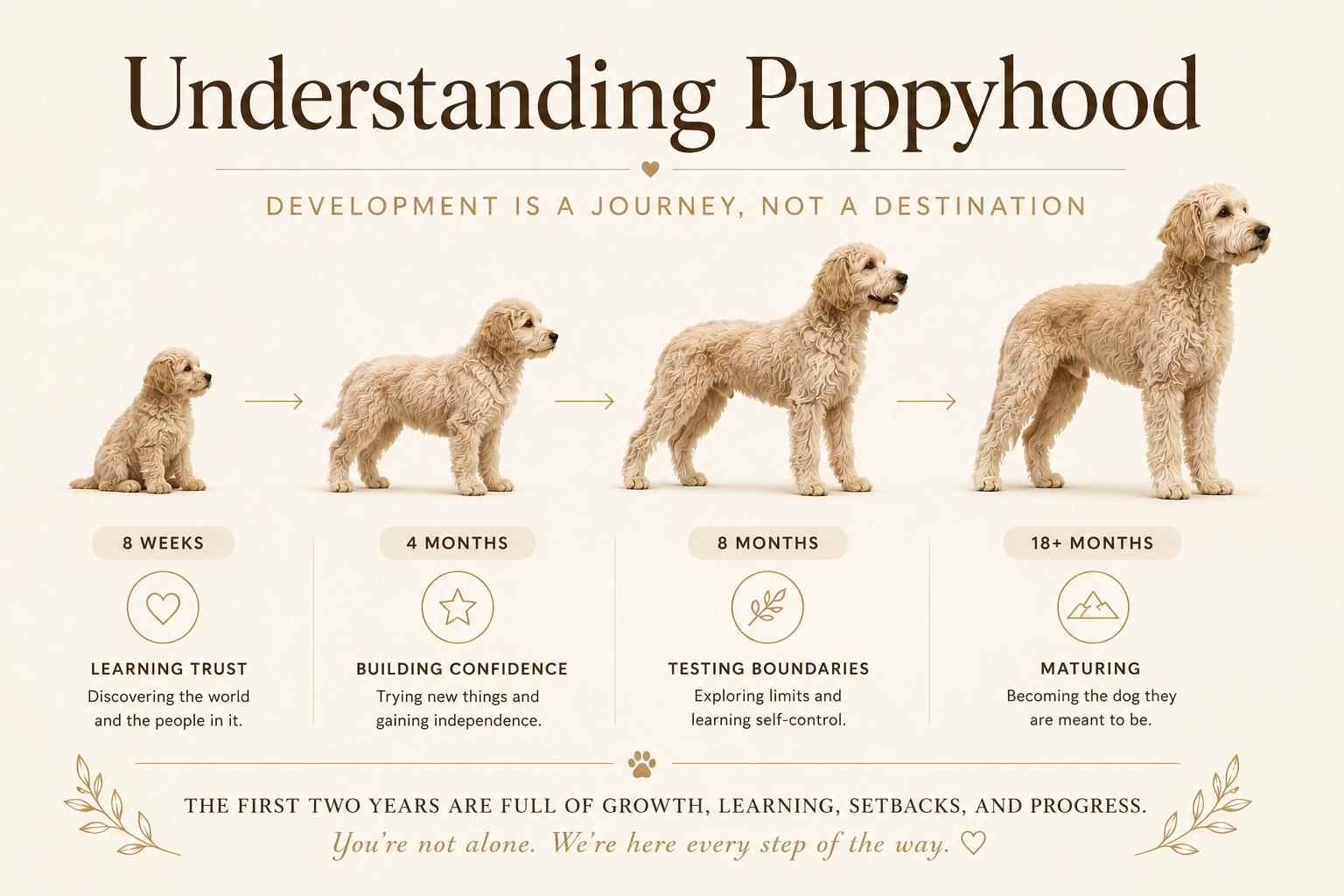
The First 72 Hours: Understanding The Transition
Most families spend the first few days evaluating behavior. We encourage families to evaluate recovery.
In a single day, your puppy leaves behind:
Their littermates
Familiar routines
Familiar smells
Familiar sounds
Everything they have ever known
This is one of the biggest transitions of their young life. Some puppies settle in immediately. Others need a few days to process everything. Both can be normal.
It is common for a puppy to:
Eat less than usual
Sleep more than expected
Follow you everywhere
Seem quieter than anticipated
Whine occasionally
Feel overwhelmed by new experiences
Many families worry that something is wrong when a puppy isn't acting exactly how they expected. In reality, your puppy's nervous system is processing a tremendous amount of change. The first few days are not a personality test. They are a recovery period. The goal during this stage is not to entertain your puppy or introduce them to every person they will ever meet. The goal is helping them feel safe. Simple routines. Clear boundaries. Plenty of sleep. A calm environment. These things often do far more for a puppy's long-term success than a busy schedule of activities and visitors.
Every Behavior Has A Reason
One of the biggest mistakes new puppy owners make is focusing only on the behavior they see.
Instead, we encourage families to ask a different question:
What might my puppy be trying to communicate?
A puppy that is whining may be:
Uncertain
Tired
Frustrated
Seeking connection
Adjusting to a new environment
A puppy that is biting may be:
Teething
Overtired
Overstimulated
Exploring the world the way puppies naturally do
A puppy that suddenly seems cautious may be:
Processing a new experience
Going through a developmental stage
Experiencing a temporary fear period
Before asking how to stop a behavior, it often helps to understand why the behavior is happening. Communication is the foundation of every relationship. Training becomes much easier when we understand what our puppy is trying to tell us.
While development influences behavior, individual puppies also bring their own personality traits, strengths, sensitivities, and natural tendencies. You can learn more about how we evaluate those characteristics on our Temperament Testing page.
Underneath Every Behavior Is A Nervous System
One phrase we use often is:
We Are Raising More Than Behaviors
Underneath every behavior is a nervous system. Puppies become tired. Puppies become overwhelmed. Puppies experience stress. Puppies need recovery.
Many behaviors that owners describe as "naughty" are actually signs of:
Fatigue
Overstimulation
Frustration
Emotional overload
Just like overtired toddlers, puppies often make poor decisions when they are exhausted. The puppy that suddenly becomes mouthy. The puppy that starts zooming through the house. The puppy that can't seem to settle. Often these are not signs of a bad puppy, they are signs of a tired puppy. Stress itself is not the problem. Learning how to recover from stress is what builds resilience.
This is one reason we place such a strong emphasis on confidence-building, exposure, recovery, and age-appropriate challenges during early development. Much of that foundation begins before puppies ever leave our home and continues after go-home day.
You can learn more about those early experiences on our How Our Puppies Are Raised page.
One of the most valuable things we can teach a puppy is not how to be busy. It is how to recover. How to settle. How to regulate themselves. How to move through the world with confidence. Because we are not simply raising behaviors. We are raising dogs that are learning how to experience the world.
Social Media Rarely Shows The Middle
One challenge for new puppy owners is that most online content shows outcomes rather than the process.
You see:
The puppy calmly sleeping in a crate
The perfect recall
The polite greeting
The dog lying quietly at a restaurant
The finished product
What you rarely see are the weeks and months that came before it. The whining. The accidents. The biting. The setbacks. The repetition. The learning. Most social media posts show session number ten. They rarely show session number one.
As a result, many owners develop unrealistic expectations. When their own puppy struggles, they assume something is wrong. They assume they are failing. They assume their puppy is different. Usually, none of those things are true. They are simply experiencing puppyhood.
Development is not a straight line. Progress is not a straight line. The goal is not perfection. The goal is helping your puppy develop confidence, resilience, self-control, and good habits over time.
If your puppy is struggling with something today, it does not automatically mean you are doing something wrong. It may simply mean your puppy is still learning.
What's Normal? Common Puppy Behaviors Explained
One of the most valuable things we can do for families is explain what normal puppy development actually looks like.
Many of the questions we receive involve behaviors that are completely expected.
Puppy Biting
Many families expect puppy biting to disappear within a few weeks.
In reality, teething often peaks between four and five months of age, and many puppies continue developing bite inhibition long after that.
Most puppy biting is not aggression.
More often it reflects:
Teething discomfort
Fatigue
Excitement
Overstimulation
Normal developmental behavior
The question is often not "How do I stop the biting?"
The better question is "Why is the biting happening?"
Understanding the cause often changes the solution.
Potty Training Regression
Potty training is rarely a straight line. Many puppies make excellent progress before experiencing temporary setbacks.
Growth spurts. Routine changes. Fear periods. Excitement. Too much freedom too soon. All can contribute to accidents.
One of the biggest mistakes we see is assuming a puppy who has had a few good days is ready for unlimited access to the house.
Puppies learn through repetition. Every successful trip outside helps build a habit. Every accident inside becomes practice too. Regression is often information—not failure. It simply tells us that more support, more supervision, or more structure may be needed for a little longer.
See our Complete Potty Training Guide
Fear Periods
Many puppies experience temporary developmental stages where they become more cautious or sensitive.
A puppy that confidently approached something yesterday may hesitate today. A garbage can. A vacuum. A stranger. A familiar object that suddenly seems suspicious. These stages are normal and typically temporary.
The goal is calm guidance, patience, and continued confidence-building—not forcing the puppy through the experience or avoiding the world entirely.
Overstimulation
As puppies become comfortable in their new homes, many begin showing more energy, excitement, and expression.
This is often the stage where owners start describing their puppy as:
Wild
Hyper
Naughty
Out of control
In reality, many of these puppies are simply overtired or overstimulated. Just like young children, puppies often lose their ability to make good decisions when they become overwhelmed. Sometimes the answer is not more exercise. Sometimes the answer is more rest.
The Universal Truth About Teenagers
There seems to be a rule that applies across nearly every species:
Babies are adorable.
Teenagers are challenging.
Dogs are no exception. One of the most frustrating stages of development often arrives just as owners begin feeling confident. Your puppy knows their name. They understand household routines. Their recall has been improving. They seem to understand what you are asking. And then one day they look directly at you and choose something else.
Many owners assume training has failed. More often, adolescence has arrived. Just like human teenagers, adolescent dogs begin exploring independence. They become more interested in the environment. More interested in distractions. More interested in making their own decisions. The challenge is no longer understanding. The challenge is choosing. The puppy who came running every time in your living room may suddenly discover that squirrels, smells, friends, and the rest of the world are extremely interesting.
This stage can be frustrating. It can also be completely normal.
One of the biggest misconceptions in dog training is believing that understanding a behavior means it is fully learned. A puppy may understand a cue long before they can perform it consistently in real-world situations. Reliability develops through repetition, practice, maturity, and successful experiences over time.
This is one reason we place so much emphasis on building strong foundations, confidence, and self-control during puppyhood. To better understand how we evaluate puppies and the traits they naturally bring to the table, visit our Temperament Testing page.
Most importantly:
Your adolescent dog is probably not giving you a hard time. More often, they are having a hard time. Their body is changing. Their brain is changing. Their priorities are changing. Patience, consistency, management, and realistic expectations matter tremendously during this stage. For many families, adolescence is not evidence that training failed. It is simply the next stage of development.
Puppies Become What They Practice
Dogs learn through repetition. Confidence is practiced. Calmness is practiced. Independence is practiced. Good habits are practiced. Unfortunately, unwanted habits are practiced too. Every repeated behavior becomes easier to repeat. This is one reason puppyhood is often less about teaching and more about creating opportunities for success.
A puppy does not become reliable because they performed a behavior correctly once. They become reliable because they have successfully practiced that behavior hundreds or even thousands of times.
The same principle applies to confidence. A puppy becomes confident by repeatedly experiencing new situations, recovering, and learning they are safe.
The same principle applies to calmness. A puppy becomes calm by repeatedly practicing calm behavior.
The same principle applies to independence. A puppy becomes comfortable being alone by repeatedly learning that being alone is safe.
One of the biggest misconceptions in puppy raising is believing that understanding equals reliability.
A puppy may understand exactly what you are asking long before they are capable of doing it consistently. Learning happens in layers. First they learn the behavior. Then they learn it in familiar environments. Then they learn it around distractions. Then they learn it when life gets exciting.
The goal is not perfection. The goal is enough successful repetitions that good decisions become habits.
Freedom Is Earned, Not Given
One of the biggest mistakes new puppy owners make is giving a puppy too much freedom too soon. Most training challenges are not caused by puppies being stubborn. They are caused by puppies being given opportunities to practice behaviors we do not want.
Puppies learn through repetition. Every accident on the carpet. Every stolen sock. Every successful counter surf. Every time they discover something fun to chew.
Those behaviors become practice. And practice becomes habit.
This process actually begins before puppies leave our home. At four weeks of age, when we begin introducing potty training and dog doors, puppies are not given unlimited access to the world. Their environment is intentionally structured to encourage successful choices. The goal is not restriction for the sake of restriction. The goal is creating opportunities for success. As puppies demonstrate reliability, freedom gradually expands.
The same principle applies after go-home day. A puppy who has access to an entire house often has far more opportunities to make mistakes than a puppy who is gradually earning additional space. Baby gates. Exercise pens. Leashes. Crates. Closed doors. These are not signs that a puppy is failing. They are tools that help create successful repetitions while habits are being built.
One of the most valuable lessons puppy owners can learn is this:
Management is not failure. Management is often what allows training to succeed.
One phrase our puppy families hear often is:
Don't reward the crazy.
Puppies repeat what works. If jumping, barking, spinning, mouthing, and frantic excitement consistently earn attention, interaction, or engagement, those behaviors become more likely to happen again. Even negative attention is still attention. This is one of the biggest surprises for new puppy owners.
A puppy jumps. The owner pushes them away. The puppy jumps again. The owner talks to them. The puppy jumps again. The owner reacts. From the puppy's perspective, interaction happened. Mission accomplished.
Many of the ways humans naturally respond to excitement look surprisingly similar to how puppies play with one another. Pushing. Touching. Talking. Engaging.
While the intention may be correction, the puppy often experiences it as attention. Instead, we focus on rewarding the behaviors we want to see.
Calmness.
Four feet on the floor.
Self-control.
Thoughtful choices.
When puppies become overly excited, we often become very boring. We remove the reward. Then, the moment the puppy offers a calmer choice, that choice becomes valuable.
Over time, puppies learn something incredibly important- Calm behavior works. Self-control works. Thoughtful choices work. This does not mean we want quiet or shut-down puppies. Quite the opposite. We want happy, social, enthusiastic dogs who also know how to regulate themselves. Teaching self-control may be one of the most valuable lessons a puppy ever learns. Long after sit, down, and come are mastered, self-control continues to influence how a dog navigates everyday life. Greeting visitors. Walking through exciting environments. Settling in the house. Recovering after excitement. Making good decisions when emotions run high.
In many ways, teaching self-control is more important than teaching commands.
Why We Encourage Crate Training
Many people think of a crate as something puppies need for a few months and then outgrow.
We view it differently. A crate is not simply a management tool for puppyhood. It is a life skill.
In the early months, a crate helps with:
Potty training
Preventing destructive behaviors
Establishing routines
Teaching independence
Creating opportunities for rest
Keeping puppies safe when they cannot be directly supervised
One of the biggest mistakes we see is giving a puppy more freedom than they are ready for. Freedom is earned through successful habits over time. A crate helps prevent puppies from practicing unwanted behaviors while those habits are still developing. It is much easier to build good habits than it is to undo months of rehearsal. As puppies mature, the purpose of the crate often changes. At some point, most dogs will likely spend time in a crate or kennel environment.
That may include:
Veterinary stays
Grooming appointments
Boarding facilities
Travel
Surgery recovery
Injury recovery
Major household transitions
A dog who is already comfortable being crated often navigates these situations with far less stress. Many people also assume crates are only necessary during puppyhood. The reality is that some dogs may benefit from crate time well into adolescence and young adulthood. Some dogs earn complete freedom quickly. Others need more time.
A move. A new baby. A second dog. A change in routine. Adolescence. Life happens.
Management is not failure.
Sometimes it is simply the best way to set a dog up for success.
Perhaps the most overlooked benefit of crate training has nothing to do with management at all. When introduced properly, many dogs come to view their crate as a personal retreat. A place to rest. A place to decompress. A place to say:
"I've had enough."
"I need a break."
"I want some quiet time."
Just as importantly, that choice should be respected. If your dog chooses to retreat to their crate, children and visitors should allow them to rest undisturbed. Much like a child retreating to their bedroom after a long day, dogs benefit from having a space that belongs to them. One of the most important skills a puppy can learn is not how to be busy. It is how to settle. The goal is not creating a dog that tolerates a crate. The goal is creating a dog that feels safe there.
Confidence Building vs Coddling
Confidence is not created by avoiding challenges. Confidence develops when puppies learn they can overcome them. One of the most common mistakes well-intentioned owners make is stepping in too quickly.
The moment a puppy hesitates. The moment something feels new. The moment a puppy becomes uncertain. We naturally want to help. Sometimes the best help is support. Sometimes the best help is allowing the puppy to work through a manageable challenge on their own. Throughout puppyhood, puppies are constantly learning lessons about themselves and the world around them.
Every successful experience teaches:
"I can do hard things."
"I can recover."
"I can figure this out."
This does not mean forcing puppies into overwhelming situations. Confidence is not built through flooding. Confidence is built through appropriate challenges followed by successful recovery. Not rushed. Not pushed. Not overwhelmed.
Supported.
One successful experience at a time. This philosophy influences much of how we raise puppies during their first eight weeks. From new environments and surfaces to novel objects and age-appropriate problem-solving opportunities, we focus on helping puppies develop confidence rather than simply exposing them to experiences.
You can learn more about that process on our How Our Puppies Are Raised page.
The goal is not creating a puppy that never experiences uncertainty. The goal is creating a puppy that learns uncertainty can be overcome.
Socialization Is More Than Meeting Dogs
When many people hear the word socialization, they picture puppies meeting other dogs. While dog interactions can certainly be part of socialization, they represent only a small piece of the picture.
True socialization is learning how to experience the world.
New people.
New sounds.
New environments.
New surfaces.
New objects.
New situations.
The goal is not simply exposure. The goal is teaching puppies that the world is safe, people are kind, and new experiences can be navigated successfully. A well-socialized puppy is not necessarily the puppy that has met the most dogs. A well-socialized puppy is one that can move through unfamiliar situations with confidence and recover when something feels new or surprising. This is one reason we place such a strong emphasis on confidence-building, novelty exposure, handling exercises, grooming preparation, and positive experiences during early development. Many of those experiences begin long before puppies leave our home.
To learn more about how that foundation is built, visit our How Our Puppies Are Raised page.
Socialization does not end at sixteen weeks. It continues throughout life. Every new experience becomes another opportunity to teach your puppy:
The world is safe.
People are kind.
Dogs are friendly.
Sometimes The Answer Isn't Training
Not every challenge is behavioral. Not every problem needs a training solution. Sometimes the answer is developmental. Sometimes the answer is medical. Sometimes the answer is simply part of growing up.
One of the most valuable skills puppy owners can develop is learning to ask:
Why is this happening? Before asking: How do I stop it?
For example:
A puppy that suddenly becomes mouthier may be teething. A puppy that seems wild and out of control may be overtired. A puppy that is struggling to focus may be overstimulated. A puppy that begins having accidents may need more supervision, more structure, or a veterinary evaluation.
The goal is not becoming a veterinarian or a trainer. The goal is learning how to recognize what is normal, what is common, and when it may be time to seek additional help.
Ear Infections
One of the more common issues we see in Goldendoodles, Golden Retrievers, and Poodles involves the ears.Drop ears create a warm environment where moisture can occasionally become trapped.
A puppy may leave our home with perfectly healthy ears and then develop an infection after:
A bath
Swimming
Playing in sprinklers
Kiddie pools
Grooming
This does not automatically mean anyone did something wrong. It is simply one of the realities of living with many drop-eared breeds.
Signs may include:
Head shaking
Ear scratching
Odor from the ears
Redness
Increased sensitivity
When in doubt, contact your veterinarian.
Teething & Tooth Development
Many puppy owners are surprised by how dramatic teething can be. Lost teeth. Bloody chew toys. Increased chewing. Changes in mouthiness. These are often normal parts of development.
Occasionally, veterinarians may also identify concerns such as narrow-based canine teeth or other developmental issues that warrant monitoring. Most of these conversations are far less alarming than they initially sound.
When questions arise, work closely with your veterinarian and remember that many aspects of puppy development continue changing throughout the first year of life.
Continuing The Work We Started
Go-home day is not the finish line. It is the handoff.
The foundation has already been started. Now your puppy continues learning through everyday experiences. Relationship building. Confidence building. Socialization. Grooming preparation. Recovery. Resilience. Self-control.
Good habits become habits because they are practiced repeatedly over time. The months following go-home day are where much of that learning takes place. This is one reason we encourage families to think beyond obedience commands.
Sit.
Down.
Come.
Those skills matter.
But so do:
Confidence
Independence
Emotional regulation
Recovery
Communication
Self-control
The dogs that are easiest to live with are often not the dogs that know the most commands. They are the dogs that have learned how to navigate everyday life successfully. Much of that foundation begins before puppies ever leave our care.
If you haven't already, we encourage you to explore our How Our Puppies Are Raised page and our Temperament Testing page to better understand how those early experiences influence later development.
Support Doesn't End At Go-Home Day
One of the most common comments we hear from families is how valuable ongoing support becomes during puppyhood. Because questions arise. Challenges happen. Development changes. Life changes. A puppy who was doing well may suddenly struggle. An adolescent dog may begin testing boundaries. A family may experience a move, a new baby, a schedule change, or another major life event. That is normal.
Raising a puppy is not about avoiding challenges. It is about learning how to navigate them.
Our private owner community, educational resources, and ongoing breeder support exist to help families better understand what is normal, what may need additional attention, and how to continue building on the foundation already established. This page provides a glimpse into that philosophy. The conversations inside our owner community allow us to go much deeper. Because every puppy is different. Every family is different. And sometimes having someone to talk through those challenges with makes all the difference.
Your Puppy Is Not Broken
If there is one message we hope families take away from this page, it is this:
Puppyhood is messy.
Development is not linear.
Progress is not always obvious.
Challenges are normal. Mistakes are normal. Setbacks are normal.
Learning takes time.
Social media often shows the finished product.
The puppy sleeping peacefully in a crate. The flawless recall. The calm dog at a restaurant. The perfectly behaved family companion.
What it rarely shows is everything that came before it.
The repetition. The accidents. The setbacks. The frustration. The growth. The learning.
The reality is that most puppies go through periods where owners wonder if they are doing something wrong. Most puppies go through stages where owners wonder if the behavior will ever improve. Most puppies go through phases that feel harder than expected. That does not mean your puppy is broken. And it does not mean you are failing. The goal is not perfection.
The goal is helping your puppy learn:
The world is safe.
People are kind.
Dogs are friendly.
And giving them the confidence, resilience, and trust to navigate life alongside the people they love.
Continue Your Research
Frequently Asked Questions
-
Yes.
Many puppies protest when they are first separated from littermates, familiar routines, and constant companionship.
Whining does not automatically mean something is wrong.
Like many aspects of puppyhood, learning independence takes time, consistency, and practice.
-
Most puppies continue biting far longer than many owners expect.
Teething often peaks around four to five months of age, and some puppies continue working on bite inhibition well beyond that.
Biting is one of the most common concerns we hear from puppy owners and is usually a normal part of development.
-
Puppies commonly go through temporary developmental stages called fear periods.
During these times, familiar objects, people, or situations may suddenly seem concerning.
These stages are typically temporary and do not necessarily reflect your puppy's long-term temperament.
-
Potty training is rarely a straight line.
Growth spurts, excitement, routine changes, increased freedom, stress, and developmental changes can all contribute to temporary setbacks.
Regression does not automatically mean training has failed.
-
Most puppies gradually develop better emotional regulation, impulse control, and decision-making as they mature.
Many families notice significant improvements between one and three years of age.
The exact timeline varies by individual dog.
-
For many owners, adolescence is one of the most challenging stages of puppy development.
Dogs often become more independent, more distracted, and less consistent during this period.
While frustrating, these changes are often a normal part of development.
-
Every family is different.
However, we strongly encourage puppies to learn how to relax comfortably in a crate.
Crates can help with potty training, management, travel, veterinary stays, grooming appointments, injury recovery, and teaching independence.
Most importantly, many dogs learn to view their crate as a safe place to rest and decompress.
-
Earlier than most people think.
Many puppy classes allow enrollment as early as 10 weeks of age, depending on vaccination requirements.
Training classes provide valuable opportunities for socialization, confidence building, relationship development, and professional guidance.
-
Almost certainly not.
Most puppy owners experience moments where they wonder if they are doing something wrong or if their puppy is developing normally.
More often than not, the behaviors causing concern are common developmental stages that improve with time, consistency, and realistic expectations.
-
Because most people share their successes, not their struggles.
Social media often highlights the calm puppy, the successful training session, the perfect recall, or the adorable photo.
What it rarely shows are the accidents, the biting, the whining, the setbacks, the adolescence, and the months of repetition that came before those successes.
Comparing your real puppy to someone else's highlight reel is rarely helpful.
Focus on the puppy in front of you.
Progress is not always linear, and development does not happen on a fixed timeline.
Many of the challenges that feel discouraging today are completely normal parts of raising a puppy.