

Our Goldendoodle Breeding Program
At Oregon’s Legendary Goldendoodles, our program is built around raising exceptional companions with the temperament, health, and foundation to thrive in family life. As a responsible Goldendoodle breeder, we believe thoughtful breeding practices, early puppy development, and careful family matching are essential to producing well-balanced dogs. Every step of our program is designed to give puppies the best possible start.
Responsible breeding is about far more than producing beautiful puppies. It means carefully selecting parent dogs, raising puppies in a structured and enriching environment, and thoughtfully matching each puppy with the family that fits them best. As a responsible Goldendoodle breeder in Oregon, our goal is to raise healthy, well-adjusted companions through careful breeding decisions and thoughtful early development.
Every step of our program—from health testing to early development and temperament evaluation—is designed to support the long-term success of the dogs we raise and the families who welcome them home.
Below you can explore the principles and practices that guide our breeding program.
Our Breeding Philosophy
Our approach to breeding focuses on the whole dog. We consider temperament, health, structure, and long-term wellness when planning each litter.
The goal of our program is to raise dogs that are not only beautiful, but confident, adaptable, and well suited for family life. Thoughtful pairings and careful early development help puppies grow into balanced companions who integrate smoothly into their homes.
Breeding decisions are made with the future in mind, always prioritizing the health and well-being of the dogs we produce.
Breeding decisions are made with the future in mind, always prioritizing the health and well-being of the dogs we produce. The males and females selected for our program play a critical role in producing consistent, well-balanced puppies.
👉 Learn more about the dogs behind our program in our Stud Program
What “Purpose Bred” Means in Our Program
Every litter in our program begins with a clearly defined goal.
Rather than breeding simply for availability, we design each pairing with intention — combining health, temperament, and structure to produce predictable, well-balanced dogs.
From there, each puppy is evaluated individually to understand how those traits develop and where they are best suited.
Each pairing has a purpose — and each puppy is evaluated to see how that purpose shows up.
While every litter is built on the same foundation, their goals may include:
• developing future breeding dogs
• improving genetic diversity
• producing service or therapy prospects
• refining temperament consistency
• creating ideal family companions
• producing low-shedding coats
How Our Puppies Are Raised
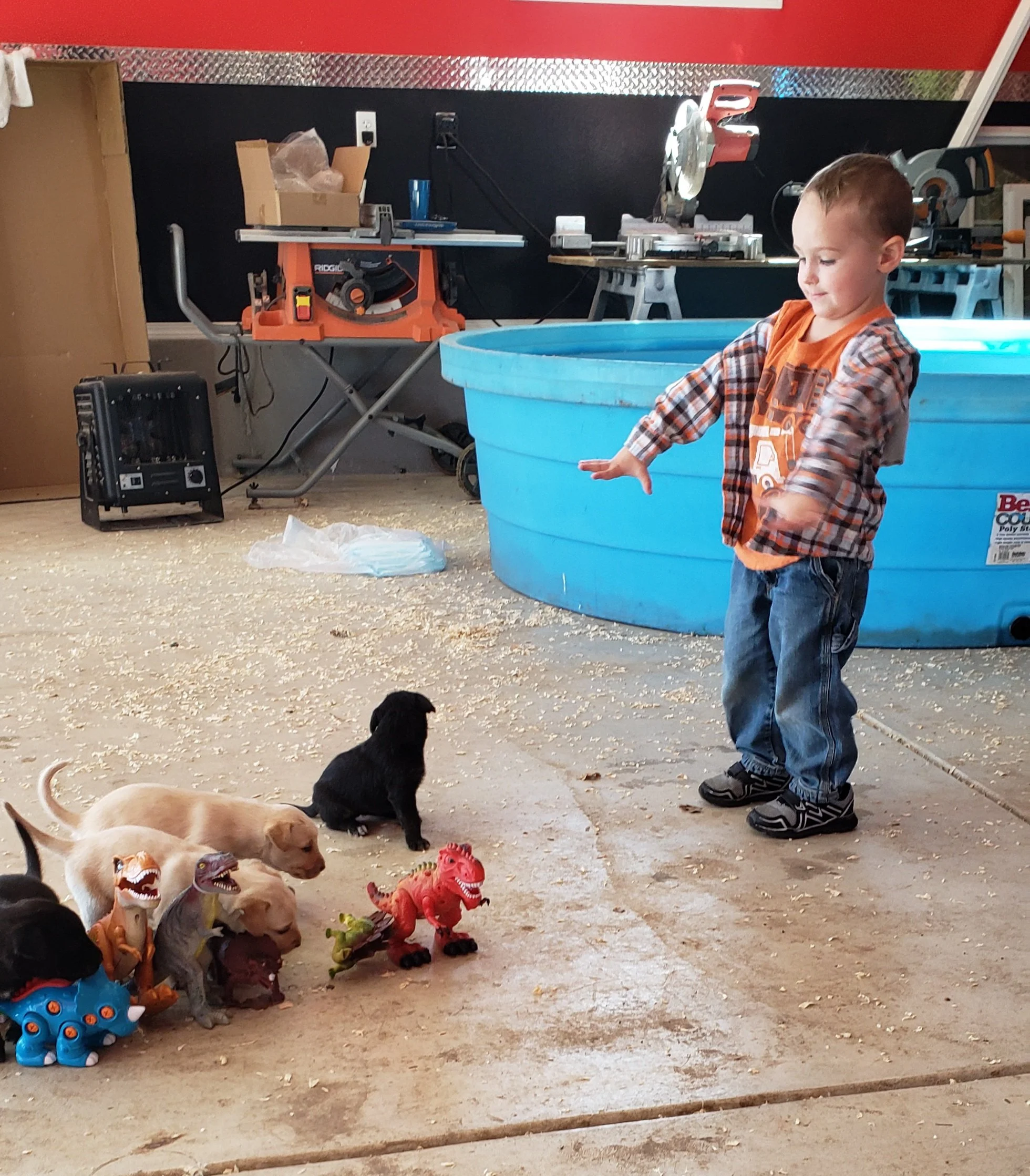
The earliest weeks of a puppy’s life are incredibly important for development. During this time, puppies begin forming the foundation for confidence, curiosity, and adaptability.
Our puppies are raised with structured early experiences designed to gently introduce them to the world. These experiences include enrichment activities, exposure to new sights and sounds, and positive interactions that help them build confidence.
Early development helps puppies transition more smoothly into their new homes and prepares them for life as family companions.
Temperament-Focused Matching
Each puppy has its own personality and energy level. Finding the right match between puppy and family is one of the most important parts of our program.
Rather than selecting puppies based solely on appearance, we take temperament into consideration when placing puppies with families. Observing how puppies interact with their environment helps us better understand their individual traits and tendencies.
This thoughtful matching process helps ensure that puppies are placed in homes where they are most likely to thrive.
👉 Learn more about how we evaluate and match puppies
Health Testing and Responsible Breeding
Health is a central priority in responsible breeding. Careful health screening helps breeders make informed decisions when planning litters and supports the goal of producing healthy companions.
Our program considers the full picture of each parent dog, including genetic health, structure, and temperament. Responsible breeding practices help give puppies the strongest possible start in life.
👉 Learn more about the health standards behind our program
Thoughtful Breeding Timelines
Responsible breeding is not simply about completing health testing and choosing two dogs that complement one another. We also have to decide when a female should begin breeding, how frequently she should be bred, when taking a cycle off makes sense, and when it is time for her to retire. Those decisions are made individually for each dog rather than by following a predetermined schedule or a rule repeated on social media.
When We Begin Breeding
Our females are not bred simply because they have reached reproductive maturity. We typically complete their breed-appropriate health testing between 18 and 24 months of age, which gives us time to evaluate their adult structure, temperament, overall health, and whether they truly belong in our breeding program.
We do not breed our females before their second birthday. By that point, we have had considerably more time to know the dog in front of us—not just what her preliminary promise looked like as a puppy, but who she became as an adult. We can make breeding decisions with completed health information, a better understanding of her strengths and weaknesses, and a thoughtful plan for the dog she should be paired with.
Reaching age two still does not automatically mean a female will be bred. Timing also depends on her individual maturity, health, heat cycle, our plans for that pairing, and whether breeding her at that time makes sense for both her and our program.
How Often We Breed
One of the most persistent beliefs surrounding dog breeding is that a female should automatically skip a heat between every litter. It sounds reasonable, and socially it has become associated with responsible breeding, but reproductive decisions are more complicated than counting heat cycles.
We look at the female in front of us. How did she handle pregnancy and delivery? How quickly did she return to a healthy body condition? How is her coat, muscle condition, energy and overall wellbeing? What does her reproductive history look like, and is there a reason to breed her on the next cycle or a reason to wait?
For a healthy female who has recovered well, breeding consecutive cycles may sometimes be the appropriate reproductive choice. For another female, taking additional time between litters may be the better decision. “Every other heat” is not our automatic rule, and neither is “every heat.” The decision belongs to the individual dog.
Knowing When to Stop
Retirement is handled the same way. We do not believe every female should produce a predetermined number of litters simply because she technically can. Some of our girls may have fewer litters because of timing, family demand, the direction of our breeding program, reproductive history, or simply because we have already produced what we hoped to preserve from her line.
Age matters, but it is not the only consideration. Recovery, reproductive health, previous pregnancies, body condition and quality of life all matter when deciding whether another litter is appropriate. Our goal is not to fit every female into the same breeding schedule. It is to make thoughtful choices throughout her time in our program and know when breeding her no longer serves her or the future of the program.
Science, Welfare and Social Expectations
Breeding dogs comes with plenty of strongly held opinions. Some are rooted in good intentions, but a rule becoming popular online does not necessarily make it reproductive science. We believe responsible breeding requires being willing to look beyond what sounds right and understand what current canine reproductive medicine tells us, while still considering the individual dog in front of us.
Our breeding choices should be defensible because they make sense for that dog, at that point in her life—not because they satisfy an arbitrary timeline. Health testing, reproductive veterinary guidance, physical condition, maturity, recovery and long-term welfare all have a place in those decisions. That individualized approach is part of what responsible breeding means to us.
Our Process
Bringing a puppy into your home is an exciting journey, and we strive to make the experience supportive and transparent for every family.
Our process helps guide families from their first inquiry through the puppy matching process and ultimately to bringing their puppy home. Clear communication and education are important parts of ensuring both puppies and families are set up for success.
👉 Learn more about our placement process
The People Behind the Program
Every breeding program is shaped by the people behind it. Our work with dogs is guided by a deep appreciation for the companionship they bring into people’s lives.
We believe responsible breeding should prioritize the long-term well-being of both the dogs and the families they join. Our goal is to raise puppies that grow into confident, affectionate companions who integrate seamlessly into their homes.
👉 Learn more about our goals and the heart behind our program
Our Story
Like many meaningful journeys, our program began with a love for dogs and a desire to raise companions that truly enrich the lives of their families.
Over time, that passion grew into a thoughtful breeding program built around responsible practices, careful planning, and a deep commitment to the dogs we raise.
👉 Read the story behind our program
The Sizes of Goldendoodles in Our Program
Our program produces several sizes including Micro, Petite, Mini, Medium, and Standard Goldendoodles. The right size often depends on a family’s lifestyle and preferences.
👉 Learn more about Goldendoodle sizes
Within our breeding program, we carefully plan pairings that produce a range of sizes while maintaining the temperament and structure we prioritize.
You can learn more about each size below:
Petite Goldendoodles
Typically mature between 15–25 pounds and are a wonderful option for families seeking a smaller companion.
Mini Goldendoodles
A popular size for families who want a slightly smaller dog while still enjoying the personality of a retriever-type companion. Typically mature between 25–35 pounds
Medium Goldendoodles
A balanced size that fits well in many active homes. Typically mature between 35–50 pounds
Standard Goldendoodles
Larger companions known for their presence, intelligence, and affectionate nature. Typically mature between 50–70 pounds. Some of our litters can produce 75+ pounds
See Our Available Puppies
Families who are exploring adding a puppy to their home can visit our Available Puppies page to learn about current and upcoming litters.

Our Commitment to Responsible Breeding
Choosing a breeder is an important decision for families searching for a healthy and well-adjusted puppy. Responsible breeding programs focus on the long-term well-being of the dogs they produce, including thoughtful pairing decisions, early development, and careful placement with families.
At Oregon’s Legendary Goldendoodles, our goal is to raise companions that thrive in their homes for many years to come. Every part of our program—from health testing and early puppy development to temperament-based matching—supports that goal.
Families interested in learning more about our standards and philosophy can explore the pages below: