
Poodle Sizes Explained:
Toy, Miniature, Moyen, Standard & Royal Poodles
If you have started researching Poodles, the sizes can get confusing surprisingly quickly. You may see Toy, Miniature and Standard Poodles, but you may also encounter Moyen, Medium, Klein, Royal, Giant and Teacup Poodles. Some of those terms have official meanings in certain parts of the world. Others are descriptive terms breeders use.
The most important thing to understand is that these are not different breeds of dog. They are all Poodles.
A well-bred Poodle should retain the fundamental structure, movement, intelligence and temperament of the breed regardless of size. A Miniature Poodle isn't supposed to be a different type of dog than a Standard Poodle, and a Moyen isn't supposed to have a special temperament simply because it falls between the two.
Size changes the scale of the Poodle. It doesn't change what a Poodle is.
That distinction matters when you're trying to decide which size is right for your family.
How Many Poodle Sizes Are There?
The answer depends partly on which kennel club you're talking about—and partly on whether you're talking about an officially recognized variety or simply a commonly used size description.
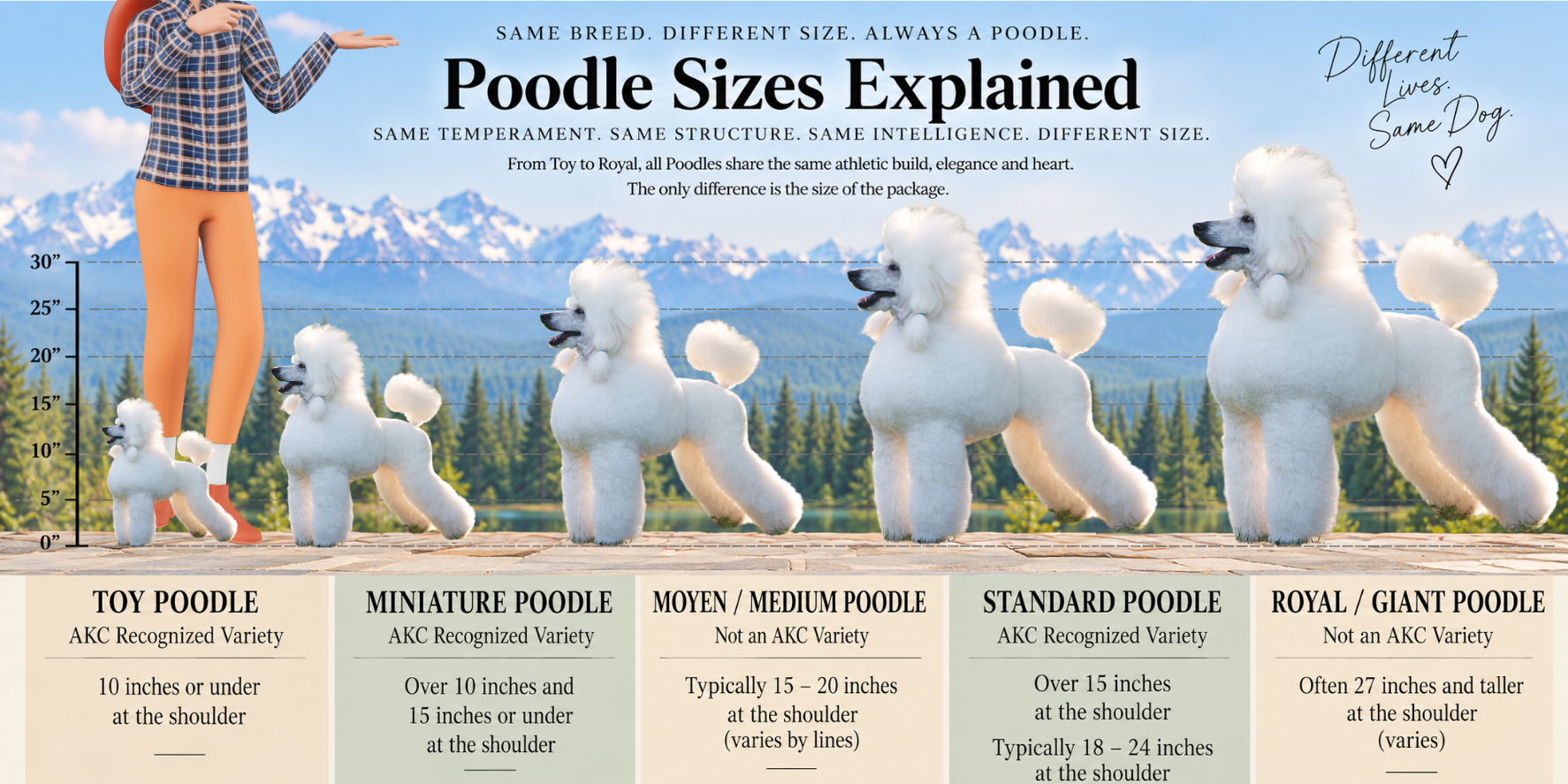
In the United States, the American Kennel Club recognizes three Poodle varieties based on height:
Toy Poodle: 10 inches or under at the highest point of the shoulders.
Miniature Poodle: over 10 inches and 15 inches or under.
Standard Poodle: over 15 inches.
Under the AKC system, that's it. A 16-inch Poodle and a 28-inch Poodle are both Standard Poodles.
But that doesn't mean every Poodle over 15 inches is actually the same size. There is an enormous physical difference between a small Standard and a very large Standard, which is one reason you'll encounter additional terms such as Moyen, Medium, Klein, Royal and Giant.
International registries also divide Poodles differently than the AKC does, including recognition of an intermediate Medium size.
So when someone says, “There are only three Poodle sizes,” what they usually mean is that the AKC recognizes three varieties. That isn't quite the same thing as saying Poodles only occur in three practical size ranges.
Poodle Size Is Based on Height, Not a Weight Chart
One of the biggest misconceptions about Poodle sizes is that they can be neatly divided by weight.
They can't.
Official Poodle varieties are defined primarily by height at the withers, not by whether a dog weighs 12, 25, 40 or 60 pounds.
Weight can still be useful when helping a family picture how large an adult dog may feel in everyday life, but it isn't what makes a Poodle a Toy, Miniature or Standard under the AKC breed standard.
Two Poodles of the same height can also weigh differently because of differences in bone, sex, maturity and conditioning. This is one reason we prefer to talk about both expected height and expected weight rather than treating a weight range as the definition of a Poodle variety.
Why Are There So Many Unofficial Poodle Size Terms?
Terms like Moyen, Medium, Klein, Small Standard, Compact Standard, Royal and Giant are sometimes dismissed because they are not official AKC varieties. But that doesn't make the language meaningless.
These terms developed because the official Standard Poodle category covers an unusually broad range of dogs. Under the AKC definition, a Poodle just over 15 inches at the shoulder and a Poodle approaching 30 inches can both simply be called a Standard Poodle. Yet those can be very different-sized dogs to purchase, transport, lift, live with and plan for.
Descriptive size terms give breeders and families additional language for talking about that range. Someone searching for a Moyen Poodle, Small Standard Poodle or Compact Standard Poodle is often trying to communicate that they want something between a Miniature and the larger Standards they have encountered. Someone searching for a Royal Standard Poodle or Giant Poodle is usually trying to find the opposite end of that spectrum.
There is no universal definition for many of these terms, which is why the label should never replace the actual information. Ask how tall the parents are, what they weigh, what sizes are consistently produced in the pedigree and what the breeder realistically expects from the litter.
The purpose of the terminology is not to create additional breeds of Poodle. It is to give people a more useful way to describe the tremendous amount of size variation that can exist within one breed.
Understanding the Poodle Sizes
Toy Poodles
Toy Poodles are the smallest recognized AKC variety, measuring 10 inches or less at the shoulder.
They are compact enough for families who genuinely need a small dog, but their small size shouldn't be confused with being delicate little ornaments. They are still Poodles: intelligent, athletic, trainable and capable of learning an enormous amount.
A Toy should also still look like a Poodle. The goal isn't an exaggerated head, extremely short legs or a fragile body simply because the dog is tiny. The same fundamental balance and breed characteristics should remain present on a smaller frame.
Their physical size does change some practical considerations. A very small dog requires more awareness around young children, larger dogs, jumping from furniture and other situations where the dog's body size makes accidental injury easier.
But being Toy-sized does not automatically mean low energy, quiet, cuddly or easy.
Those are temperament questions, not measurements.
Miniature Poodles
Under the AKC standard, Miniature Poodles stand over 10 inches and no more than 15 inches at the shoulder.
Miniatures can offer a wonderful middle ground for families who want a physically manageable dog without moving into the very smallest size range. They are still athletic dogs and can participate in obedience, scent work, agility and many other activities.
Again, however, size doesn't determine temperament.
A Miniature from highly driven performance lines may be considerably more intense than a larger Poodle bred from generations selected for steadier companion temperaments. Another Miniature may be exceptionally calm and easygoing.
Knowing that a puppy will be 15 inches tall tells you something useful about physical size.
It doesn't tell you the whole dog.
Moyen, Medium & Klein Poodles
This is where American Poodle terminology gets messy.
Moyen means “medium” in French, and in the United States the term is commonly used for Poodles that fall between the traditional American Miniature and larger Standard size ranges. You may also hear Medium Poodle or Klein Poodle used when discussing this general size.
However, Moyen is not a separate AKC-recognized Poodle variety. A Moyen-sized Poodle registered with the AKC is generally registered as a Standard if it is taller than 15 inches.
That doesn't mean the size itself was invented by American breeders.
Medium-sized Poodles have an established place within international Poodle classification. Depending on the country, registry and language, you'll encounter terms such as Medium Poodle, Moyen and Klein or Kleinpudel.
A Moyen Is More Than a Weight Label
This distinction is important to us.
We don't believe every smaller Standard should automatically be marketed as a “Moyen” simply because it weighs somewhere around 25 or 35 pounds.
When we talk about Moyen Poodles, we're interested in the breeding behind the dog: generations of Poodles intentionally produced within that intermediate size range, including established European lines where medium-sized Poodles have long been recognized and bred.
Pedigree matters, and so does the purpose behind the pedigree.
A Poodle happening to mature smaller than expected and a Poodle produced from generations intentionally selected for a consistent medium size aren't necessarily the same breeding story, even if the two dogs ultimately weigh the same amount.
If you're considering a Moyen, don't just ask what the breeder calls the dog. Ask how tall the parents are, how much they weigh, what sizes are consistently produced in the pedigree and where those lines originated.
Those answers tell you much more than the word “Moyen.”
Standard Poodles
Under the AKC system, every Poodle over 15 inches at the shoulder falls into the Standard variety.
That creates an enormous range.
A smaller Standard may be relatively compact and easy to travel with, while a large Standard can be a substantial dog. Both are Standards according to the AKC.
This is another reason weight labels alone can be misleading. Looking at the parents, their height, their structure and what their pedigrees consistently produce gives us a much better picture of likely adult size.
Standards are the largest officially recognized AKC Poodle variety, but even within Standards there can be considerable variation in physical size. We see that variation firsthand in our own dogs. Some of our Standard Poodles are among the larger Poodles we regularly encounter in the UKC show ring here in the Pacific Northwest.
Geography and bloodlines can also influence what people think of as a “typical” Standard. In our experience, many of the Standards we encounter in the Pacific Northwest are more moderate in size, while some lines from other regions produce considerably taller, leggier dogs. That doesn't create a different variety—it simply demonstrates how much variation can exist within the Standard classification.
And once Standards become particularly large, you'll often hear another term.
Royal & Giant Standard Poodles
If you've seen advertisements for a Royal Poodle, Royal Standard Poodle or Giant Standard Poodle, you're still looking at a Standard Poodle.
Royal is not another AKC-recognized Poodle variety.
The term is generally used by breeders to describe particularly tall or substantial Standard Poodles. You may see breeders use heights such as 27 inches or greater when describing their Royals, but there is no official AKC measurement where a Standard suddenly becomes a Royal.
There is also no separate Royal Poodle breed standard.
That doesn't mean large Poodle lines don't exist. Some pedigrees consistently produce very tall, substantial Standards, and knowing that can be useful to a family specifically looking for a larger dog.
What matters is understanding the difference between describing size and creating a new variety.
A Royal is still a Standard Poodle.
Bigger Isn't Automatically Better
This is also where breeding priorities matter.
We don't believe the goal should simply be to produce the biggest Poodle possible.
If breeders continually select for more height or more weight simply because “Royal” sounds impressive, size can begin taking priority over the qualities that actually matter: correct structure, balance, movement, health and temperament.
A very large Poodle should still be a sound, balanced, athletic Poodle.
We would rather tell you how tall the parents are, how much they weigh, what their pedigree consistently produces and what we realistically expect from a litter than rely on a marketing term to make a dog sound more impressive.
What About Teacup Poodles?
“Teacup” is another term families frequently encounter online, but there is no Teacup Poodle variety recognized by the AKC.
A very small Poodle may fall within the Toy variety, but “Teacup” is generally a marketing description for an exceptionally small dog rather than another official size.
Extremely small size shouldn't automatically be viewed as desirable. Breeding decisions still need to prioritize sound structure, health and the overall dog rather than pursuing increasingly tiny size simply because there is a market for it.
The Poodle Should Still Look Like a Poodle
One of the most important things we want families to understand about Poodle size is that we aren't talking about different versions of the breed.
The same basic Poodle structure should carry through the sizes.
Poodles should remain squarely built, balanced, athletic dogs with the structure necessary to move soundly and comfortably. Making a Poodle smaller shouldn't mean intentionally creating disproportionately short legs, an oversized head, excessive fragility or another exaggerated feature to achieve a particular look.
The same principle applies at the opposite end. Making a Standard taller and heavier shouldn't mean creating an oversized, cumbersome dog that no longer retains the balance and athleticism of the breed.
Whether we're looking at a Toy, Miniature, Moyen or a very large Standard, the goal is still a Poodle.
Size is one characteristic of the dog. It should never become more important than the dog itself.
Does Poodle Size Change Temperament?
Not in the simplistic way people are often led to believe.
You'll sometimes hear descriptions suggesting Toys have one personality, Miniatures have another and Standards have an entirely different temperament.
We don't think that's a particularly useful way to understand Poodles.
A Poodle is a Poodle.
The fundamental breed temperament doesn't change because we've changed the dog's height. What does vary considerably is the individual dog and the genetics behind that dog.
Temperament varies from dog to dog and from pedigree to pedigree. Genetics matter. The purpose behind a breeding program matters. Selection matters. Early development matters. And the individual puppy standing in front of you matters.
This is why we put so much emphasis on understanding the dogs behind a litter.
A pedigree isn't merely a collection of registered names and titles. We want to know what those dogs were actually like.
Were generations of dogs selected for hunting ability and stamina? Performance sports? Conformation? Service work? Stable family companionship? High drive and intensity? An easy off-switch?
You get what you breed for.
A hunting-bred Poodle may bring considerable drive, energy and stamina regardless of whether that dog is relatively small or large. A Poodle from performance-focused lines may be incredibly quick, intense and eager to work. Another pedigree may consistently produce steadier dogs that naturally fit more easily into ordinary family life.
This is why we would never tell someone, “Get this size because it has the best temperament.”
We would rather help you find the right dog from the right lines.
Intelligence Doesn't Change With Size Either
Poodles are exceptionally intelligent dogs throughout the breed.
That intelligence is one of the things people love about them, but it deserves more explanation than simply saying Poodles are smart.
They learn quickly—including the things you didn't intend to teach.
A clever Poodle can figure out routines, patterns, weaknesses in household rules and exactly which family member is most likely to give in. Without consistent expectations, a very intelligent dog can become surprisingly good at training its humans.
That applies whether the dog weighs 10 pounds or 60.
Their intelligence is part of what makes Poodles so rewarding for training, sports, therapy work, service work and active family life. It also means they benefit from owners who enjoy living with a dog that thinks.
For a deeper look at temperament, purpose, trainability and everyday life with the breed, visit About the Poodle.
So What DOES Change With Poodle Size?
Quite a bit—just not the fundamental breed.
Physical size changes the practical experience of living with a dog.
A 10-pound dog and a 60-pound dog may share many of the same Poodle characteristics, but carrying one through an airport is very different from carrying the other. So is fitting one into a small camper, helping an aging dog into a vehicle, managing an adolescent puppy on leash or sharing your couch.
Size can affect travel, housing, physical handling, food consumption, equipment size and cost, how easily you can lift your dog, interactions with very young children, play with other household dogs and which service tasks a dog can physically perform.
For an active family, a larger Poodle may be exactly what they want. Another family may want the athleticism and trainability of a Poodle in a body that's easier for them to manage physically.
Neither choice is inherently better.
The question is which size fits the life you're actually going to live with your dog.
Poodle Size and Children
Families with children sometimes assume smaller automatically means better.
Not necessarily.
A smaller dog is easier for a child to physically handle, but the child is also much larger relative to the dog. Accidental falls, being picked up incorrectly or rough play can have greater consequences for a very small dog.
Larger Poodles are physically sturdier, but an enthusiastic adolescent Standard can also knock over a small child without intending any harm.
For families with children, we care about the individual dog's temperament, confidence, resilience, energy, intensity and comfort around children in addition to adult size.
This is another reason we don't choose puppies for families based on color, sex or size alone.
Poodle Size for Hiking, Sports & Active Families
Poodles were developed as athletic working dogs, and their ability can surprise people who primarily associate the breed with elaborate grooming.
Across the sizes, Poodles can be active, capable dogs.
The right size for an activity depends on the actual activity, the dog's structure and conditioning, and what you want to do together. Smaller Poodles can be remarkably athletic, while Standards can make wonderful partners for families wanting a substantial dog capable of accompanying them on outdoor adventures.
For dog sports, drive, confidence, motivation, structure and the pedigree behind the dog may matter far more than simply choosing a size.
Poodle Size for Service & Therapy Work
Again, we start with temperament rather than size.
A service prospect needs the appropriate confidence, nerve strength, human focus, trainability, resilience and ability to work in demanding environments. Size is then considered according to the tasks the dog needs to perform.
Someone needing mobility-related tasks may require a substantially larger dog than someone needing scent-based medical alert work. Psychiatric service tasks can have entirely different physical requirements.
Therapy work is similar. Bigger isn't automatically better, and smaller isn't automatically easier. We want the dog that genuinely enjoys people and has the temperament to remain comfortable and appropriate in the environments where it will work.
Choose temperament for the job first, then make sure the dog's physical size can perform the job safely.
How Big Will My Poodle Puppy Get?
We can estimate adult size, but an estimate is still an estimate.
Parent size, grandparents, pedigree trends, sex and the sizes produced in previous litters all give us information. Growth patterns can provide additional clues once puppies are born.
But genetics don't read our website.
Two appropriately sized parents can produce some variation within a litter, particularly when there is greater size diversity behind them.
Our job as breeders is to understand the pedigrees as thoroughly as possible and give families a realistic expected range—not promise an exact adult weight that no breeder can guarantee.
Choosing the Right Poodle Size
Instead of beginning with, “Which size is best?”, we encourage families to ask a slightly different question:
“What do I want everyday life with my dog to look like?”
Think about your home, travel, children, other animals, activity level, physical ability to handle a dog, the activities you hope to enjoy together and what you want your adult dog to be able to do.
Then we look beyond size.
We consider the parents. We consider the pedigree. We consider why those lines were developed. We consider the temperament tendencies we know about the family. And once puppies are old enough, we consider the individual puppy.
Because ultimately, choosing between a Toy, Miniature, Moyen, Standard or a particularly large Standard tells us only part of the story.
You're not choosing a measurement. You're choosing a dog you'll hopefully share the next 12–15 years with.
And we want the whole dog to fit your life.
Poodles at Oregon's Legendary
Our Poodle program includes multiple sizes because different families genuinely need different amounts of dog.
But our goal isn't to create a different Poodle at every size.
Whether we're breeding a smaller Poodle, developing our Moyen lines or planning a Standard litter, we are looking for the same fundamentals: sound structure, stable temperament, intelligence, trainability, health and the unmistakable qualities that make a Poodle a Poodle.
We pay attention to pedigree and to the purpose behind those lines because size alone doesn't tell us what a dog will be like to live with.
That's also why our puppy placement process goes well beyond choosing the smallest puppy, the biggest puppy or a favorite color.
We want to understand who that puppy is.
If you're still deciding whether a Poodle is the right breed for your family, start with About the Poodle. To learn more about the dogs behind our puppies, visit Our Poodle Program.
Poodles Sizes FAQ
-
The answer depends on the registry. The American Kennel Club recognizes three Poodle varieties: Toy, Miniature and Standard, with the varieties determined by height at the shoulder. Other registries internationally recognize an additional intermediate or Medium size. This is one reason you may also encounter terms such as Moyen or Klein when researching Poodles.
-
Under the AKC standard, a Toy Poodle is 10 inches or under at the highest point of the shoulders. Toy refers to height, not a specific adult weight.
-
An AKC Miniature Poodle is over 10 inches and 15 inches or under at the shoulder. A Poodle taller than 15 inches is classified as a Standard under the AKC system.
-
Moyen means “medium” in French and is commonly used in the United States for Poodles between the traditional Miniature and larger Standard size ranges. Moyen is not a separate AKC variety; if the dog is over 15 inches, it is classified as a Standard by the AKC. Medium-sized Poodles do, however, have an established place in international Poodle classification.
-
The terms are often used to describe a similar intermediate size, particularly when discussing European Poodle lines. However, terminology varies by country, registry and breeder. Rather than relying on the label alone, ask about the actual heights of the parents, their pedigrees and the sizes consistently produced within those lines.
-
No. We don't consider “Moyen” simply another name for a Standard Poodle that happens to weigh 25 or 30 pounds. When discussing Moyen lines, we look at the breeding and pedigree behind the dog and whether generations have been intentionally bred within that intermediate size range.
-
Royal, Royal Standard and Giant Standard are terms sometimes used for particularly large Standard Poodles. Royal is not a separate AKC-recognized variety. There is no official height at which a Standard becomes a Royal. Regardless of how large the dog is, it remains a Standard Poodle under the AKC classification.
-
Teacup is not an officially recognized Poodle variety. It is generally a marketing term used for an exceptionally small Toy Poodle. We believe health, sound structure and overall quality should take priority over breeding toward increasingly extreme size.
-
Height. Official Poodle varieties are based primarily on height at the highest point of the shoulders, not weight. Weight can help families understand how substantial a dog may be, but a weight such as 20, 30 or 50 pounds does not determine its official Poodle variety.
-
Size itself doesn't create a different Poodle temperament. A Poodle is a Poodle. Temperament varies among individual dogs and pedigrees and is strongly influenced by genetics and what breeders have selected for within their lines. Hunting, performance, show, service and companion-focused lines may have different tendencies regardless of the physical size of the dog.
-
They shouldn't be different types of dogs simply because they're smaller. The same fundamental Poodle structure, balance and athleticism should carry throughout the sizes. We don't want exaggerated features created merely to make a Poodle unusually tiny or unusually large.
-
Not necessarily. Smaller does not automatically mean calmer or lower energy. A Miniature from high-drive performance lines may be considerably more energetic or intense than a Standard from lines selected for a steadier temperament. This is why understanding the pedigree matters as much as knowing the dog's expected size.
-
There isn't one Poodle size that is automatically best for children. Very small dogs require careful handling, while a larger adolescent Poodle can accidentally knock over a young child. We look at the individual dog's confidence, resilience, energy, intensity and comfort with children, along with the family's lifestyle and the dog's eventual physical size.
-
That depends on the tasks the dog needs to perform. Temperament, confidence, nerve strength, trainability and resilience come first. Physical size then needs to be appropriate for the required tasks. A dog performing certain mobility tasks will have very different size requirements from one performing medical alert or psychiatric service work.
-
No breeder can guarantee an exact adult height or weight. Parent size, grandparents, pedigree trends, previous offspring and the puppy's growth can help us make an educated estimate, but genetics can still produce variation. We prefer to give families a realistic expected range rather than promise an exact number.
-
Start with the life you expect to share with your adult dog rather than choosing a size because you've heard that size has a particular personality. Consider travel, children, other pets, housing, physical manageability, outdoor activities, sports or service work and your personal preferences. Then look at the temperament and purpose behind the breeding lines.