
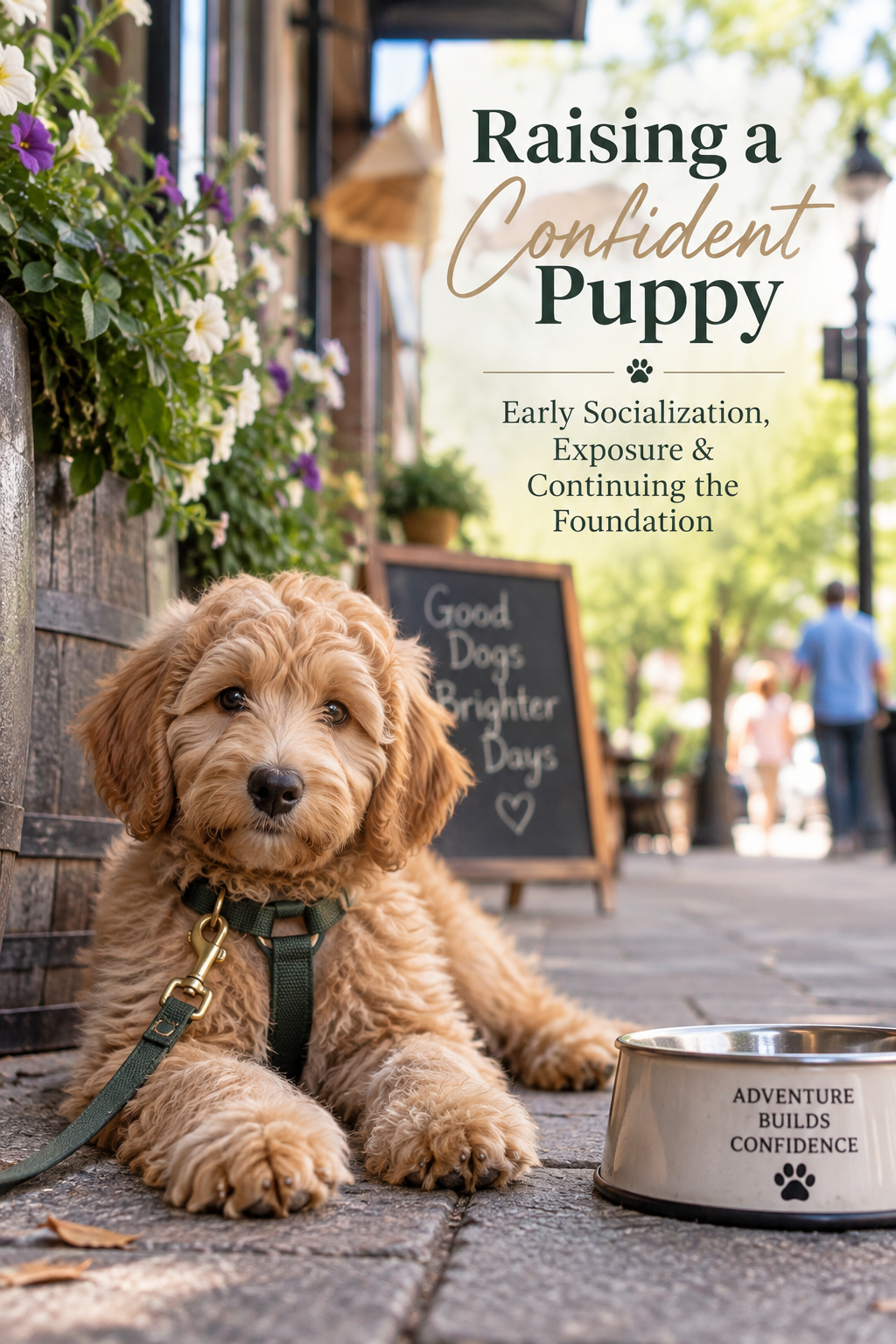
Raising a Confident Puppy
Early Socialization, Exposure & Continuing the Foundation
For the first eight weeks of your puppy's life, we have been intentionally introducing them to the world. Different surfaces, sounds, people, movement, handling, grooming, confinement, problem solving, frustration and new environments are all part of how we raise our puppies. These aren't random enrichment activities or things we do simply to keep puppies busy. They are part of a developmental curriculum, with experiences and challenges changing as the puppies grow.
You've already watched much of this happen. Through your litter's private Facebook group, we've shared photos and videos of what your puppies are doing, explained why we're doing it and shown you how they respond. By the time your puppy comes home, we've built the beginning of that foundation—but we haven't finished it. In fact, some of the most important developmental weeks are still ahead of you.
Now the curriculum passes to you. Your puppy doesn't need you to recreate everything we've done. They need you to continue making their world bigger, thoughtfully and safely, while they're still at an age when those experiences can have an enormous influence on how they approach the world later.
Socialization Is About More Than Being Social
The word socialization is a little misleading because people naturally assume it means meeting people and playing with other dogs. Those can certainly be part of a puppy's experiences, but they aren't the primary goal. When we talk about early socialization, we're really talking about exposure to the world your puppy will eventually be expected to live comfortably in.
Think about the adult dog you want. Maybe you picture a dog lying quietly beside you at an outdoor café, walking through a hardware store, traveling with the family, attending a child's soccer game or relaxing under the table while you visit friends. Perhaps you're raising a future therapy or service dog who will eventually need to work comfortably around elevators, wheelchairs, crowds, unusual sounds and people moving unpredictably. None of those skills suddenly appear when a dog reaches adulthood. The foundation begins now.
A shopping cart rattling across pavement is an experience. So is an automatic door opening, a toddler running past, someone using a walker, a motorcycle starting, walking across gravel, hearing a garbage truck, watching a dog from across a parking lot or encountering a person wearing a big hat. Your puppy doesn't need to interact with all of these things. In many cases, we specifically don't want them to interact. Learning to notice something and then continue about their business is incredibly valuable.
This is also why a well-socialized dog isn't necessarily the dog who desperately wants to greet every person and dog they see. For our companion puppies, and especially for puppies with service or therapy potential, neutrality matters. We want a dog who is comfortable with the world without believing the entire world exists for their entertainment.
Why These Early Weeks Matter
During early puppy development, the brain is rapidly collecting information about the environment. Puppies are learning what is ordinary, what deserves attention, what might be threatening and how to respond when something unexpected happens. Learning certainly doesn't stop at 16 weeks, and an older dog can absolutely develop new skills and confidence, but the early socialization period gives us a developmental opportunity we don't want to waste.
I like to think of it as building your puppy's reference library. A wheelchair becomes one reference. A screaming child becomes another. Slippery floors, automatic doors, livestock, umbrellas, thunder, traffic, stairs and people who look or move differently all add information to that library. We could never show an eight-week-old puppy every single thing they will encounter during their lifetime, and that isn't actually the goal.
What we're trying to develop is a puppy who has enough successful experiences with unfamiliar things that novelty itself isn't alarming. When something startles them, they learn that they can recover. When they aren't sure about something, they learn that they can investigate. When they encounter something completely new, their previous experiences have already taught them that unfamiliar doesn't automatically mean unsafe.
That is much closer to what we mean when we talk about building confidence.
Exposure Is Not the Same as Overwhelming Your Puppy
There is a temptation with early socialization to turn it into a checklist: meet ten people, visit five stores, walk on twelve surfaces and hear twenty sounds. But simply exposing a puppy to something doesn't automatically make that exposure beneficial. The experience your puppy has matters much more than how many boxes you can check.
If you take a puppy into a busy hardware store and they're overwhelmed by the carts, strangers, noises and movement, staying there longer doesn't necessarily teach them that hardware stores are safe. They may be learning the opposite. We want to give puppies challenges they can work through successfully, not put them into situations where they're simply trying to survive until we leave.
This is where you have to pay attention to the puppy in front of you. A puppy who can look around, take food, engage with you, investigate and recover after being startled is still able to learn. A puppy who freezes, continually tries to escape, refuses food they normally love or cannot recover may be telling you that you've asked for too much. That doesn't mean you avoid the experience forever. It may simply mean you need more distance, less intensity or a shorter visit.
Sometimes successful socialization looks like walking through the store. Sometimes it means sitting outside the entrance for five minutes and watching shopping carts go by. Both puppies learned something. We aren't measuring success by how far the puppy made it through the building; we're measuring it by what the puppy learned while they were there.
Your Puppy Isn't Fully Vaccinated Yet—So What Do You Do?
This is one of the most difficult parts of early puppy ownership because two important developmental needs overlap. Your puppy is still completing their vaccine series at the same time that their early socialization window makes thoughtful exposure especially valuable. Waiting until a puppy is fully vaccinated before allowing them to experience the world can mean losing weeks that we would much rather use productively.
That doesn't mean ignoring infectious-disease risk. It means being thoughtful about where your puppy goes and how they experience it. Your veterinarian is the right person to discuss the current disease risk in your area and any precautions that are particularly important where you live. From there, you can make choices that allow your puppy to experience the world without unnecessarily exposing them to heavily trafficked dog areas.
You can carry your puppy through a store or use a cart with a clean barrier underneath them. You can sit outside a coffee shop and watch people come and go, take a drive through town, visit a friend's home with healthy vaccinated dogs, watch a construction crew from a safe distance or sit together at school pickup. Your puppy can hear traffic, see bicycles, watch people using mobility devices, encounter children and experience dozens of sights and sounds without ever setting foot in a dog park or on the floor of a pet store.
This is also a good reminder that exposure doesn't require interaction. Your puppy can learn about another dog by watching one calmly from across a parking lot. They can learn about children without having six children crowd around them. They can learn about the grocery cart return while safely sitting in your arms. There are countless ways to make your puppy's world bigger while still making reasonable decisions about health and safety.
You Don't Need Everyone to Pet Your Puppy
One of the most common mistakes people make during socialization comes from very good intentions. Someone asks, "Can I pet your puppy?" and because we're trying to socialize the puppy, we automatically say yes.
But your puppy doesn't need to learn that every person they see is coming over to touch them. If every stranger becomes an exciting greeting opportunity, we can accidentally create a puppy who expects interaction whenever they see someone. A few months later, that can look like pulling toward strangers, jumping, whining or becoming frustrated when they're prevented from saying hello.
Instead, give your puppy experience with people who simply exist around them. Let someone walk past without stopping. Talk to the cashier while your puppy waits. Sit near a family without asking the children to pet the puppy. Walk past another dog and keep moving. Those experiences are socialization too, and they're incredibly important if your goal is an adult dog who can comfortably accompany you in public.
When you do allow greetings, they should be positive and appropriate for the individual puppy. A confident, highly social puppy may actually need more practice not greeting people, while a puppy who is initially unsure may benefit from being allowed to observe before choosing whether to approach. We aren't trying to make every puppy respond identically. We're helping each puppy develop the skills they need.
Socializing With Dogs Doesn't Mean Meeting Every Dog
The same principle applies to other dogs. Your puppy does not need to play with every dog they encounter to become good with dogs. In fact, learning to calmly exist around another dog without interacting is an important part of social development.
Choose your puppy's playmates thoughtfully. Healthy, appropriately vaccinated dogs that you know to have good social skills can provide wonderful experiences. A well-run puppy class can also provide controlled opportunities for learning around other puppies while beginning formal training. What we don't need is uncontrolled access to every unfamiliar dog simply because someone says their dog is friendly.
Dog parks aren't required for raising a well-socialized dog. Your puppy can develop excellent canine social skills through carefully chosen interactions while also learning that seeing another dog doesn't automatically mean playtime. Again, we're looking at the adult dog we eventually want and building those habits now.
What Should You Expose Your Puppy To?
You don't need a giant checklist hanging on your refrigerator, but it can help to think in categories so you don't accidentally give your puppy lots of experience in one area while missing another. Look for different people, places, sounds, surfaces, movement, objects, animals, handling and everyday situations.
People can include children, older adults, men, women, people with facial hair, people wearing hats or uniforms and people who move differently or use mobility equipment. Surfaces might include grass, concrete, gravel, wood, metal, carpet, tile, wet ground and uneven terrain. Sounds can come from appliances, traffic, construction, storms, children playing, household equipment and everyday life.
Think about movement too. Bicycles, skateboards, strollers, shopping carts, running children, flags blowing in the wind and automatic doors can look very different to a young puppy. Practice being in the car, being handled, having feet and ears touched, standing on a grooming surface and hearing clippers or a dryer at an appropriate distance. Visit different environments, from quiet neighborhoods to busier public spaces.
You don't need to accomplish all of this in a weekend. Variety over time is far more useful than trying to cram as much as possible into a puppy's day.
What If My Puppy Is Afraid?
At some point, your puppy is going to encounter something they aren't sure about. That is normal. Confidence does not mean never feeling uncertain, and our goal isn't to prevent a puppy from ever being startled.
If your puppy is worried, give them enough distance that they can think again. Let them observe. You can reward them for checking in with you, looking at the object calmly or choosing to investigate. Avoid dragging them toward something they are afraid of or surrounding them with it in an attempt to prove that it isn't scary. We want the puppy to discover that they can handle the situation, not learn that they have no choice.
Your response matters too. You don't need to make an enormous production every time something surprises your puppy. Be calm and matter-of-fact. Give them information and an opportunity to recover. If they need more distance, create it. If they're ready to investigate, let them. If today isn't the day, you can come back to it another time.
Sometimes the most valuable part of an exposure isn't that your puppy never reacted. It's that something surprised them, they processed it and then they recovered. Recovery is a skill, and puppies get better at it through experience.
Don't Forget to Teach Your Puppy How to Do Nothing
Families understandably focus on exposing puppies to activity, but one of the most valuable things you can teach a young dog is that sometimes absolutely nothing is happening—and they don't need to create entertainment.
Take your puppy somewhere and sit. Let them watch people walk by. Sit outside the hardware store instead of going inside. Have a conversation with a friend while your puppy hangs out beside you. Bring them to an outdoor café and spend part of the visit simply practicing being under the table. Let another dog exist nearby without arranging a greeting.
This is where early socialization begins to overlap with many of the other skills we'll teach throughout this puppy-raising guide. Don't Reward the Crazy, Sit on the Dog, impulse control and learning to settle all begin with the same basic idea: your puppy does not need to participate in everything happening around them.
For future service and therapy prospects, this is particularly important. A working dog may encounter hundreds of people, sounds, animals and distractions while being expected to remain focused and emotionally regulated. But it's just as valuable for a family companion. The dog you eventually want relaxing beside you at the café has to first learn that going to the café doesn't mean bouncing from person to person looking for attention.
Being comfortable in the world is important. Being comfortable while the world carries on around you is another skill entirely.
How Much Socialization Does Your Puppy Need?
You don't need three field trips a day, and more exposure isn't automatically better. Puppies need tremendous amounts of sleep, and an overtired puppy can quickly become a wild, bitey, seemingly unmanageable puppy. Socialization shouldn't come at the expense of rest or turn every day into a marathon.
Instead, look for small opportunities within your normal life. A five-minute stop somewhere new can be enough. Take the puppy along when you pick up coffee. Spend a few minutes outside the hardware store. Sit near a playground and watch from an appropriate distance. Let your puppy investigate the recycling bin that blew over in the driveway. Walk across a new surface or listen to a sound they haven't heard before.
Some days may include a bigger adventure. Other days, the new experience may happen in your own kitchen. What matters is that your puppy's world continues to expand without becoming overwhelming.
Pay attention to what your individual puppy needs, too. The puppy who wants to charge enthusiastically into every situation may need you to practice slowing down and observing. A more thoughtful puppy may need extra time to investigate before moving forward. Socialization isn't about turning every puppy into the same dog.
Continue the Foundation We Started
When your puppy leaves our home, you aren't starting from zero. We've spent the first eight weeks building a foundation, and you've been able to watch that process through your litter's private Facebook group. You've seen the new experiences, the problem solving, the sounds, the handling and the confidence work. You've watched us challenge the puppies and then give them opportunities to figure things out.
Now you get to make their world bigger.
The goal isn't to raise a puppy who has completed the longest socialization checklist. It's to raise a dog who has learned that they can encounter something unfamiliar, gather information, look to their person when they need help and recover when the world surprises them. We want them to learn that new experiences can be handled.
And socialization is only one part of that development. The same puppy who needs exposure also needs to learn how to engage with you, tolerate frustration, settle when nothing exciting is happening, spend time alone and understand how their behavior affects what happens next.
That's why this guide is part of our larger Continue the Foundation puppy-raising series. From here, we'll build on the same developmental curriculum with Puppy Training 101, The Power of Three: Hand Feeding, Sit on the Dog, Tether Training, Don't Reward the Crazy, Preventing Separation Anxiety, Potty Training and the other skills that help turn that eight-week-old foundation into the adult dog you're hoping to live with.
We started the work. We showed you how we did it. Now it's your turn to continue it.