
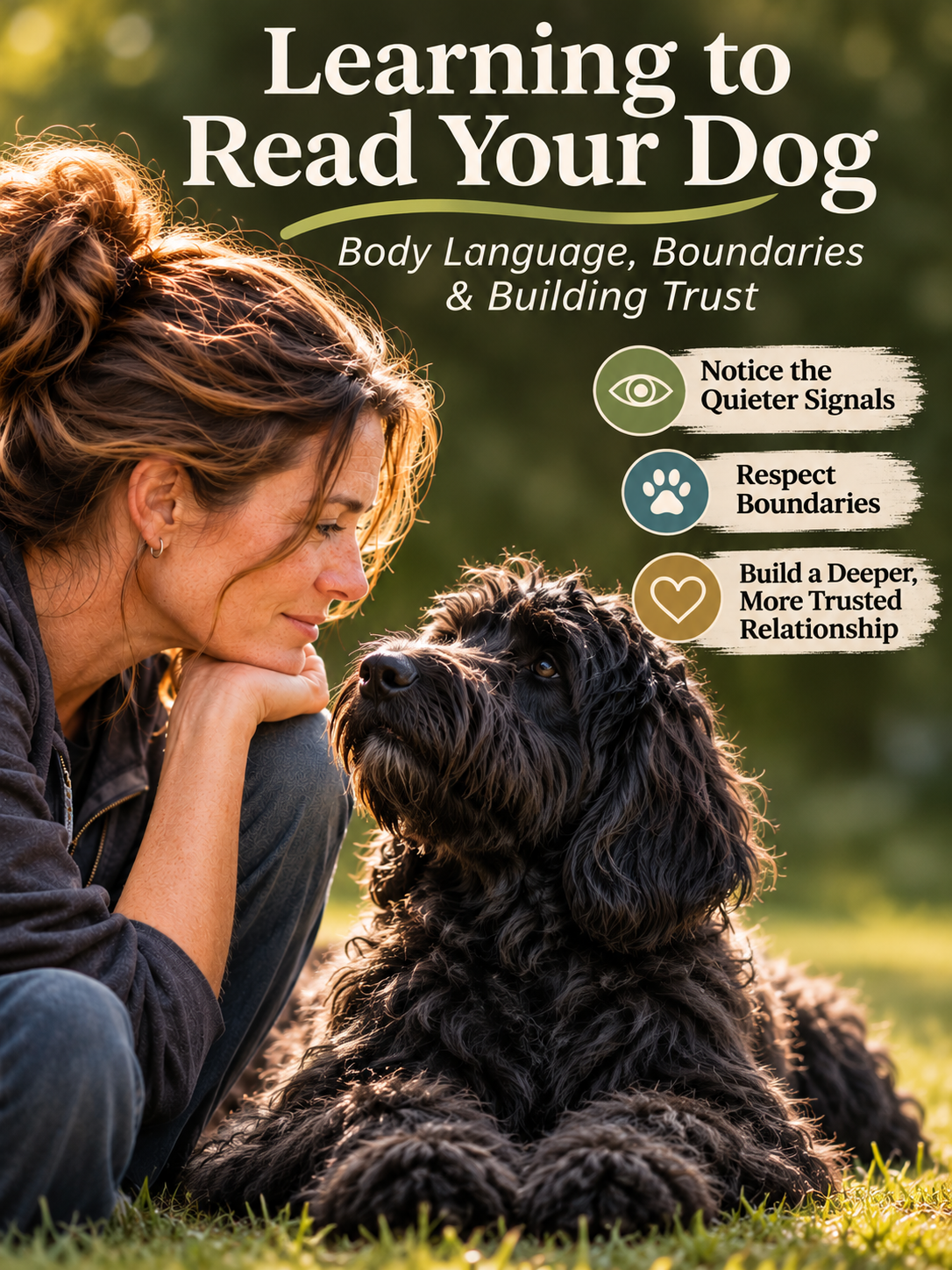
Learning to Read Your Dog: Body Language, Boundaries & Building Trust
Legendary Academy | Oregon's Legendary Goldendoodles
A Little Homework: Watch Your Puppy
Every Legendary puppy goes home with our Building Trust Through Respectful Handling guide, which illustrates some of the subtle ways puppies communicate discomfort, including turning away, avoiding eye contact, leaning away, becoming still, and hesitating before being picked up.
These aren't bad behaviors. They're opportunities to recognize what our puppies are communicating and adjust how we interact with them. But learning to recognize these signals doesn't stop after puppyhood. The same observational skills become increasingly valuable throughout your dog's life.
Start by watching your dog when they're comfortable. Notice how they carry their body, what their face looks like, and how they move. Then pay attention to what changes when they're excited, uncertain, frustrated, or uncomfortable.
The better you understand your dog's whispers, the less likely you are to miss what they're trying to tell you.
The relationship you've always wanted with your dog begins with learning to understand them
When we bring a puppy home, most of us have a picture of the relationship we're hoping to build. We imagine a loyal companion, a dog who understands us, trusts us, and becomes part of our everyday lives. Maybe we're even hoping for that once-in-a-lifetime heart dog—the one who seems to know what we're thinking before we say a word.
We spend an enormous amount of time teaching dogs our language. We teach them to sit, stay, come when called, walk politely on a leash, and follow the rules of our homes. We expect them to recognize our expectations, adapt to our routines, and navigate a world designed primarily for people.
But how much time do we spend learning their language?
Dogs are communicating with us constantly, often in ways so subtle that we don't recognize them. A glance, a change in posture, a quiet grumble, or a decision to walk away can tell us something about what they're experiencing. Sometimes those signals reveal discomfort or uncertainty. Other times, they tell us about excitement, curiosity, preferences, or the unique personality of the dog standing in front of us.
Learning to recognize that communication changes more than how we manage behavior. It changes the relationship itself.
1. Dogs Are Always Talking. Are You Listening?
One of the most fascinating things about living with multiple dogs is watching the conversations happening around us every day. A slight change in posture, a pause in movement, or a glance can change the direction of an interaction. After years of observing our dogs and their relationships, I've learned to recognize patterns and sometimes anticipate a problem before anything obvious happens.
One dog becomes a little too excited, another is no longer enjoying the attention, or a puppy ignores an older dog's request for space. It's almost like watching a conversation where you understand enough of the language to recognize when someone is getting annoyed.
Try Watching the Conversation
Imagine watching two people talking across a room. You can't hear what they're saying, but their facial expressions, gestures, and reactions give you clues about whether they're joking, disagreeing, or becoming frustrated. Now try watching two dogs the same way.
Notice how they approach each other, their posture, movement, and expressions. Does one dog turn away? Does the other respect that decision? Do they pause and voluntarily return to the interaction? Try imagining what they might be saying.
Perhaps an enthusiastic puppy is saying, "Come on! Let's play!" while an older dog responds, "Not interested." The puppy persists, the older dog turns away, and the puppy jumps on them again. Eventually, the older dog responds more firmly: "I said no."
Of course, we can't literally translate canine communication into sentences, but imagining the conversation helps us observe the entire interaction rather than focusing on one behavior. The most important part isn't simply what one dog communicates. It's whether the other dog recognizes and responds to it.
Try this exercise with familiar, compatible dogs in a safely supervised setting, or watch a video of dogs interacting. Watch it once to observe the overall exchange, then again to look for the smaller signals you missed. You may be surprised by how much was happening before anything obvious occurred.
Understanding these exchanges is particularly valuable during dog-to-dog interactions. We'll explore this further in our upcoming Legendary Academy article, When Dogs Play: Understanding Healthy Play, Social Boundaries & When to Step In (coming soon), including how to recognize when play is mutually enjoyable and when it's time for us to intervene.
2. Learning to Recognize the Whispers
Dogs don't always begin by growling, barking, or snapping. Often, their earliest communication is much quieter. I like to think of these early signals as whispers: a slight turn of the head, a change in posture, a moment of stillness, or an attempt to walk away. These subtle changes may be the first indications that a dog is uncomfortable, uncertain, overwhelmed, or simply asking for space.
What Do Those Whispers Look Like?
A relaxed, comfortable dog often has a loose body, soft eyes, relaxed facial muscles, and fluid movements. Their posture and expression give us a useful starting point for recognizing when something changes.
A dog asking for space may turn their head away, avoid eye contact, lean away from someone, or physically leave an interaction. These are especially important signals because the dog is attempting to disengage without confrontation.
A dog feeling uncertain or uncomfortable may lick their lips, yawn, lower their body, tuck their tail, or hold their ears back. These behaviors can have different meanings depending on the circumstances, but they're worth noticing when they appear during an uncomfortable interaction.
A dog becoming tense or overwhelmed may suddenly freeze, stiffen, stare intensely, or change how they carry their body or tail. These changes deserve attention, particularly when they occur alongside other signs of discomfort.
None of these signals tells the entire story on its own. A yawn may simply mean your dog is tired. A wagging tail doesn't automatically mean happiness, and raised hackles don't necessarily mean aggression. Breed differences matter, too. A naturally curled tail, floppy ears, or a face partially hidden by a long coat can make some signals harder to interpret.
Context matters. The entire dog matters. And knowing what's normal for your individual dog matters.

3. When the Whispers Go Unheard
Here's where understanding body language becomes more than an interesting skill. It becomes a responsibility.
We miss the whispers, but when the dog finally growls or snaps, we suddenly pay attention. And too often, we're angry. We reprimand the dog, punish the warning, or label them aggressive and unpredictable. In serious cases, dogs may be surrendered, rehomed, or even euthanized following an incident.
But what happened before that moment? More importantly, what has been happening for weeks, months, or even years leading up to it? Did the dog repeatedly try to walk away, communicate discomfort, or look to their person for help, only to discover that nothing changed?
Sometimes we proudly describe a dog as incredibly tolerant. They put up with children climbing on them, puppies constantly pestering them, or people handling them in ways they don't particularly enjoy. But there's a difference between a dog who is genuinely comfortable and one who has simply learned to tolerate discomfort.
Sometimes what we interpret as a dog's failure to behave appropriately began with a long history of our failure to recognize what they were communicating.
When Dogs Feel They Have to Handle Things Themselves
Imagine a dog resting on the couch while children begin climbing over it. The dog turns its head away, becomes still, or shifts position. Eventually, it gets up and leaves. That dog has made a reasonable decision. Rather than escalating the interaction, it has chosen to disengage.
But what happens if the children follow? What if this happens regularly, and the dog spends months being described as patient and wonderful with children, even though they've repeatedly communicated that certain interactions are uncomfortable?
Eventually, the dog may learn that creating distance doesn't work. One day, instead of getting up and walking away, the dog growls or snaps. To the family, it seems sudden. The dog has always been so tolerant, and they've never reacted like that before. But the problem may not have started that day. The whispers may have been there all along. We just weren't listening.
We expect dogs to tolerate uncomfortable interactions, yet when they finally communicate more forcefully, their behavior suddenly becomes unacceptable. We cannot expect dogs to respect boundaries if we aren't willing to establish and protect theirs.
It's our responsibility to supervise interactions, recognize when a dog needs space, and teach children to respect those boundaries. We shouldn't wait for the dog to establish them through growling or snapping.
What Happens to Trust?
When a dog repeatedly discovers that their attempts to avoid uncomfortable situations aren't respected, they may begin responding differently. They may become more defensive, react sooner, or stop attempting to disengage because experience has taught them that it doesn't accomplish anything.
A dog who once turned away, moved across the room, or looked to their person for help may eventually appear to go straight to a growl. Suddenly, we describe that dog as quick to react or unpredictable. But what if the dog has simply learned that whispering doesn't work?
This doesn't happen with every dog, and not every reaction is preceded by recognizable warnings. Pain, fear, startle responses, genetics, and previous experiences can all influence behavior. Even attentive owners cannot prevent every incident. But repeated experiences can shape how a dog responds to future situations, and rebuilding confidence and trust can take considerable time and careful work.
I want my dogs to learn that when something makes them uncomfortable, they can look to me for help. Almost as though they're asking, "Are you going to do something about this?" And I want them to trust that the answer is yes. Not because I'll remove every challenge or allow them to avoid every uncomfortable experience, but because I'll recognize when they need me to step in.
That's where advocacy begins, and it's one of the ways we build the relationship we're hoping to have.
4. Growling Is Communication: Whiskey Has Something to Say
If you've ever met Whiskey, you know he's a dog with plenty to say. He's an incredibly intelligent, high-drive Standard Poodle who communicates through huffs, grumbles, groans, sighs, and an entire vocabulary of sounds that I'm convinced only he fully understands. I often joke that he must have been a Husky in a past life. I'm also fairly certain he's given me an eye roll or two.
Whiskey is expressive in everything he does, and that's one of the reasons we have such a wonderful working relationship. He's easy for me to read, not simply because I can recognize when he's happy, frustrated, or uncomfortable, but because I've learned to understand his individual preferences, motivations, and reactions.
For example, Whiskey really doesn't like the odor of birch, one of the introductory odors used in scent work. He has tremendous drive and loves having a job, but that doesn't mean he enjoys every activity or every part of training. I've also watched how much he enjoys competition and how his enthusiasm and confidence can change when things don't go the way he'd hoped. I can't know exactly how he experiences disappointment, but I can recognize when an unsuccessful experience seems to discourage him.
Understanding those differences helps me make better decisions as his handler. I can recognize when he's enthusiastic, when he's simply going through the motions, when he needs encouragement, and when an activity isn't bringing out the best in him. Reading your dog goes far beyond identifying whether they're happy, sad, or angry. It's learning what makes them tick.
Sometimes a Grumble Is Just a Conversation
One of my favorite examples happens when Whiskey plays fetch with Jackson. Whiskey has tremendous drive, and retrieving the ball is only part of the excitement. Once he catches it, he likes to spend a little time celebrating his accomplishment, chomping on his ball and enjoying the moment. If Jackson reaches for it too soon, Whiskey sometimes gives him a little grumble that might as well mean, "Hang on, I'm not finished yet!"
Jackson knows Whiskey well enough to understand. He gives him another moment to enjoy his ball, and then they continue playing. There's no confrontation or conflict. It's simply two individuals who have learned to communicate with each other.
Dogs have a much broader vocal vocabulary than we sometimes give them credit for. Growling can be part of play, excitement, frustration, discomfort, or a request for space. Some dogs are naturally much more vocal than others, and the sound itself doesn't tell us whether a dog is happy, worried, or upset.
That's why body language and context matter so much. Whiskey's enthusiastic grumbling during a familiar game looks and sounds very different from a dog who becomes rigid, freezes, or growls because someone is making them uncomfortable. We need to consider the whole dog, not simply react to the noise.
When a Growl Really Is a Warning
Sometimes a growl is a genuine warning, and that's equally important to recognize. A dog may be asking someone to back away, stop touching them, or give them more space. When that happens, the growl is valuable information about how the dog is feeling.
Punishing the warning doesn't necessarily change the underlying discomfort. It may simply discourage the dog from expressing it. That's one reason we should be careful about reprimanding a dog for growling without first understanding the situation. If a dog is stiffening, threatening, or warning someone away, the immediate priority is to create space safely—not to test whether the dog will tolerate more.
Respecting that communication doesn't mean allowing inappropriate behavior or abandoning expectations. We can teach dogs to release objects, accept necessary handling, and respond appropriately to boundaries. We can also recognize when a situation needs to change, when a dog needs more training, or when we should intervene before frustration escalates.
What I appreciate about Whiskey is that he's comfortable expressing himself, and the people who know him have learned to listen. That understanding allows us to work together rather than constantly misunderstand each other.
The better we understand our dogs as individuals, the better we can communicate, train, advocate for them, and build a relationship that works for both of us.
5. Advocating for Your Dog: Building Trust Through Understanding
Learning to read your dog is only half the equation. The other half is what you do with that information. Recognizing that your dog is uncomfortable, overwhelmed, frustrated, or asking for help is valuable, but trust develops when your dog learns that you will respond.
I want my dogs to know they can depend on me. If another dog is being too pushy, a child isn't respecting their space, or an unfamiliar situation is becoming overwhelming, I want them to look to me rather than feel they have to handle everything themselves. That doesn't mean I'll immediately remove them from every situation, but it does mean I'll pay attention and make a thoughtful decision about what happens next.
Being Your Dog's Advocate Doesn't Mean Avoiding Every Challenge
There's an important distinction between respecting a dog's communication and allowing them to dictate every aspect of their life. Dogs still need boundaries, training, and experiences that may initially be uncomfortable. They need to learn how to cooperate with us, navigate unfamiliar situations, and develop the confidence to handle challenges.
My dogs still need baths, blow-drying, nail trims, veterinary examinations, and grooming. I can't promise they'll enjoy every part of those experiences, and I certainly can't allow them to refuse everything they don't like. But I can approach those situations with patience, preparation, and an understanding of what they're communicating.
If a puppy is nervous about having its feet handled, I can introduce the process gradually, reward cooperation, and give the puppy opportunities to relax rather than forcing a struggle every time. If a dog is overwhelmed by a new environment, I can adjust the difficulty, create some distance, or give them a moment to regroup before continuing.
The expectation doesn't necessarily change, but how we help the dog meet that expectation absolutely can.
Trust Is Built Through Everyday Experiences
We often think of trust as something that develops through affection, play, and positive experiences. Those things matter, but I believe trust is also built through the difficult moments. It's built when a puppy is uncertain and discovers that we'll guide them through the experience rather than overwhelm them. It's built when we recognize that a dog has reached their limit and adjust our expectations accordingly.
It's also built through consistency. Dogs need to understand our boundaries just as we need to recognize theirs. Clear expectations, predictable routines, and appropriate management help create a relationship where neither side is constantly guessing what will happen next.
This is closely connected to our philosophy that freedom is earned. We don't give puppies unlimited freedom and then punish them for making choices they weren't prepared to handle. We manage their environment, teach the skills they need, and gradually increase responsibility as they're ready. The same principle applies to communication: we shouldn't place dogs in situations beyond their ability to manage and then expect them to make perfect decisions.
You can learn more about establishing expectations, building good habits, and setting puppies up for success in our Puppy Training 101: Before You Start Training Your Puppy guide.
The Relationship Goes Both Ways
There's a difference between honoring what a dog communicates and allowing that communication to determine every outcome. Honoring the dog means recognizing the communication. Advocating for the dog means taking responsibility for what happens next.
Sometimes that means stepping in and protecting their space. Sometimes it means helping them work through something difficult. And sometimes it means recognizing that our expectations need to change because the individual dog in front of us isn't the dog we imagined we'd have.
I don't want a relationship where my dogs simply obey because they've learned they have no other choice. I want cooperation built on clear communication, reasonable expectations, and mutual trust. I want them to understand that I will provide guidance and boundaries, but that their communication matters, too.
A dog who trusts you doesn't have to love every decision you make. They need to know you're someone they can depend on, even when the answer isn't what they wanted.
6. Children, Dogs, and the Responsibility to Set Boundaries
One of the most important places we can apply everything we've discussed is in the relationship between dogs and children. We want our dogs to be patient, gentle, and forgiving, particularly with the youngest members of our families. But even the most tolerant dog has limits, and those limits deserve to be respected.
When we evaluate our puppies' temperaments, we look at qualities such as touch tolerance, resilience, and how readily they recover from uncomfortable experiences. These characteristics help us understand the individual puppy and make thoughtful placement decisions. But temperament exists on a continuum. A puppy who is exceptionally tolerant today isn't being given a lifetime assignment to tolerate whatever people do to them.
The Double Standard We Create
Think about how we respond when a young puppy pesters an adult dog. The puppy jumps on them, grabs at their ears, and repeatedly ignores attempts to disengage. If the adult dog eventually gives a brief, appropriate warning, we may recognize that the puppy needs to learn some manners.
Now imagine a child behaving similarly toward that same dog. The child climbs on them, grabs their face, or follows them when they try to leave. If the dog growls, our reaction is often very different. Suddenly, the dog is the problem, even though the dog may have been communicating discomfort long before that warning.
Of course, children and puppies aren't interchangeable. Children cannot be expected to interpret canine communication with an adult's judgment, and the consequences of a bite can be devastating. That's precisely why the responsibility belongs to us, not to the child or the dog.
Don't Make the Dog Set the Boundary
Children need to learn that dogs are living individuals, not toys. A dog who is sleeping, eating, chewing something, or resting in a quiet space should be allowed to do so without interruption. If a dog moves away, that decision should be respected rather than treated as an invitation to follow.
Our responsibility is to supervise, recognize the whispers, and intervene before the dog feels the need to communicate more forcefully. That might mean redirecting a child, separating the interaction, or providing a protected resting space where the dog knows they won't be disturbed. Young children should never be left unsupervised with dogs, regardless of the dog's temperament or history.
If a dog growls at a child, we need to take that communication seriously. Rather than punishing the warning, immediately create safe separation, determine what contributed to the interaction, and make changes to prevent it from happening again. Repeated warnings, snapping, or other concerning behavior warrant guidance from an appropriately qualified behavior professional and, when indicated, a veterinarian.
Teaching Respect Builds Trust on Both Sides
I want children to grow up loving dogs, but I also want them to understand that loving an animal includes respecting its boundaries. A dog shouldn't have to endure unwanted attention simply because a child means well, and a child shouldn't be put in a position where they're expected to recognize and respond to a dog's escalating discomfort on their own.
When we consistently protect those boundaries, we're teaching two valuable lessons. The child learns empathy, patience, and appropriate ways to interact with animals. The dog learns that their family will recognize when they need space and help keep interactions safe.
Our goal isn't to raise dogs who will tolerate absolutely anything. It's to create relationships where they rarely have to.
7. Honoring the Dog in Front of You
We all have an idea of the dog we hope to have. Maybe it's a confident adventure companion, a competitive sport dog, a social butterfly who loves everyone, or an easygoing family dog who happily joins us wherever we go. There's nothing wrong with having those dreams, but building a great relationship sometimes means recognizing that the dog in front of us has different ideas.
Dogs have individual personalities, preferences, motivations, strengths, and limitations. Some are naturally outgoing, while others are more reserved. Some thrive on challenging activities and constant engagement, while others are happiest with familiar routines and a quieter lifestyle. Even within the same litter, puppies can be remarkably different.
That's one reason temperament evaluation is such an important part of our puppy placement process. We look beyond appearance to better understand each puppy's individual characteristics and help families recognize what those differences may mean in everyday life. Our Temperament Testing guide explains the qualities we evaluate, what we're looking for, and how that information helps us make thoughtful matches between puppies and families.
Honoring your dog means getting to know the individual you actually have, rather than continually measuring them against the dog you imagined.
Just Because You Love It Doesn't Mean Your Dog Will
Whiskey is a perfect example of why we need to look beyond a dog's abilities when choosing activities. He's athletic, incredibly driven, and absolutely loves fetch. On paper, you might think he'd be a fantastic dock-diving dog. He has the enthusiasm, the retrieving drive, and the physical ability.
There's just one problem. Whiskey hates water play. His love of fetch isn't going to convince him to jump into a swimming pool, no matter how exciting that ball might be.
And that's perfectly fine. Whiskey has plenty of activities he genuinely enjoys, and understanding his preferences allows us to focus on experiences that bring out the best in him.
It's easy to assume that because a dog has the physical ability, intelligence, or drive for an activity, they should enjoy it. But dogs are individuals. A dog might love retrieving on land and dislike swimming, excel at certain scent-work challenges but dislike others, or have tremendous athletic ability without enjoying competitive sports.
We can help dogs develop confidence, learn new skills, and explore unfamiliar activities. Sometimes their interests grow with experience. But there's a difference between encouraging a dog to try something new and continually pushing them toward something they clearly don't enjoy.
Understanding What Your Dog Can Handle
Individual differences go beyond personality and preferences. A dog's ability to cope with a situation can change depending on their age, maturity, physical comfort, previous experiences, and what else has happened that day.
Think about how your own patience changes when you're exhausted, uncomfortable, stressed, or dealing with too many demands at once. Something you would normally handle without a second thought might suddenly feel overwhelming. Dogs experience changes in their capacity to cope, too.
A puppy who handled a busy outing beautifully yesterday may struggle with a similar experience today because they're overtired or overstimulated. A normally sociable dog may want more personal space when they're uncomfortable. A dog who suddenly resists handling they previously accepted may be experiencing pain or another health issue that deserves veterinary attention.
This is why knowing your dog's normal behavior is so valuable. When you understand their usual posture, enthusiasm, movement, and responses, you're better equipped to notice when something changes.
Realistic Expectations Are Part of Responsible Ownership
Honoring your dog doesn't mean making excuses for unwanted behavior. We still have a responsibility to teach appropriate manners, establish boundaries, and help our dogs develop the skills they need to live successfully in our homes and communities.
But expectations should be realistic for the individual dog, their developmental stage, and their current ability to cope. Sometimes the right response is more training. Sometimes it's better management, a slower introduction, or an opportunity to rest. And sometimes it means reconsidering whether the goal we're pursuing is genuinely appropriate for that dog.
For a deeper look at how age, development, and maturity influence what we can reasonably expect from a puppy, explore our Understanding Puppyhood: Realistic Expectations guide.
We shouldn't assume every challenge is something a dog must simply push through, but we also shouldn't assume every hesitation means they're incapable of learning. Our job is to recognize the difference and provide the guidance they need.
The Relationship Matters More Than the Expectation
One of the most rewarding parts of living and working with dogs is discovering what makes each of them unique. The more closely we observe, the more we recognize their individual personalities, preferences, and ways of communicating. That understanding helps us choose better activities, adjust our training, recognize when they need support, and appreciate the qualities that make them who they are.
Your dog doesn't need to be the most athletic, the most outgoing, the most obedient, or the most accomplished dog to be an extraordinary companion. They need opportunities to succeed, expectations they can reasonably meet, and a person willing to understand them.
Sometimes the relationship we've always wanted begins when we stop trying to create the dog we imagined and start appreciating the dog standing right in front of us.
8. Learning to Notice When Something Changes
One of the greatest benefits of learning to read your dog is that you begin recognizing things you might otherwise overlook. Once you're familiar with your dog's normal posture, expressions, movement, and personality, even small changes can tell you something important. You may notice that they're less enthusiastic about an activity they usually love, more hesitant around another dog, or unusually sensitive to handling.
These observations aren't limited to preventing unwanted behavior. They can help us recognize changes in confidence, comfort, motivation, and even physical health. A dog who suddenly avoids jumping into the car, hesitates on stairs, or becomes less tolerant of being touched may be experiencing discomfort rather than simply being stubborn. Changes in behavior deserve attention, particularly when they're sudden, persistent, or unusual for that individual dog.
Recognizing the Moment Before the Reaction
This awareness is especially valuable when we're out in the world with our dogs. Imagine walking down the street when another dog appears in the distance. Before your dog barks, lunges, or pulls toward it, you might notice a change in their posture. Their movement slows, their attention becomes fixed, or their body begins to stiffen.
Those early changes give you an opportunity to respond before the situation becomes more difficult. You might create additional distance, redirect their attention, or help them move past the distraction while they're still able to respond to you. The goal isn't to wait until your dog reacts and then correct the behavior. It's to recognize when they may be approaching the limits of what they can comfortably manage.
Of course, not every dog who becomes alert is about to react. Some are simply curious or excited. That's why understanding your individual dog matters more than memorizing a list of signals. Over time, you'll begin to recognize which changes are meaningful for your dog and which are simply part of their normal behavior.
A dog's ability to respond is also influenced by their level of arousal, stress, and emotional regulation. Our upcoming Legendary Academy article, Understanding Your Puppy's Nervous System (coming soon), will explore why a puppy who can manage a situation one day may struggle with it another day, and how we can help them develop the ability to cope.
The More You Observe, the More You'll Understand
You don't need to turn every interaction into a training exercise. Some of the most valuable learning happens when you simply watch your dog during everyday life. Notice how they greet familiar people, approach unfamiliar situations, respond to other dogs, and settle after excitement. Pay attention to what they enjoy, what they avoid, and how their behavior changes depending on the environment.
Watching videos of dogs interacting can also be an excellent learning opportunity. Try observing an interaction without sound, focusing on posture, movement, distance, and how each dog responds to the other. Watch the same video again and look for the smaller signals you missed the first time. Educational videos that explain canine body language can help develop these observational skills, particularly when they show the entire interaction rather than isolated expressions.
The more familiar you become with your dog's communication, the more naturally you'll begin responding to it. You'll recognize when they need encouragement, when they're becoming overwhelmed, when they're asking for space, and when something simply isn't quite right.
Learning to read your dog isn't about predicting every behavior or interpreting every movement perfectly. It's about paying enough attention that you recognize when something changes—and understanding when it's time to respond.
9. A Relationship Built on Understanding
Throughout this article, we've explored the many ways our dogs communicate, from the quietest changes in body language to their individual personalities, preferences, and boundaries. We've talked about recognizing when they need help, understanding when they're struggling, and learning to appreciate the dog standing in front of us.
But none of this is about becoming a perfect interpreter of canine behavior. We'll still misunderstand our dogs occasionally, just as they sometimes misunderstand us. What matters is making the effort to listen, paying attention to what we learn, and allowing that understanding to shape how we interact with them.
The relationship we dream of having with our dogs isn't built through obedience alone. It's built through countless everyday experiences in which they discover that we're paying attention, that our expectations are fair, and that they can depend on us for guidance and support. It's also built through the joy of discovering their personalities, sharing activities they genuinely enjoy, and learning how to work together.
When we make the effort to understand our dogs, we're doing more than preventing problems. We're giving them a voice in a relationship where we make most of the decisions.
We ask our dogs to spend their lives learning our language. Perhaps one of the greatest things we can do for them is make the effort to learn theirs.
Because the best relationships aren't built on one individual doing all the listening. They're built on understanding each other.
A Note About Our Educational Resources
The information shared through Legendary Academy reflects my hands-on experience raising, breeding, training, and living with dogs. I am not a certified dog trainer or animal behaviorist, and these articles are intended to help families better understand their dogs, not replace individualized professional guidance.
Every dog is different. If you're experiencing concerning behaviors, including growling, snapping, aggression, or significant fear, I encourage you to consult a qualified, reward-based training or behavior professional and your veterinarian when appropriate. Safety should always come first.