
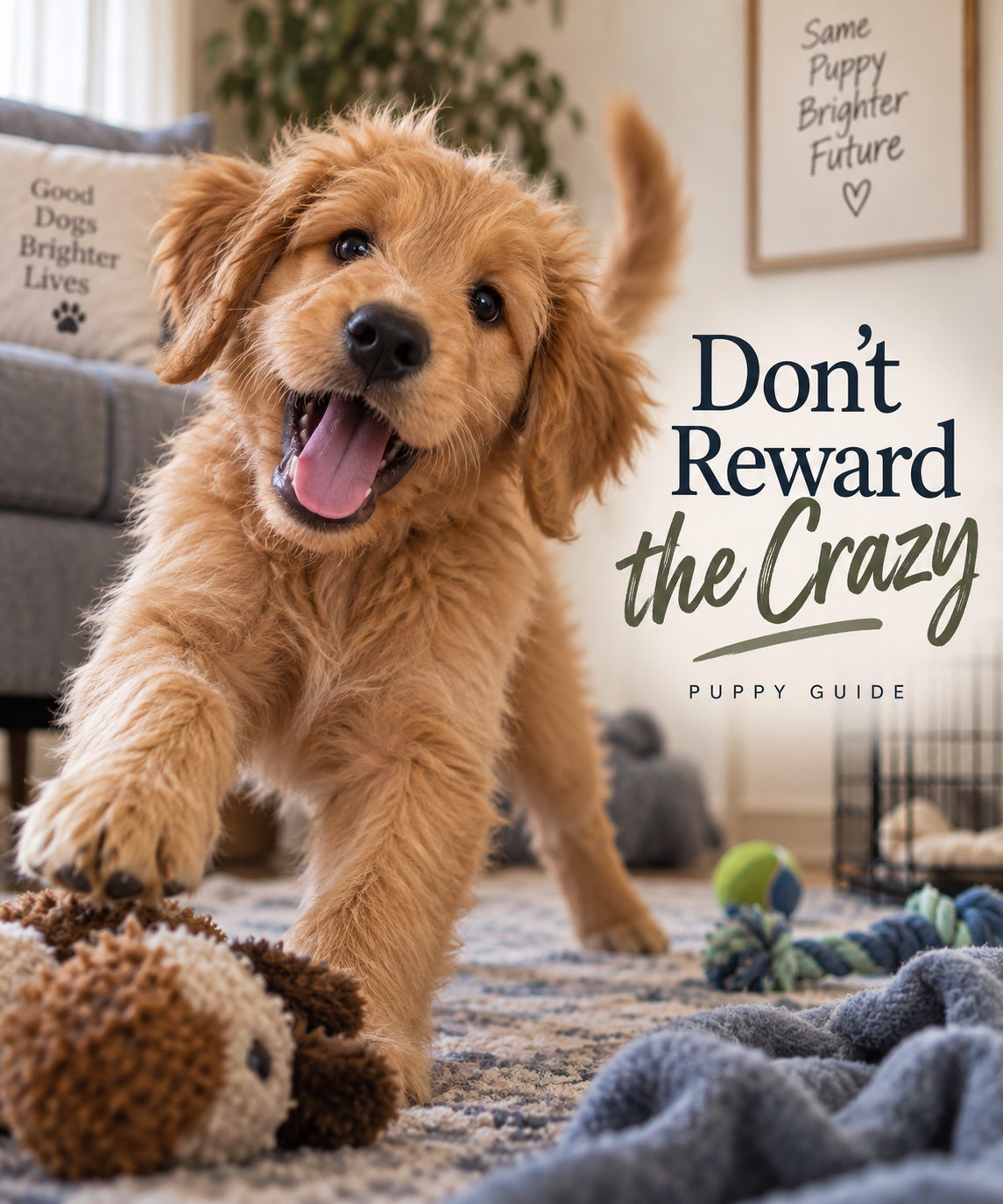
Don’t Reward the CRAZY!!
Crazy is funny. It can be entertaining. And when they’re tiny puppies, some of it is downright endearing. The puppy launching themselves at you when you walk through the door, barking because dinner isn't coming fast enough, climbing all over you because they want attention, or throwing a full-blown tantrum because you had the audacity to put them behind a gate can make you laugh.
The problem is that we aren't only raising the puppy who lives in our house today. We are shaping the dog we want to live with for the next 15 years.
A ten-pound puppy jumping against your legs might be adorable. A 70-pound adult dog doing the same thing to your grandmother isn't nearly as charming. The puppy barking at you because you stopped petting them can be funny. The adult dog who has learned to bark every time they want something can make living together exhausting.
Puppies don't simply grow out of behaviors because those behaviors stop being cute to us. They repeat the things that work.
And that is the foundation of this entire lesson:
Be careful what you teach your puppy works.
Your Puppy Is Always Learning
Training doesn't only happen when you have treats in your pocket and decide it's time to practice sit, down or come. Your puppy is learning all day long. They are learning what makes you look at them, what gets you to touch them, what makes doors open, what gets food delivered, what starts a game and what makes you get off the couch. They are constantly experimenting with their environment and discovering which behaviors produce results.
Sometimes we intentionally teach those lessons. A puppy sits, we reward them, and sitting becomes more valuable. But some of the strongest lessons we teach happen completely by accident. The puppy paws at your leg, so you pet them. They bark at you, so you talk to them. They jump up, so you reach down and touch them. They whine at the gate, so you walk over. They scream in the crate, so you open the door. They shove past you, and the outside door opens.
From our perspective, we may not have been training at all. From the puppy's perspective, the experiment worked, and behaviors that work are worth trying again.
You Are the Reward
When people hear the word reward, they usually think about food. Treats are certainly useful, but one of the most valuable rewards in your puppy's world is often you. Your attention has enormous value, and attention can mean looking at your puppy, talking to them, touching them, picking them up, playing with them or following them across the room.
The tricky part is that attention doesn't necessarily stop being rewarding simply because you're annoyed. You may think, I didn't reward him. I told him no. Your puppy may have learned, I barked, and Mom looked at me and talked to me. You may think you corrected your puppy for jumping because you said “off” and pushed them down. Your puppy may have experienced your eyes, your voice and both of your hands touching them. If the entire reason they jumped was to get you to engage with them, they may have gotten exactly what they wanted.
This doesn't mean we never interrupt inappropriate behavior or tell our puppies no. There are absolutely times when we need to step in. It means we need to recognize that good attention and bad attention can both still be attention. If your puppy's goal was to make you engage, a giant reaction from you may be much more rewarding than you realize.
How We Accidentally Teach Puppies to Turn Up the Volume
Imagine your puppy wants you to play. They walk over and look at you, but nothing happens. They paw at your leg, and nothing happens. Then they make a little noise and you look at them. Tomorrow, they try barking and you answer, “What?” Now they have discovered something useful. Barking gets a response.
Eventually, they may stop bothering with the quieter behaviors and go straight to barking because barking has a history of working. This is how a lot of what people later describe as demanding behavior develops. The puppy isn't plotting against you or trying to become the boss of the house. They have simply learned which button gets the fastest response.
This can also teach puppies to escalate. If a small behavior doesn't work but a bigger behavior does, they learn to make the behavior bigger. Bark louder, jump higher, paw harder or scream longer. When we finally respond because we can't take it anymore, we can accidentally teach the puppy that persistence works too. They don't learn that barking for thirty seconds didn't work; they may learn that barking for thirty-one seconds did.
Reward the Dog You Want
“Don't reward the crazy” doesn't mean spending your life ignoring your puppy. In fact, I want you to give your puppy a tremendous amount of attention. I just want you to become more intentional about when you give it.
When your puppy walks over and stands beside you with four feet on the floor, reach down and love on them. When they sit in front of you instead of jumping, give them your attention. When they lie quietly beside the couch while you're watching television, reach down and give them a scratch. When they wait for a moment instead of launching themselves through the doorway, let the door open. When they stop barking and look at you quietly, engage with them.
We tend to notice puppies when they're doing something wrong because crazy demands our attention. A puppy quietly lying on the floor doesn't interrupt our television show. A puppy sitting politely beside us doesn't make us stop what we're doing. Unfortunately, that means we can spend an enormous amount of time interacting with our puppies when they're behaving badly while completely overlooking them when they're doing exactly what we want.
Start noticing those moments. Your attention is valuable, so spend more of it on the behaviors you would like to see again.
At First, One Second Is Enough
Young puppies don't arrive with much impulse control, and we shouldn't expect them to. If an eight-week-old puppy has been bouncing against the crate door, you don't need to stand there waiting for five minutes of perfect calm before opening it. You might initially be looking for the single second when all four feet hit the floor. If they've been barking, you may be looking for the tiny pause when they stop to take a breath.
That moment is enough to begin teaching. As your puppy starts figuring out what makes the door open, what brings the food bowl down or what gets you to interact, you can gradually ask for a little more. One second of calm becomes two. Two becomes five. Eventually, what began as a tiny pause starts becoming a habit.
This is how self-control develops. We don't expect puppies to arrive with it, and we don't create it by demanding more than they're developmentally capable of giving us. We create thousands of small opportunities for them to practice making better choices.
Timing Matters
This is where our lesson about rewarding the action becomes especially important. Your puppy needs to connect the reward with what they were doing when the reward happened, which means a difference of only a second or two can completely change the lesson.
If your puppy is barking at the crate door and you open it while they're barking, barking helped open the door. If you wait for the pause and then open it, quiet helped open the door. If your puppy jumps on you and immediately receives attention, jumping worked. If your attention becomes available when their feet return to the floor, four feet on the floor worked.
Once your puppy is consistently offering the behavior, you can begin attaching language to it. This is the same principle we use throughout our training: first get the action, reward the action, and then give that action a name. Instead of spending puppyhood constantly telling them what not to do, we're building a vocabulary around the behaviors we actually want.
Use Everyday Life as the Reward
You don't need to walk around with a treat pouch all day to teach these lessons because your puppy wants things from you all day long. Meals, doors, toys, walks, affection, freedom, play and access to interesting things are all opportunities to reinforce behavior.
Meals are a great example. If your puppy is jumping, barking, pawing and spinning while you're lowering the bowl and you continue lowering it anyway, dinner can reinforce all of that behavior. Instead, let the food move according to what the puppy is doing. When the puppy settles, the bowl moves toward the floor. If they launch themselves at it, the bowl simply stops moving. When they settle again, it continues. You don't need a lecture, a battle or a ten-minute obedience exercise. The puppy begins discovering that their own behavior affects what happens next.
Doors work the same way. Outside is exciting. The backyard is exciting. Going for a walk is exciting. If throwing their body at the door consistently makes the door open, they have no reason to stop. Instead, the door can begin opening when they're under control. If they surge forward, it stops. When they settle, it moves again. Over time, the environment itself becomes part of the lesson.
Greetings Are Where We Really Struggle
Greetings can be one of the hardest places not to reward the crazy because people love excited puppies. You walk through the door and your puppy loses their mind because they're so happy to see you. They jump, wiggle, climb your legs and fling themselves at you, and it feels wonderful to be loved that much. We get excited too. We squeal their name, bend down, pet them and let them climb all over us.
Then six months later, we're trying to teach the same dog not to tackle people when they come through the front door. The puppy didn't suddenly develop a greeting problem. We may have spent six months practicing that greeting with them.
Your puppy can absolutely be excited to see you. We aren't trying to remove joy from greetings or turn them into a robot. We're teaching them how to access people while they're excited. If jumping makes your attention disappear while four feet on the floor makes you available, the puppy begins learning that keeping those feet down works better.
Be Careful With Demand Barking
Demand barking is another behavior humans are incredibly good at reinforcing because our natural reaction is to answer. The puppy barks, we say “What?” They bark again, we say “No.” They bark again, we tell them to stop. Pretty soon we're having an entire conversation with a dog who may have started barking specifically because they wanted us to engage.
Before reacting, consider what the puppy actually needs. Do they need to potty? Are they hungry? Are they overtired? Have they been confined too long? Are they frightened or uncomfortable? Or are they simply demanding your attention because demanding has worked before?
If their needs are met and the barking is specifically intended to make you engage, be thoughtful about when you make yourself available. You don't need to wait for five minutes of silence. Catch the pause and let quiet be the thing that brings your attention back.
Sometimes Crazy Means Your Puppy Has Had Enough
Before you decide your puppy is being wild, naughty or demanding, stop and look at the bigger picture. Sometimes what looks like “crazy” isn't a behavior problem at all. It is an overtired, overstimulated or overwhelmed puppy who no longer has the ability to regulate themselves.
Puppies can be a lot like overtired toddlers. They don't always recognize that they're exhausted and quietly put themselves to bed. Instead, they may get faster, louder and mouthier. They start grabbing clothes, biting hands, racing around the room, jumping, barking, ignoring things they knew perfectly well an hour ago, pestering the other dogs or seemingly bouncing from one bad decision to the next. Families often look at that puppy and think, Wow, you still have a ton of energy. We need to wear you out.
Sometimes that's exactly the wrong answer.
Another round of fetch, another walk, more wrestling or another exciting activity can push an already overstimulated puppy even further over threshold. What they may actually need is less: less noise, less activity, less access to the entire house and less interaction. They may need a potty break, a quiet space, something appropriate to chew and an opportunity to sleep.
This is particularly important after big puppy days. A training class, visitors in the house, a trip to the store, playing with another dog, a family gathering, the kids having friends over or even a day with lots of new sights and experiences can be mentally exhausting. Your puppy doesn't have to have spent hours running to be tired. Thinking, processing new information and navigating exciting environments take energy too.
Learning to recognize your own puppy's version of I've had enough is part of learning to live with them. For some puppies it looks like zoomies. For others it's biting, barking, inability to settle, pestering, frantic play or suddenly seeming to forget every bit of training you've done. Instead of automatically asking, How do I stop this behavior? first ask, Does this puppy need something from me, or does this puppy simply need help going to sleep?
This is also why “Don't Reward the Crazy” cannot mean “ignore every crazy puppy.” If your puppy is dysregulated because they're exhausted or overwhelmed, we're not trying to teach them a lesson by withholding ourselves. We're recognizing that they have reached the end of what they can handle and helping them come back down. Sometimes good puppy training looks less like asking for another behavior and more like recognizing that training is finished for the day.
Don't Confuse a Need With “Crazy”
Not every undesirable behavior should be ignored, and this distinction is extremely important. A puppy crying because they desperately need to potty isn't manipulating you. A frightened puppy needs support. A puppy who is completely overtired may be incapable of making good choices and need help settling. A puppy who has been crated for an unreasonable amount of time has a legitimate need, and a puppy struggling with something beyond their developmental ability doesn't need us standing there waiting for them to figure it out.
Part of raising a puppy is learning to read the puppy in front of you. We don't want families so worried about reinforcing bad behavior that they're afraid to comfort their puppy or meet a legitimate need. Instead of simply asking, Is my puppy doing something I don't like? ask yourself, Why is my puppy doing this, and what am I teaching them with my response?
Understanding the reason behind the behavior helps you decide whether this is a puppy who needs something from you or a puppy who has discovered an effective way to make something happen.
Excitement Isn't the Enemy
We like dogs with personality. We want puppies who play, explore, wrestle, run, chase toys, get excited about their people and occasionally tear through the house like their tail is on fire. Your puppy is allowed to be a puppy, and “Don't Reward the Crazy” should never be interpreted as “Don't Allow the Crazy.”
There are appropriate places for wild play and appropriate times to run, wrestle and be ridiculous. Part of raising a well-balanced dog is giving them healthy outlets for those behaviors. What we're also teaching is how to come back down. A dog who can become excited and then regulate themselves is very different from a dog who has practiced living in a constant state of escalation.
We aren't trying to remove the gas pedal. We're helping the puppy develop brakes. That ability to transition between activity and rest is one of the reasons exercises such as Sit on the Dog, structured play, crate training, hand feeding and intentionally rewarding calm behavior all fit together. These aren't unrelated training exercises. Together, they help teach a puppy how to function comfortably in a household.
Think About the Adult Dog
One of the easiest ways to decide whether something is worth encouraging is to remove the adorable puppy from the picture for a moment and imagine the adult dog. Would this still be cute at 40 pounds, 60 pounds or 80 pounds? Would you want your adult dog doing it to a child, an elderly family member, someone wearing nice clothes or a guest who doesn't particularly like dogs? Would you want them doing it every morning for the next 15 years?
If the answer is yes, enjoy it. There are plenty of silly behaviors that make our dogs uniquely ours and don't create any problem at all. But if the answer is no, puppyhood is the easiest time to begin shaping something different. That usually doesn't require harsh corrections or constant obedience drills. It means becoming much more conscious of what you're already reinforcing.
Everyone in the House Is Training the Puppy
Your puppy doesn't only learn from the person who attends training class. They learn from everybody. If one person requires four feet on the floor while another scoops the puppy into their arms every time they jump, the puppy quickly learns that jumping works with one person even if it doesn't work with the other.
The same is true for barking, crate behavior, door manners, begging and almost everything else. Dogs are remarkably good at figuring out which behaviors work with which people. That doesn't mean every member of the household needs to become a professional dog trainer. It does mean everyone should understand the basic behaviors you're trying to make valuable.
When the whole family starts asking, What do we want the puppy to do instead? training becomes much clearer. Then everyone can use the things the puppy already wants—attention, affection, food, play, doors and access to the world—to reinforce those choices.
Use Your Attention on Purpose
Over your dog's lifetime, you are going to give them an unbelievable number of things they value. You will feed thousands of meals, open thousands of doors, give thousands of scratches, throw thousands of toys, say their name thousands of times, invite them onto furniture, clip on leashes, open crates and welcome them home over and over again.
Every one of those things has value, which means you already have thousands of rewards available without ever reaching into a treat bag. The puppy who waits can get the door. The puppy with four feet on the floor can get your hands. The quiet puppy can get your voice. The puppy who settles can get invited closer. The puppy who checks in with you can get your engagement.
Over time, those little repetitions become habits. Your puppy begins learning that good choices make their world work, and perhaps most importantly, they learn that access to you doesn't require escalating into chaos.
Shape the Dog You Want to Live With
Your puppy isn't going to do this perfectly, and neither are you. You're going to laugh when you probably shouldn't. You're going to accidentally pet the jumping puppy. You're going to open the crate while they're making noise because you're running late and need to get out the door. Someone in your family is absolutely going to break the rules. None of that ruins your puppy.
Raising a puppy isn't about never making a mistake. It's about the patterns we create most often. The more often calm behavior works, the more likely your puppy is to offer calm behavior. The more often patience works, the more likely they are to try patience. The more often checking in with you works, the more valuable that behavior becomes. And the more often crazy gets them exactly what they wanted, the more crazy they're likely to offer.
So enjoy the puppy in front of you. Laugh at them, play with them and let them be silly. Take pictures of the ridiculous things they do because puppyhood goes unbelievably fast. Just remember that underneath all that puppy chaos, you are shaping the adult dog who will share your home for years to come. Enjoy the crazy, laugh at the crazy and take pictures of the crazy—just be careful not to reward it.