
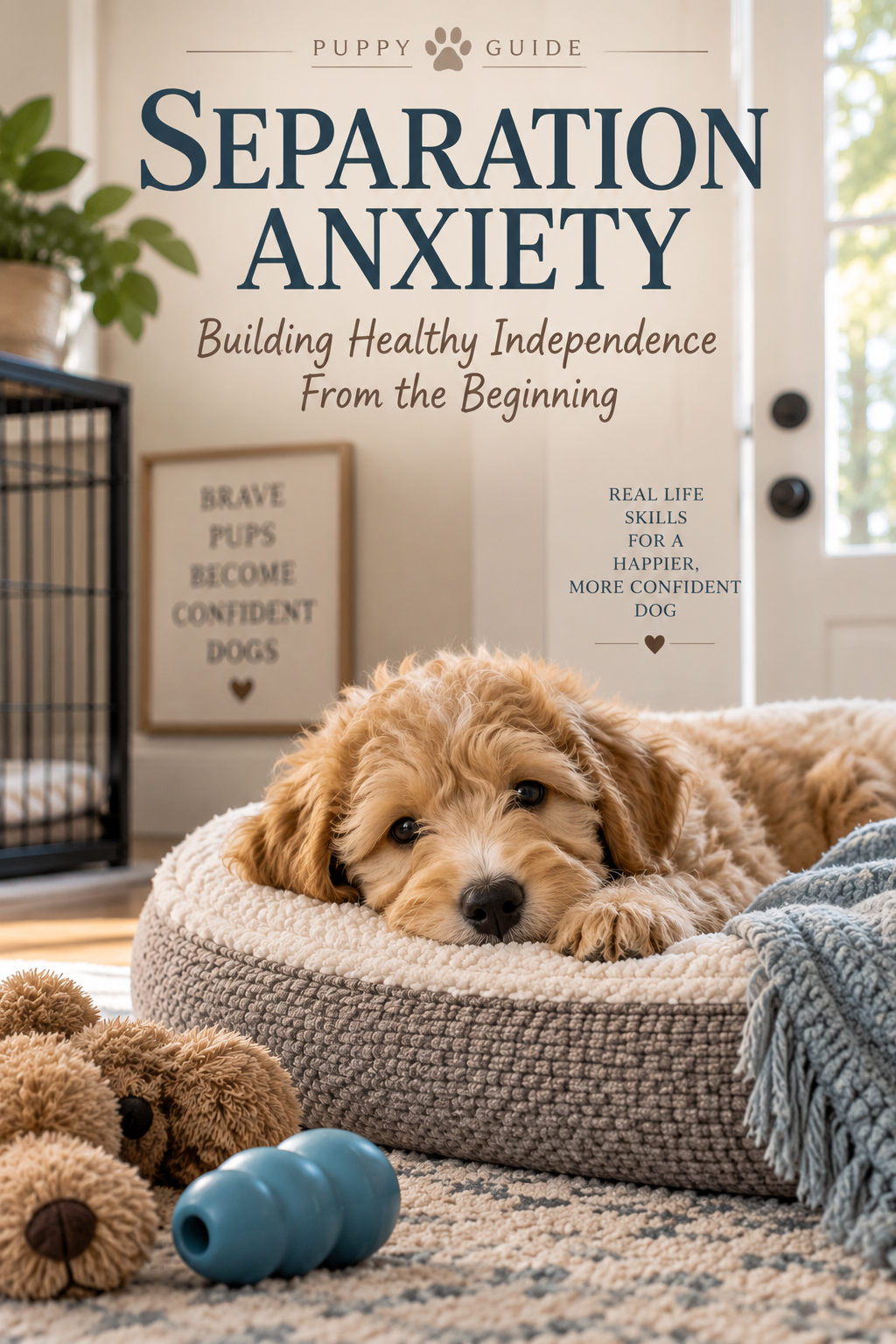
Separation Anxiety in Puppies: Prevention, Warning Signs & What It Might Be Instead
Separation anxiety is one of those phrases that gets used for almost any puppy who cries in a crate, barks behind a baby gate, follows their owner from room to room, or becomes upset when they are left out of something. Sometimes separation anxiety really is the problem. Very often, however, what we're seeing is normal puppy behavior, frustration, confinement distress, an overtired puppy, learned attention-seeking behavior, or simply a puppy who hasn't yet learned how to be alone.
That distinction matters because the way we respond should depend on why the puppy is struggling.
Our goal isn't to raise a puppy who doesn't care whether we're around. We want our dogs deeply bonded to us. We want them to trust us, enjoy being with us, seek affection, and look to us for guidance. At the same time, we want them to develop enough independence that our presence isn't required for them to feel safe.
A healthy relationship should teach both: I can depend on you, and I can also be okay without you.
Give Your Puppy a Realistic Picture of Life
One of the easiest mistakes to make when bringing home a puppy comes from the very best intentions. We clear our schedules. We take time off work. We spend every waking moment watching the puppy. We sit beside the crate while they fall asleep, carry them from room to room, let them nap on us, entertain them whenever they're awake, and respond immediately when they make a sound.
We are trying to help them feel safe.
But if that isn't what the puppy's life is actually going to look like, we may also be teaching something we never intended: you need a human with you in order to be okay.
Then two weeks later, real life starts again. Someone goes back to work. The kids return to school. We need to grocery shop. There is a doctor's appointment. The puppy can't come along. Suddenly we're asking the puppy to cope with something we have spent the previous two weeks preventing them from experiencing.
From the beginning, try to give your puppy a realistic picture of the life they will eventually be expected to live. That doesn't mean bringing an eight-week-old puppy home and immediately leaving them alone for eight hours. It means introducing normal independence in small, developmentally appropriate pieces.
If your adult dog will occasionally spend several hours home alone, begin teaching alone time. If you work from home but don't want a dog who must lie against your feet for eight hours, let your puppy sometimes nap in another room. If your dog will need to tolerate baby gates, crates, grooming appointments, boarding, pet sitters, or being cared for by another family member, those experiences shouldn't suddenly appear when the dog is a year old.
Puppyhood is practice for adulthood.
Attachment and Human Dependency Aren't the Same Thing
There is nothing wrong with having a dog who adores you. There is nothing wrong with cuddling your puppy, letting them sleep beside you, carrying them sometimes, or enjoying a puppy who follows you around the house.
Affection doesn't cause separation anxiety.
The problem comes when the puppy has very few opportunities to practice functioning without human involvement. If someone always helps them settle, always provides entertainment, always responds to vocalization, always solves frustration, and is almost always physically available, the puppy may begin relying on people to regulate themselves.
We sometimes see this in puppies who can't seem to settle unless they're touching someone, immediately follow whenever their person moves, continually solicit interaction, struggle to entertain themselves, or become increasingly frustrated whenever access to a person is interrupted.
That isn't automatically separation anxiety. It may simply be human dependency, and it's something we can unintentionally strengthen.
The answer isn't less love. The answer is affection plus independence. Snuggle your puppy. Play with them. Train them. Take them places. Let them sleep in your arms sometimes. And also let them take a nap without you, chew something independently, spend a few minutes behind a gate, remain home during a short errand, and discover that nothing terrible happens when you aren't available.
What Is Separation Anxiety?
True separation anxiety or separation-related distress involves more than a puppy simply preferring that you stay. The dog experiences significant distress associated with being separated from a particular person or being left alone.
Signs can include persistent vocalization, frantic escape attempts, destructive behavior concentrated around doors or windows, excessive drooling or panting, pacing, inability to settle, toileting despite otherwise appropriate house training, refusing food when alone, or behavior that escalates rather than gradually subsides.
Context is important. One behavior by itself doesn't diagnose separation anxiety. A puppy who barks for five minutes when you leave and then falls asleep isn't showing us the same thing as a dog who spends an hour pacing, panting, drooling, vocalizing, and attempting to escape.
Look at the entire pattern, not simply how loud the puppy is.
Things That Can Look Like Separation Anxiety
One reason separation anxiety gets overidentified is that puppies have plenty of reasons to object to being separated or confined. Some of them can be extremely dramatic, particularly in a young puppy who hasn't developed much frustration tolerance yet.
Barrier Frustration
Imagine putting your puppy behind a baby gate while you're standing six feet away. They can see you. They know exactly where they want to go. The only thing preventing them from getting there is that stupid gate.
Some puppies will bark, whine, paw, jump, bite the gate, or throw an impressive little fit. That can look alarming, but pay attention to what actually triggers the behavior. Is the puppy comfortable being away from you in other circumstances? Does the behavior happen primarily when they can see something they want but can't access it? Can they settle once the initial frustration passes?
The emotion here may be frustration rather than fear.
Learning to tolerate barriers is an important life skill. Gates, crates, doors, fences and leashes all occasionally tell a dog, “You cannot have access to that right now.” Puppies need opportunities to learn that being told not yet, not right now, stay here is something they can handle.
Waiting, tolerating frustration, settling, and learning that they don't always get immediate access to what they want are all forms of impulse control. Puppies aren't born knowing how to do those things. We have to give them opportunities to practice.
Confinement Distress
Some dogs aren't particularly bothered by being alone but strongly dislike being confined.
A puppy may scream when the crate door closes while being perfectly content alone in a puppy-proofed room. Another may tolerate an exercise pen but struggle in a crate. A puppy may even object to being crated while you're sitting three feet away.
That gives us valuable information. If the puppy is upset while you're still right there, your absence isn't necessarily the problem.
Confinement and separation are two different variables. Before deciding a puppy has separation anxiety, we need to understand which one is actually triggering the behavior.
FOMO and Puppy Protest
Sometimes the puppy simply wants to be where the action is.
You put the puppy in the pen while everyone eats dinner and suddenly there is barking. You contain them while another dog gets to go outside and they object. You walk through the baby gate without them and they make their displeasure known to the entire neighborhood.
Puppies can be extraordinarily dramatic about being excluded. That doesn't mean the emotion isn't real. Frustration is real. But frustration isn't the same thing as panic, and learning to tolerate small amounts of frustration is an important part of growing up.
An Overtired or Overstimulated Puppy
An exhausted puppy doesn't always look sleepy. Sometimes an exhausted puppy looks completely insane.
They bite harder, zoom faster, stop listening, bark, grab clothing, become increasingly frustrated, and fight settling even though sleep is exactly what they need. Put that puppy into a crate or pen and they may initially protest.
Before deciding your puppy cannot tolerate separation, look at what happened during the hour or two before the behavior began. Sometimes what appears to be anxiety is simply an overwhelmed, overstimulated puppy whose nervous system needs a break.
This is why learning to settle matters just as much as exercise and enrichment. We don't want to spend the entire day trying to physically exhaust a puppy. Puppies also need to learn how to come back down and, sometimes, how to simply do nothing.
An Unmet Need
A puppy who needs to potty shouldn't be expected to quietly remain in a crate. Neither should a puppy who is thirsty, uncomfortable, sick, frightened, or hasn't had appropriate physical and mental activity.
Before deciding a behavior is behavioral, make sure the puppy's basic needs have actually been met. That doesn't mean we respond to every complaint by immediately releasing the puppy. It means we know our puppy well enough to make an educated decision about what they're communicating.
Learned Demand Behavior
This is where our own behavior becomes important.
Puppies are constantly learning what works. If barking makes you look at them, barking worked. If whining makes you walk over to the pen, whining worked. If screaming makes the door open, screaming worked. Even saying, “You're okay! Shhh!” can provide exactly what the puppy wanted: your attention.
Remember, you are the reward. Attention doesn't have to be positive to reinforce behavior.
We talk much more about this in [Don't Reward the Crazy], because one of the easiest ways to accidentally create behaviors we don't want is to repeatedly reward them without realizing we're doing it.
This doesn't mean we should ignore every sound a puppy makes. It means we should pay attention to what we're teaching with our response. If every escalation causes the human to return, puppies can become very good at escalating.
Preventing Separation Problems Starts on Day One
Independence shouldn't suddenly become a lesson when maternity leave ends, vacation is over, or you have to return to the office. Start teaching it while you have the luxury of making the lesson easy.
Your puppy might chew something appropriate in the pen while you make coffee. They might nap while you shower. Walk outside to get the mail without taking them. Step behind a gate for a minute. Fold laundry in another room. Let them remain home during a short errand rather than automatically taking them everywhere simply because you can.
These little moments teach something incredibly valuable: people leave, people come back, and nothing bad happens in between.
We don't need to manufacture distress to teach independence. Repeatedly pushing a puppy far beyond what they can handle isn't helpful either. We want manageable experiences that allow the puppy to practice being successful. Over time, those experiences can become longer and more varied.
Practice Independence Even When You're Home
Teaching a puppy to be alone doesn't require you to leave the house every time. In fact, some of the most valuable independence practice happens while you're still home.
Put the puppy down for a nap somewhere other than beside you while you work. Use a baby gate while you cook dinner. Let them spend some time with an appropriate chew while you're moving around the house. Take a shower without bringing the puppy into the bathroom. Close your office door occasionally. Your puppy can know perfectly well that you're somewhere in the house without having unlimited access to you.
This is particularly important for people who work from home. Being physically available all day makes it very easy for a puppy to spend nearly every waking and sleeping moment beside you. Then the occasional day when you actually leave can be dramatically different from anything the puppy has practiced.
Sometimes the lesson is simply: You don't have access to me right now, and you can handle that.
It also makes barriers ordinary. A gate or closed door doesn't always mean you're leaving. Sometimes it simply means the puppy needs to remain on one side while you're on the other. That's a small but important opportunity to practice independence and frustration tolerance without actually being alone.
Don't Become the Only Person Your Puppy Needs
Independence also means being comfortable receiving care, comfort and guidance from someone other than one favorite person.
It is incredibly easy for one person to become the puppy's entire world, particularly when that person works from home, does most of the training, feeds every meal, takes the puppy outside, handles bedtime, goes to every class, and brings the puppy along on errands. Before long, nearly everything good in the puppy's life comes through one human.
Again, that relationship can feel wonderful. But we're trying to build a secure attachment, not a puppy who believes one specific person is required for life to function normally.
When possible, let other members of the household participate. Someone else can feed breakfast. Another person can take the puppy outside. Let your partner handle bedtime occasionally. Have someone else do a short training session or take the puppy on an appropriate outing without you.
If the puppy will eventually spend time with trusted family members, a sitter, groomer, trainer, or boarding facility, being comfortable functioning with other people is an important life skill. This doesn't weaken your bond. A secure relationship doesn't require exclusivity.
It also gives us useful information when evaluating possible separation anxiety. Is the dog comfortable as long as any person is present? Are they distressed whenever they're completely alone? Or are they specifically distressed when one particular person leaves even though other familiar people remain?
Those are different patterns.
Our Puppy Exposure & Development Curriculum is about much more than introducing puppies to different sounds and surfaces. We're building flexibility and confidence for the life those puppies will eventually be expected to navigate.
Don't Wait Until You Actually Have to Leave
The worst time to discover that your puppy has never learned to be alone is the morning you absolutely have to leave them.
Practice when you don't need to. That gives you the freedom to make an experience two minutes instead of two hours. Walk outside. Sit in the car for a minute. Go check the mail. Take one dog somewhere while the puppy stays home. Close your office door for a little while even though you could leave it open.
As your puppy demonstrates that they can handle those small separations, gradually ask for more. Sometimes you're behind a closed door. Sometimes you're outside. Sometimes the puppy is confined. Sometimes they're safely contained another way. Sometimes you're gone for two minutes and sometimes longer.
We don't want puppies memorizing one exact routine. We want them learning the broader lesson that separation is a normal, temporary part of life.
Don't Make Your Departure a Big Event
Your leaving shouldn't predict an emotional production. If every departure involves repeated hugs, apologies, excited goodbyes and “Mommy will be right back!” we can unintentionally make leaving feel significant. The same thing can happen when returning home becomes an enormous explosion of attention.
Coming and going should become a normal part of household life. You leave. You return. Sometimes the puppy comes with you. Sometimes they don't.
Normal is boring—and boring can be incredibly useful.
Don't Sneak Away Every Time
It can be tempting to wait until the puppy is asleep and quietly disappear because we don't want them to notice us leaving. Occasionally leaving while a puppy sleeps is perfectly normal, but we also want them to experience seeing us leave and discovering that they can handle it.
Practice ordinary departures. Pick up your keys. Put on your shoes. Walk outside. Come back. Let those cues become unremarkable rather than reliable predictors of a long, stressful absence.
Teach Your Puppy to Settle Without You
A puppy who only ever sleeps on your body doesn't get much practice falling asleep independently. That doesn't mean you can't have those wonderful puppy naps. Enjoy them. Just don't make them the puppy's only way of settling.
Settling is a skill. Doing nothing is a skill. Frustration tolerance is a skill. Independence is a skill. A puppy doesn't arrive knowing any of them.
Give your puppy opportunities to be near you without being entertained by you. Let them discover that you can work at your desk, watch television, talk to someone, cook dinner, or sit outside without constantly interacting with them. They don't need a toy thrown every time they're awake, a hand touching them every time they lie down, or a human solving every moment of boredom.
Learning how to do nothing is enormously valuable.
Should I Let My Puppy Cry?
This question needs more nuance than a simple yes or no.
A puppy complaining because they would rather be sitting on your lap isn't necessarily being harmed by experiencing a little frustration. If we immediately remove every barrier the moment a puppy protests, we can teach them that persistence makes barriers disappear.
But genuine panic is different.
A puppy whose behavior continues escalating, who cannot recover, who is frantically attempting escape, injuring themselves, heavily panting or drooling, or showing sustained distress isn't simply learning frustration tolerance. Continuing to push that puppy through an overwhelming experience can make the problem worse.
The goal isn't “never let your puppy cry,” and it isn't “let them cry it out.” The goal is learning to recognize the puppy in front of you and understand what the behavior is actually communicating.
Watch What Happens After You Leave
One of the best tools for understanding separation behavior is probably already in your pocket. Set up a camera.
Many owners know what their puppy does while they're putting on their shoes and what happens when they return home. They have absolutely no idea what happened during the 45 minutes in between.
Video can tell you whether your puppy barked twice and went to sleep, paced for ten minutes before settling, spent the entire absence watching the door, happily worked on a chew, or became increasingly distressed.
That information is much more useful than coming home to a barking puppy and assuming the puppy barked the entire time. It also gives you a baseline. Instead of relying on whether you feel like the puppy is getting better, you can actually see whether settling is becoming easier and faster over time.
Independence Is Not Rejection
Teaching independence doesn't mean withholding comfort. It doesn't mean refusing to bond with your puppy, ignoring genuine fear, or deliberately making them unhappy.
It means recognizing that one of the kindest things we can give a puppy is confidence in their own ability to cope.
We want our dogs to love being with us. We also want them capable of sleeping when we're gone, staying with someone else, being groomed without us standing beside them, resting behind a gate while company arrives, spending a few hours home alone, and handling the ordinary separations that happen throughout life.
A secure dog doesn't have to be attached to us every second to know we're still their safe place.
When Should You Be Concerned?
Occasional whining, barking, frustration, following you around, or protesting confinement can all be completely normal puppy behavior. What concerns us more is a persistent pattern of significant distress that isn't improving with appropriate practice.
Pay attention when a puppy cannot settle at all during absences, distress consistently escalates rather than decreases, escape attempts become frantic or dangerous, the puppy cannot eat when left alone, physical signs of severe stress appear, or your attempts at gradual independence aren't producing improvement.
Sudden changes also deserve attention. If a dog who previously stayed alone comfortably suddenly cannot, don't automatically assume it's a training problem. Pain, illness, environmental changes, frightening experiences and other factors can alter behavior.
For significant or worsening separation distress, involve your veterinarian and an appropriately qualified behavior professional. True separation anxiety isn't something we solve by simply letting a dog scream longer.
The Bigger Picture
When we bring home a puppy, it is natural to want to make everything easy for them. We want them to feel protected, loved and secure in their new family. But our job isn't only to make our puppy comfortable today. We're preparing them for the life they're actually going to live.
That means giving puppies a realistic picture of that life from the beginning. Sometimes we're available. Sometimes we're busy. Sometimes they come with us. Sometimes they stay home. Sometimes we cuddle on the couch. Sometimes they settle on their own. Sometimes a gate says no. Sometimes they have to wait. Sometimes they're frustrated, and they discover they can work through that feeling.
We aren't trying to raise a puppy who doesn't need us. We're trying to avoid teaching a puppy that they cannot function without us.
Through all of those experiences, the puppy learns something much more valuable than simply how to tolerate being alone: My people are safe. They come back. And even when they aren't here, I know how to be okay.