
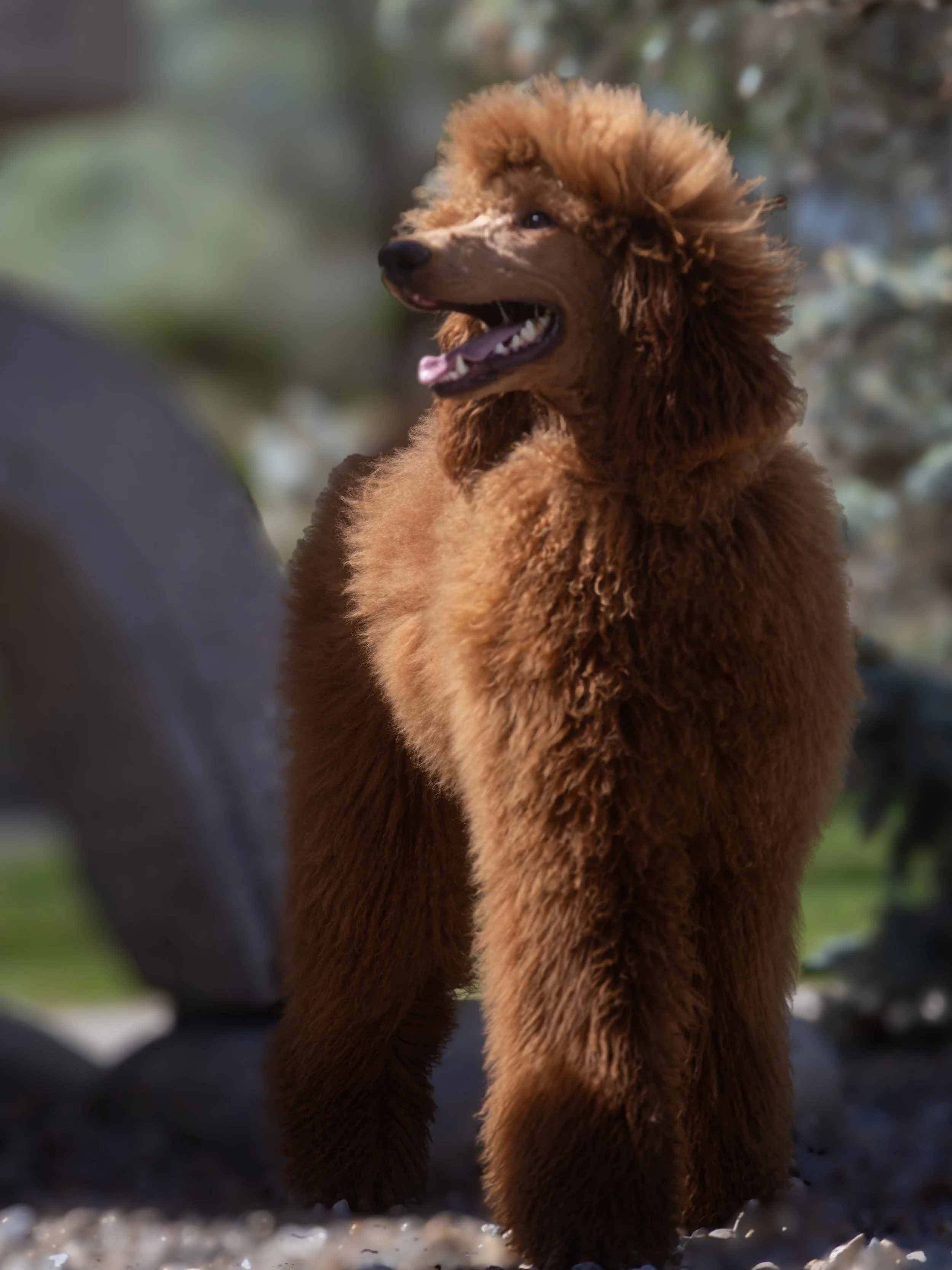
About the Poodle
The Poodle You Think You Know May Not Be the Poodle at All
One of the things we hear surprisingly often is, “I don't think I've ever met a Poodle.”
Sometimes they have, but they didn't recognize one. Other times, their entire picture of the breed comes from the little Poodle their grandmother had decades ago, a dog they remember from television, or the beautifully sculpted dogs they have seen in a show ring.
They picture bows, bracelets, elaborate haircuts and a somewhat fancy dog that would prefer not to get its feet dirty.
They don't picture a gun dog.
They don't picture a Poodle crashing into cold water after a retrieve, hiking through the woods, working in a field, competing in performance sports or spending the day doing a job alongside its person. They may not picture a serious service dog prospect, an athletic family companion or a dog with enough drive and stamina to work for hours.
But that dog is very much a Poodle.
Underneath the coat is an athletic, intelligent working breed with a history as a water retriever. The fancy haircut didn't create the Poodle. In some ways, it has hidden the dog underneath it from generations of people who have never had the opportunity to really know the breed.
Poodles can be silly. They can be muddy. They can be remarkably athletic. They can have substantial retrieving and prey drive. They can be soft and deeply connected to their people, or bold, busy and intensely motivated to work. They are often extremely trainable, but they are also clever enough to notice every inconsistency in your training.
There can also be tremendous variation within the breed. A Poodle bred from generations of hunting dogs may be very different from the Poodle your grandmother owned. A high-drive performance dog may be very different from a dog intentionally bred with service work in mind. One family of Poodles may consistently produce moderate dogs with an easy off-switch, while another produces dogs that want to be moving, thinking and working.
Understanding the Poodle requires more than reading a list of breed characteristics. You need to understand what the breed was created to do, what a particular breeder is breeding for today, and what the dogs behind your puppy are actually like.
That is the Poodle we want to introduce you to.
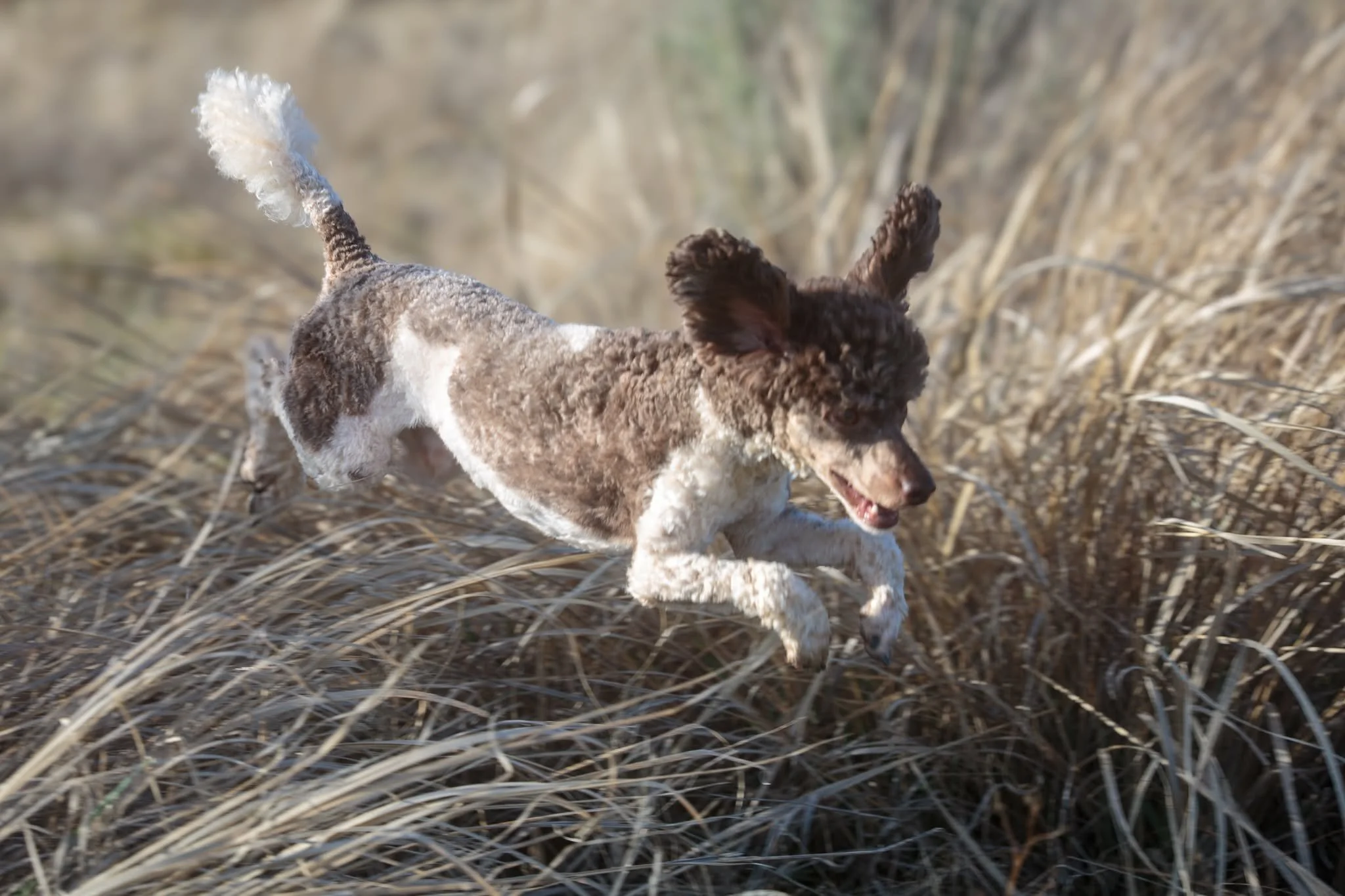
The Poodle Was Bred to Work
The Poodle's appearance can make its history easy to overlook. This is a breed with roots as a water retriever—a dog developed to work with people, enter the water, retrieve game and have the athleticism and stamina necessary to do it repeatedly.
That working heritage helps explain much of what we still see in Poodles today: intelligence, athleticism, retrieving instinct, trainability, awareness of their handler and an ability to excel at an enormous variety of jobs.
A well-built Poodle isn't a fragile dog wrapped in an extravagant coat. Underneath all that hair is an athlete.
That doesn't mean every modern Poodle has the same drive, energy or working ability. Generations of selective breeding have created different lines within the breed, and those differences can dramatically affect the dog you eventually live with.
Purpose-Bred Poodles: What Was This Dog Bred to Do?
One of the most important things prospective Poodle owners can understand is that not every Poodle is being bred toward the same goal.
There are breeders preserving and developing hunting ability, breeders producing dogs for performance sports, breeders concentrating heavily on conformation, breeders selecting dogs with traits useful for service work, and programs where several of those goals overlap.
You tend to get what you breed for.
A Poodle from hunting lines may have considerable energy, drive and stamina. A dog expected to spend hours working in the field needs persistence, athletic ability and the desire to keep going. Strong retrieving instinct, prey drive, environmental confidence and enthusiasm for work can all be valuable traits in that setting. They may also be far more dog than someone expecting a quiet companion anticipated.
Performance lines may emphasize athleticism, speed, motivation, engagement and the desire to work. Those traits can produce exciting obedience, rally, agility, scent work and other performance dogs, but they can also produce dogs that need owners who genuinely enjoy training and giving their dog something productive to do.
Service-oriented breeding may put greater selection pressure on different qualities: nerve strength, recovery, human focus, environmental stability, trainability, appropriate energy and the ability to work when asked but settle when nothing is happening.
Conformation-focused programs select heavily for adherence to the breed standard, including structure, movement and breed type. Those things matter, too. Structure affects how comfortably a dog can use its body over a lifetime, and evaluating dogs against the breed standard gives a breeder another source of information.
These categories aren't mutually exclusive. A beautiful show dog can also be an accomplished performance dog. A hunting Poodle can have a wonderful family temperament. A service prospect can come from dogs with conformation and performance accomplishments.
The point isn't that one type is better. Purpose changes what breeders select for, and selection changes what they produce.
A Pedigree Doesn't Tell You What the Dogs Were Like to Live With
A pedigree gives you names, ancestry and documented accomplishments. Those accomplishments can provide valuable information about the dogs behind a puppy. What a pedigree cannot tell you is what those dogs were actually like to live with.
It doesn't tell you that one family of dogs tends to have tremendous stamina while another tends to produce a naturally easy off-switch. It doesn't tell you that a particular line tends to be exceptionally handler-focused, somewhat independent, environmentally sensitive, socially outgoing or highly prey driven.
The breeder has to tell you that.
A breeder should know more than the registered names in a pedigree. They should be able to tell you what their dogs are like, what they know about the dogs behind them, which traits consistently appear through the generations, what each parent contributes and why they chose those two dogs for one another.
When you choose a Poodle, you aren't simply choosing a breed, size or color. You're choosing generations of breeding decisions.
What Is a Poodle's Temperament Really Like?
There isn't one temperament that describes every Poodle. There are characteristics we commonly associate with the breed, but those give us a starting point—not a description of every individual dog.
Poodles tend to be intelligent, observant and very aware of what is happening around them. Many are strongly people-oriented and want to participate in whatever their family is doing. They often learn household routines incredibly quickly, sometimes faster than their humans realize they are teaching them.
They can also be wonderfully silly. Poodles frequently have a playful, almost ridiculous side that surprises people expecting a serious or dignified dog. They can be incredibly capable one moment and completely absurd the next.
Within those broad breed traits, however, we see meaningful differences in energy, confidence, nerve strength, human focus, assertiveness, independence, sensitivity, prey drive, motivation, intensity, sociability and ability to settle.
Even littermates raised in the same environment can approach the world very differently. One puppy may walk into a new environment ready to investigate everything while another prefers to observe first. One may desperately want human interaction while another is more independent. One may have tremendous toy and prey drive while another has very little. One may recover instantly when startled while another needs more time to process what happened.
A tenderhearted, sensitive puppy isn't inherently better or worse than a bold, assertive one. A highly social dog isn't automatically better than a more neutral dog. A puppy with enormous drive isn't superior to one with moderate motivation.
Those traits tell us who the dog is and what kind of life may suit it best.
That is why we lean heavily on temperament when helping families choose a puppy. Breed gives us a framework. Genetics and lines help us predict tendencies. The individual puppy tells us much more about the dog that particular family may actually be living with.
Poodle Intelligence: Smart Enough to Keep You on Your Toes
Poodles have a reputation for being exceptionally intelligent, and that reputation is well earned. They tend to learn quickly, recognize patterns, solve problems and pay close attention to what works.
That can make them incredibly enjoyable to train.
It can also mean they outsmart their people.
A Poodle doesn't only learn the behaviors you intentionally teach. They learn your routines, your inconsistencies and exactly what they can get away with. If barking makes you get up, barking worked. If refusing to come inside earns another ten minutes of chasing them around the yard, they may decide that is a much better game. If nudging your hand eventually convinces you to continue petting them, they have successfully trained you.
Give an intelligent dog inconsistent boundaries and it can become surprisingly good at running the household.
That doesn't mean Poodles need harsh handling. They don't. It means they benefit from clear expectations, consistency and humans who understand that attention itself can be a reward. What seems funny or harmless in a puppy can become a firmly established behavior in an adult dog because the puppy was smart enough to notice that it worked.
Their intelligence also doesn't mean every Poodle is equally easy to train. Motivation, human focus, confidence, independence, sensitivity, frustration tolerance and drive all affect how a dog approaches learning. One Poodle may be intensely handler-focused and eager to repeat a task with you. Another may be highly intelligent but more independent and constantly asking, “What's in it for me?”
Smart is only one piece of temperament.
Puppy Training 101 · Don't Reward the Crazy · Teach Calmness & Impulse Control (coming soon)
What Is It Like to Live With a Poodle?
For many people, this is where the breed really shines. Poodles often want to be involved in their person's life. They notice where you are, what you're doing and whether something interesting might be about to happen. Many happily move between being an active partner outside the house and a companion inside it.
But the dog we want to live with isn't simply a dog capable of doing a lot. We also value the dog capable of doing nothing.
An off-switch matters.
We don't believe every intelligent dog needs to be entertained from morning until night. Constantly providing activity can create a dog that never learns how to handle inactivity. Exercise and enrichment are important, but so are naps, boredom, independence and learning that sometimes the humans are busy.
A Poodle can absolutely be an active dog without running the household. Some of that balance comes from genetics, and some of it is taught.
The Best Poodle Is the One That Fits Your Life
There is no universally perfect Poodle temperament because families aren't all asking a dog to live the same life.
A high-drive, energetic Poodle with tremendous motivation and stamina may be exactly what a performance home has been searching for. Put that same dog into a quiet household wanting an easygoing companion, and everyone may struggle.
A highly social dog may be wonderful for therapy work or a busy family that wants a dog delighted to greet visitors. Someone training a service dog may want considerably more neutrality around strangers. A softer, sensitive dog can be deeply connected and wonderfully responsive to a thoughtful handler, while a confident, assertive puppy may thrive with someone who enjoys that personality and provides consistent boundaries.
This is why we don't believe puppy placement should be reduced to color, sex or which puppy runs into someone's lap first.
When we evaluate puppies, we look at traits such as confidence, nerve strength, energy, motivation, human focus, assertiveness, sensitivity, touch tolerance, prey drive and intensity. Then we consider what the family is actually asking that dog to do.
A home with toddlers is different from a retired couple. A first-time dog owner is different from an experienced performance handler. A family wanting a weekend hiking companion is different from someone pursuing competitive dog sports. A service prospect may need a different combination of traits from a therapy dog, and both may need something different from a family companion.
The useful question isn't simply, “Is this a nice puppy?”
It is, “Is this puppy's temperament a good match for this particular life?”
Are Poodles Good Family Dogs?
Poodles can be wonderful family companions because they tend to be interactive, trainable and interested in their people. Many enjoy being included in everyday life rather than simply existing alongside the family.
But “good family dog” is an enormous category.
A couple wanting a hiking companion has different needs from a family with four young children. A quiet retired household may want something very different from a home full of teenagers, dogs, friends and constant activity.
For some families, a confident, social and energetic Poodle may be ideal. Another household may be much happier with a moderate dog that has a strong off-switch and asks for less activity.
The goal isn't simply to find a nice Poodle. It is to find the right Poodle for that particular home.
Are Poodles Good With Children?
Many Poodles genuinely enjoy children and thrive in family environments, but liking children isn't the only thing we consider when evaluating a puppy for a home with kids.
A very energetic, physically intense puppy may overwhelm a toddler even though the puppy absolutely adores children. A softer puppy may find a loud, fast-moving household difficult. A confident puppy with good recovery may handle the unpredictability of family life beautifully.
The children matter, too. Dogs and children both need boundaries. Puppies need somewhere they can sleep without being followed. Children shouldn't be climbing on dogs, taking things from them or treating them like toys. Adults need to supervise interactions rather than expecting either the child or puppy to make good decisions all the time.
When we're helping a family choose a puppy, we're not simply checking a box marked good with kids. We're considering what that puppy is actually like and what life in that particular family will ask of it.
Hiking, Camping, Swimming and Adventures With a Poodle
Poodles are often a wonderful surprise for people who want an outdoor companion.
Standards in particular can have substantial athletic ability and stamina, but Miniatures and Toys can also be remarkably athletic for their size. Depending on the individual dog and its conditioning, Poodles can make excellent hiking, camping, swimming and travel companions.
Remember where the breed came from. Getting dirty is not a violation of the Poodle code of conduct.
The bigger consideration is choosing a dog whose energy matches your actual lifestyle rather than the lifestyle you imagine having. There is an important difference between a dog that can hike ten miles and a dog that needs ten miles before it can live peacefully in your house.
We value dogs that can participate in an active life while still being able to settle when the adventure is over.
Are Poodles Good Service Dogs?
Poodles, particularly Standard Poodles, can be excellent candidates for service work. Their intelligence, trainability, athleticism, handler awareness and low-shedding coat make the breed attractive to many handlers.
But being a Poodle does not make a dog a service dog.
Service work asks an extraordinary amount of an animal. A dog may need to navigate crowds, unfamiliar buildings, unusual surfaces, loud noises, travel, medical environments and long stretches of apparent inactivity while remaining focused and emotionally stable.
That requires far more than obedience.
When evaluating potential service prospects, we may be looking at confidence, nerve strength, recovery, environmental stability, human focus, motivation, resilience, touch tolerance, energy, intensity and the ability to settle. The specific work expected of the dog matters, too, and structure and health can become especially important when a dog will be performing physically demanding tasks.
Even in a carefully planned breeding, we do not expect every puppy to be appropriate for service work. A puppy can be an exceptional dog and still be the wrong temperament for that particular job.
We evaluate the individual puppy, not simply the breed on its registration papers.
What About Therapy Dogs?
Service work and therapy work are often grouped together, but they ask different things from a dog.
A therapy dog generally needs to be comfortable engaging with unfamiliar people and able to remain relaxed around unusual movements, sounds, equipment and handling. In many therapy environments, genuinely enjoying attention from strangers is a valuable trait.
A service dog, in contrast, is working for its handler. Being extremely social with every stranger it encounters isn't necessarily desirable.
A dog can be highly intelligent, wonderfully trained and deeply bonded to its owner without enjoying strangers enough to be a therapy dog. Another may think every person it meets is its newest best friend but lack other qualities necessary for service work.
Neither dog has failed. The job needs to fit the dog.
Poodles in Dog Sports
Poodles are remarkably versatile performance dogs. Depending on the individual, they can participate in obedience, rally, scent work, agility, retrieving, hunting, dock sports, tracking, conformation and many other activities.
We believe there is value in doing things with breeding dogs beyond simply breeding them.
Training and competition put dogs into situations daily life may not. We get to see how they learn, how they respond when something is difficult, how motivated they are to work with us, how they recover from surprises and how they behave in unfamiliar environments.
Titles aren't the entirety of a dog, but accomplishments can give us additional pieces of information.
Our own dogs participate in training, conformation and performance activities because we enjoy doing things with them, but also because every experience gives us another opportunity to understand the dogs we're making breeding decisions with.
Are Poodles High-Energy or High-Strung?
This is one of those questions where the most accurate answer is: it depends on the Poodle.
Some are naturally moderate and remarkably easy to live with. Some are busy, intense and driven. Some are softer and more environmentally sensitive. Others seem nearly unflappable. Some want to retrieve everything you throw until your arm falls off. Others are perfectly happy after a few repetitions.
Genetics matter. Lines matter. Breeding priorities matter. Early development, training and lifestyle matter.
Rather than simply asking a breeder whether their Poodles are “calm,” ask what their adult dogs are actually like in the house. How much exercise do they need? Do they settle easily? What kind of drive do they have? How sensitive are they? How do they handle frustration? How quickly do they recover when something surprises them? What kind of prey drive do they commonly see? Are their dogs highly social with strangers, more neutral or somewhere in between?
Most importantly, ask:
“What do you consistently see in your lines?”
A breeder who truly knows their dogs should be able to answer that.
Genetics Give Us a Starting Point, Not a Guarantee
Knowing the lines matters because generations of selection influence what breeders are likely to produce. The parents matter. Their relatives matter. Temperament matters. Early development matters.
But puppies aren't carbon copies of their parents.
A thoughtfully planned breeding gives us probabilities, not identical puppies.
Before puppies are born, we use what we know about the parents and their families to make educated predictions about a litter. As the puppies grow, we get to know the individuals.
That is why knowing the lines and evaluating the individual dog work together. We aren't trying to determine which puppy has the “best” temperament. We're trying to understand which temperament is best suited to which home.
Poodle Coat and Grooming
Of course, eventually we have to talk about the hair.
The Poodle's coat is one of the breed's defining features. It is continuously growing and generally low shedding, but that comes with a tradeoff: grooming.
Poodles require lifelong coat maintenance. Depending on the length and style you keep, that means brushing, bathing, clipping and regular professional grooming or learning to maintain the coat yourself.
A Poodle does not have to walk around in a show coat. Active family dogs can be kept in short, practical clips that make hiking, swimming and everyday life considerably easier.
And while Poodles are frequently sought by people concerned about allergies, no dog should be presented as universally hypoallergenic. Individual people can react differently to individual dogs.
Poodle Coat & Grooming (Coming Soon)
Poodle Sizes—and Some Confusing Terminology
Size is another area where families encounter a lot of confusing information.
Depending on where you live and which registry or breeding community you're talking about, you may encounter Toy, Miniature and Standard Poodles as well as terms such as Moyen, Klein and Royal.
Those words don't all mean the same thing, and they aren't all recognized as separate varieties by every registry.
Because there is considerably more to explain—including European size terminology and what breeders mean when they advertise a “Royal” Poodle—we cover Poodle sizing separately rather than trying to squeeze it into a paragraph here.
Poodle Sizes — Toy, Miniature, Moyen, Standard & Royal Explained (Coming Soon)
Poodle Health: There Is More to It Than a DNA Panel
Poodles can be healthy, long-lived dogs, but no breed is free from health concerns.
Responsible breeding means understanding the conditions relevant to the breed and size variety, completing appropriate health testing and using those results when making breeding decisions. It also means paying attention to what is actually occurring within your lines.
Health testing is not simply ordering a DNA panel and receiving a page full of “clear” results. Orthopedic evaluations, eye examinations and other screening may be appropriate depending on the variety. There are also issues breeders need to watch that aren't neatly solved by a single genetic test.
Things such as ear problems, dental development and narrow base canines can occur in Poodles, along with more significant inherited health concerns. A breeder should know what they are looking for, recognize problems when they occur and use that information when making future breeding decisions.
Responsible breeding doesn't mean claiming we can eliminate every health problem from living animals. It means collecting information, being honest about it and using it to make better decisions.
Poodle Health, Health Testing & Common Conditions (Coming Soon)
What About Merle Poodles?
Merle Poodles generate a tremendous amount of discussion, and the subject deserves more than a few sentences on a general breed page.
The questions surrounding merle involve genetics, breed history, health, testing and responsible breeding. They also frequently become tangled with assumptions about temperament and quality that should be examined separately.
We have an entire educational page dedicated to the subject so families can understand the genetics and the controversy rather than simply being told that merle is either “good” or “bad.”
Merle Poodles — Genetics, Temperament, Health & Responsible Breeding
Is a Poodle Right for You?
A Poodle may be an excellent fit if you want an intelligent, trainable, interactive dog and enjoy having a dog that is genuinely part of your life. Depending on the individual dog, Poodles can be family companions, hiking partners, sporting dogs, therapy dogs, service dogs, hunting dogs and couch companions—sometimes several of those things in the same dog.
But they aren't maintenance-free.
Their coats require lifelong grooming. Their intelligence requires thoughtful training and consistent boundaries. Some lines have substantial energy and drive. Some dogs are sensitive. Some are intense. Some are highly social. Others are more independent.
And a wonderful Poodle whose temperament is poorly matched to your household can still be the wrong Poodle for you.
So when you're looking for a puppy, don't stop at asking:
“Is a Poodle right for me?”
Ask what the breeder is breeding for. Ask about the dogs behind the puppies. Ask what the parents are like when nothing is happening. Ask about energy, drive, sensitivity, confidence, assertiveness, prey drive and off-switches. Ask why the breeder chose that particular pairing and what they expect it to produce.
And don't be afraid to ask the simplest question of all:
“What are your Poodles actually like to live with?”
That answer may tell you more than almost anything else.
Meet Our Poodles
Our breeding decisions begin with the dogs themselves: their health, structure, temperament, accomplishments, strengths and weaknesses, and what we know about the dogs behind them.
We health test. We train. We show. We participate in classes and performance activities. Most importantly, we live with our dogs.
We know who wants to work all day and who would rather curl up beside us. We know who walks into a new environment as though they own it, who needs a moment to take things in, who is intensely motivated to work and who is happiest simply being someone's companion.
Every dog teaches us something, and every generation gives us more information to use when planning the next.
Our goal isn't simply to produce Poodles. It is to understand the Poodles we're producing, preserve what makes this breed extraordinary, and help each puppy find the life where its individual temperament can thrive.
Frequently Asked Questions About Poodles
-
Yes, Poodles can be excellent family dogs, but the individual dog's temperament matters. Energy, confidence, sensitivity, assertiveness, sociability and ability to settle can vary considerably between Poodles. The best family Poodle isn't simply the friendliest puppy—it is the puppy whose temperament fits the people, children, activity level and expectations of that particular household.
-
Many Poodles are wonderful with children. We look beyond whether a puppy simply “likes kids,” though. A very energetic or physically intense puppy may adore children but overwhelm a toddler, while a sensitive puppy may struggle in a loud, chaotic household. Matching the individual puppy to the ages and personalities of the children matters.
-
Yes. The Poodle has a history as a water retriever, and hunting Poodles still work today. Their working heritage helps explain the breed's athleticism, retrieving ability, intelligence and trainability. However, modern Poodle lines are bred toward different purposes, so not every Poodle will have the drive, stamina or retrieving instinct of a dog from dedicated hunting lines.
-
Some are; some are quite moderate. A Poodle from hunting or high-drive performance lines may have considerably more energy and stamina than one produced from lines selected for a different purpose. Ask the breeder what their adult dogs are actually like in the house, how easily they settle and what they consistently see in their lines.
-
Poodles tend to learn very quickly, but intelligent doesn't necessarily mean effortless. They are also smart enough to recognize patterns, exploit inconsistent boundaries and figure out what gets them what they want. Clear communication, consistency and appropriate reinforcement are important. A clever Poodle can learn to train its humans surprisingly quickly.
-
Many do, but the strength of that natural off-switch varies by dog and by line. We value dogs that can participate enthusiastically in activities and then settle when nothing is happening. Calmness is also a skill that should be reinforced rather than expecting a puppy to develop it entirely on its own.
-
Sex alone tells us far less about whether a puppy will fit a particular family than the puppy's individual temperament. We would rather match a family based on traits such as energy, confidence, sensitivity, human focus, assertiveness, drive and ability to settle than assume a male or female will behave a certain way simply because of sex.
-
Look beyond color, size and availability. Ask what the breeder is breeding for, what their adult dogs are actually like to live with, what temperament traits consistently occur in their lines, why they chose a particular pairing, what health testing they complete and how they evaluate puppies for different homes.
A breeder who knows their lines should be able to tell you much more than what the puppies are expected to look like.
-
They can be excellent outdoor companions. Poodles are athletic dogs, and many enjoy hiking, swimming, camping and other adventures. The individual dog's size, conditioning, energy and temperament should match the activity. There is also an important difference between a dog capable of hiking all day and one that requires hours of exercise before it can settle at home.
-
Some Poodles can make excellent service dogs, particularly Standards, but breed alone cannot predict service suitability. Successful service work requires the right combination of health, structure, confidence, nerve strength, recovery, environmental stability, human focus, motivation and ability to settle. Not every Poodle—and not every puppy in a service-oriented breeding—will be appropriate for service work.
-
The right Poodle can be an excellent therapy dog. Therapy work generally benefits from a dog that genuinely enjoys interacting with unfamiliar people and remains comfortable with unusual environments, movement, sounds and handling. Those traits aren't identical to what we look for in a service dog, which is why the individual dog's temperament matters.
-
No dog is universally hypoallergenic. Poodles generally shed very little compared with many breeds, which can make them easier for some people with allergies to live with, but individuals can still react to a Poodle. Their low-shedding coat also requires regular lifelong grooming.
-
That shouldn't be treated as a universal Poodle trait. Poodles vary substantially in sensitivity, confidence, energy, intensity and environmental stability. Genetics, the lines behind the dog, early development and training all matter. This is one reason it is important to ask a breeder about the temperaments they consistently produce rather than relying on stereotypes about the breed.
-
The difference is primarily what breeders have been selecting for over generations. Hunting programs may prioritize drive, stamina, retrieving ability and persistence. Performance programs may emphasize motivation, athleticism and engagement. Conformation programs select for structure, movement and breed type. Service-oriented programs may place greater emphasis on traits such as nerve strength, environmental stability, handler focus and an off-switch. These purposes can overlap, and none of the labels tells you everything about an individual dog.
-
Not completely. A pedigree can tell you ancestry, registered names and documented accomplishments, but it cannot tell you everything those dogs were like to live with. The breeder should be able to explain the temperaments behind the pedigree, the tendencies they see within their lines and what they expect a particular pairing to produce.
-
No. Poodles benefit from training, exercise and appropriate enrichment, but they also need to learn how to be bored, relax and do nothing. Constantly entertaining an intelligent puppy can inadvertently teach it to expect continual stimulation. Developing independence and an off-switch is an important part of raising a Poodle.