
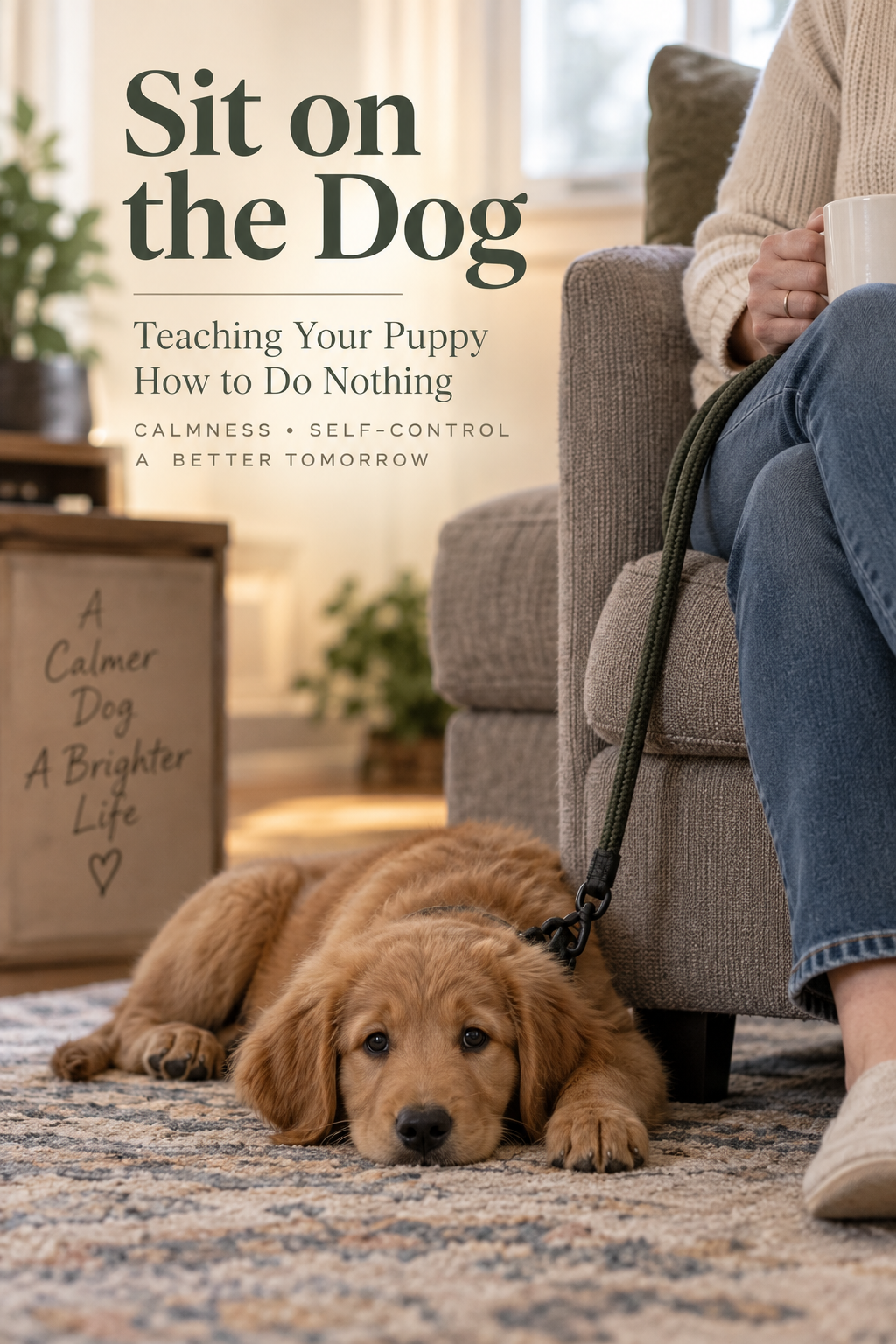
Sit on the Dog:
Teaching Your Puppy How to Do Nothing
When people bring home a puppy, one of the first questions they ask is, “What should I teach my puppy first?” Most people immediately think of commands: sit, down, come, maybe shake. There is nothing wrong with teaching those things, but they aren't our first priority. In our house, we spend much more time teaching puppies self-control, calmness, boundaries, manners, frustration tolerance, and how to settle. Those skills aren't as impressive when someone asks what tricks your puppy knows, but they are the skills that make a dog enjoyable to live with for the next 12–15 years.
One of the things people often don't realize is that doing nothing has to be taught. A puppy doesn't automatically know how to lie quietly at your feet while you eat dinner. They don't automatically know how to watch another dog walk past without needing to investigate, or that when you're working at your desk their job isn't to bring you a toy every 45 seconds. They don't know how to hear “not right now” and simply settle. Calmness and impulse control are learned skills, and one of our favorite ways to begin teaching them is an incredibly simple exercise called Sit on the Dog.
No, You Don't Actually Sit on Your Dog
Sit on the Dog is an exercise we learned through Jeanette Forrey and the 4E Kennels training program. Her podcasts and training program have heavily influenced how we raise and live with our own dogs, and this is one of the videos we share with our puppy families. In our private litter Facebook groups, we begin giving families “homework” before their puppies ever come home. We don't want you picking up an eight-week-old puppy and then wondering what you're supposed to do with them. We want you learning while we're still doing the puppy raising.
Sit on the Dog is part of that homework because it teaches one of the core foundation skills we want every puppy to develop: self-control. We encourage our families to watch Jeanette's full lesson because she does an excellent job teaching the mechanics of the exercise. Here, we're going to talk about why we believe it matters so much and how this deceptively simple exercise affects so many other parts of life with your dog.
You Can't Teach an Out-of-Control Puppy
Any good training session begins with self-control. It doesn't matter whether you're eventually trying to teach heel, recall, place, scent work, retrieving, service tasks, conformation skills, or a silly party trick. Your puppy's brain has to be available to learn. A puppy who is completely overstimulated, frustrated, frantic, or unable to control an impulse isn't in a particularly useful state for learning something new.
Before we worry about getting the perfect sit, we want to begin teaching the puppy how to regulate themselves enough to listen, think, and make choices. That's one reason our priorities may look a little different from what new puppy owners expect. I have dogs who know an enormous number of commands because they have working personalities and genuinely enjoy having a job. I also have happy, well-balanced, mentally healthy dogs who haven't needed a long list of tricks to become wonderful dogs to live with. Knowing “sit” doesn't make a dog well mannered. Knowing how to control themselves does.
Calmness Isn't Something We Wait For
There is a common assumption that the wild puppy eventually grows up and becomes the calm adult dog. Maturity certainly helps, but we don't want to spend two years simply waiting and hoping. We intentionally practice calmness from puppyhood.
Sit on the Dog gives us an incredibly easy opportunity to do that. You sit down with your puppy attached to you by a leash and give them enough room to comfortably lie beside you. Then, for the most part, you do nothing. You aren't entertaining them, repeatedly giving commands, tossing treats every few seconds, or constantly redirecting them into another activity. The puppy has to figure out what to do when nothing is happening, and that can be surprisingly difficult for a puppy.
Let the Puppy Solve the Problem
Your puppy may initially pull against the leash. They may wiggle, complain, bite at it, or test whether enough persistence will convince you to change the rules. This is where we humans tend to make things unnecessarily complicated. We talk, coax, negotiate, pet them, offer another toy, feel guilty, and sometimes even release the puppy because they're making such a fuss. Without realizing it, we can teach them that persistence works.
Sit on the Dog asks us to stop solving everything for them. The leash creates a simple boundary. When the puppy pulls away, they encounter leash pressure. When they move back toward you, that pressure disappears. Nobody needs to argue about it. The puppy gets the opportunity to problem-solve and discover for themselves that fighting the boundary accomplishes nothing while relaxing is comfortable.
That little bit of frustration isn't necessarily something we need to rescue them from. Learning how to experience frustration, think through it, and recover is part of developing impulse control. We aren't trying to eliminate every uncomfortable feeling from our puppy's life; we're helping them develop the skills to handle those feelings appropriately.
Have the Leash Conversation Before You Need to Go Anywhere
Every puppy eventually has to have a conversation with the leash, and we would much rather have that conversation while we're comfortably sitting on the couch. Think about the way many puppies first experience leash walking: the owner has somewhere they want to go, the puppy pulls in the opposite direction, maybe they bite the leash or plant their feet, and the person gets frustrated because they're trying to accomplish something. Now both ends of the leash have an opinion.
With Sit on the Dog, there is nowhere to go. We're sitting on the couch watching television, answering emails, drinking coffee, or talking with the family. The puppy can disagree with the existence of the leash all they want, but there's no destination and very little reason for us to become frustrated. Eventually they learn that the leash isn't scary, emotional, or negotiable. Pulling creates pressure; moving toward the pressure releases it.
That understanding becomes incredibly valuable later. We haven't even gone for a walk yet, and we've already begun teaching the puppy how to respond to and communicate through a leash. When we eventually add movement through tether training and leash walking, we aren't beginning from zero.
Sometimes the Answer Is “Not Right Now”
This may be one of the most important lessons a family dog ever learns. Your puppy will receive enormous amounts of attention, affection, play, enrichment, exercise, and training throughout their life. They also need to learn that sometimes the answer is simply, “Not right now.”
You're cooking dinner, helping a child with homework, on a Zoom call, talking to company, watching a movie, or sitting at a restaurant. Your puppy doesn't need an activity every time you have one. Dogs who have never practiced doing nothing can become very good at creating something to do. They demand attention, bring toys, bark, paw, pace, or find something they're not supposed to have. Because they're adorable puppies, humans frequently respond.
Attention itself is a reward, even when that attention is “Stop it.” Sit on the Dog gives puppies regular practice discovering that they don't have to participate in everything happening around them. They can simply be with us without being the center of what we're doing.
This Is How the Off Switch Develops
Eventually something really nice starts happening: you sit down, and your puppy settles. You aren't constantly telling them “down,” wrestling them into position, or creating an elaborate ritual. Your sitting down has become information. Your puppy begins to understand that when you stop, they can stop too.
That understanding begins to generalize. First it's the couch, then your desk, then the patio. Eventually it might be a park bench, your child's soccer game, or the space beneath your chair at a dog-friendly restaurant. The goal isn't a dog who never notices anything. We want them to notice the bicycle that passes, hear the child laughing, see another dog walk by, and experience the world around them. We just don't need them to participate in every single thing they notice. That's neutrality, and neutrality is an enormously valuable life skill.
Calm Doesn't Mean Shut Down
We're not trying to create a dog who is afraid to move, afraid to make choices, or afraid of making a mistake. Our dogs play hard. Some of them work hard. They run, wrestle, retrieve, swim, hike, compete, and do wonderfully ridiculous dog things. We're teaching the other half of that equation.
A dog should be able to become excited when excitement is appropriate and come back down again when it isn't. That's emotional regulation. The dog who can go from playing with another dog to relaxing beside you has learned something far more useful than simply being exhausted enough to fall asleep. They've learned how to change gears, and that's a skill they'll use throughout their entire life.
Calmness Also Requires Trust
As you begin practicing in more distracting environments, Sit on the Dog becomes about more than impulse control. It also becomes about trust. If your puppy is lying quietly beside you, or eventually sleeping, they're allowing themselves to become vulnerable. They're trusting that they don't need to monitor every person, dog, bicycle, or strange noise because you are paying attention.
We need to honor that. If your puppy is settled beneath your chair at a restaurant, don't allow another dog to wander underneath the table to greet them. If they're asleep beside you at a park, don't let a child surprise them with a hug. If they're practicing neutrality, don't ask them to greet every person who thinks they're cute. If we're asking our dogs to believe, “You don't need to handle this,” then we have to prove that we're capable of handling it for them.
Start Where Your Puppy Can Succeed
This isn't an exercise where more distraction makes you a better trainer. Start at home and, with a young puppy, start near a natural nap time when they're already ready to settle. Jeanette recommends working toward approximately 30 minutes after the puppy has settled, rather than counting the initial protest as part of the exercise.
Practice in places where you actually sit: the couch, your desk, the kitchen table, or a chair on the patio. Once that becomes easy, gradually change the environment. The front porch might come next, followed by a quiet park and then somewhere people occasionally pass. Eventually there may be children playing, bicycles, food, other dogs, or the unpredictable activity of a restaurant patio. We don't prove anything by putting an eight-week-old puppy into an environment they're nowhere near ready to handle. Training is about creating opportunities for the puppy to succeed and gradually making those opportunities harder.
Don't Accidentally Reward the Crazy
This lesson carries far beyond Sit on the Dog. Puppies repeat what works. If barking makes you look at them, barking worked. If pawing makes you touch them, pawing worked. If throwing a spectacular puppy tantrum makes you release the leash, the tantrum worked beautifully.
Our attention is valuable to our dogs, which means even negative attention can become rewarding. One of the hardest things for new puppy owners to learn is that sometimes doing less is the better response. We don't need to narrate every decision our puppy makes, correct every wiggle, or rescue them from every moment of frustration. Sometimes we need to give them enough space to work through the problem and discover the right answer themselves.
Why Sit on the Dog Comes Before Tether Training
Sit on the Dog is the second piece of what we call our Power of Three: Hand Feeding, Sit on the Dog, and Tether Training. These aren't three random puppy exercises. They build on one another. Hand Feeding begins establishing engagement and communication between you and your puppy. Sit on the Dog introduces boundaries, leash pressure, impulse control, frustration tolerance, and settling. Tether Training then takes many of those same lessons and adds movement.
By the time we begin tethering a puppy to us around the house, the leash isn't a brand-new concept. The puppy has already spent time attached to a human. They've experienced leash pressure, discovered that fighting it doesn't accomplish much, and begun learning that being near their person is a perfectly comfortable place to be. Now we can get up and move. In many ways, Tether Training is simply Sit on the Dog in motion.
This progression also works naturally alongside our approach to [Puppy Potty Training]. Very young puppies sleep an enormous amount, so Sit on the Dog gives us a practical foundation while they're still spending much of their day napping. As their awake periods become longer, tethering becomes increasingly useful for supervision, communication, potty training, and learning how to move through the household with us.
There Are More Important Things Than Tricks
We aren't anti-obedience or anti-training. Quite the opposite. We train our dogs constantly. We simply think training begins much earlier than “sit.”
Training is happening when your puppy learns that your praise word means, “Yes, that was exactly right.” It's happening when they discover they can experience a little frustration without falling apart, when they learn that a boundary isn't something they have to fight, and when they choose to settle while life continues around them. It's happening when they learn that they can trust you enough that they don't have to manage the entire world themselves.
Those lessons aren't flashy, and nobody comes over to your house and asks your puppy to demonstrate emotional regulation. But you'll notice it when your adolescent dog can settle while company comes through the door. You'll notice it when you're eating on a patio and your dog is asleep beneath your chair. You'll notice it when another dog walks past and yours notices, then goes right back to what they were doing.
Those are the skills you'll live with every single day.
Sit is easy to teach later. First, teach your puppy self-control, how to learn, how to handle frustration, and sometimes, how to simply do nothing