

The Autumn Harvest Puppies Are Ready to Find Their Families
Jump to an Autumn Harvest Puppy:
Acorn • Chai • Cider • Cobbler • Ember • Pumpkin
Born September 25, 2026
Our Autumn Harvest puppies have grown from tiny newborns into wonderfully individual little dogs, and we've reached one of our favorite milestones: temperament testing is complete, puppy profiles are ready, and it's time to begin thinking about which puppy may be the right fit for each family.
Over the past several weeks, we've had the privilege of watching their personalities unfold. We've seen how they approach new experiences, interact with people, navigate challenges, express their emotions, and engage with the world around them. Their temperament evaluations have given us an even deeper understanding of the natural characteristics that make each puppy unique.
This page is here to help you understand what we've learned about each puppy, how we interpret their temperament results, and what those characteristics may mean for the family who welcomes them home.
Our goal isn't simply to help you choose a puppy you love. It's to help you recognize the puppy whose natural temperament is a beautiful fit for the life you'll share together.
How We Evaluate the Autumn Harvest Puppies
Our puppy profiles are based primarily on each puppy's individual temperament evaluation. This testing gives us a structured way to evaluate how a puppy responds to people, pressure, novelty, challenges, handling, movement, sound, and other experiences without their littermates influencing their responses.
When puppies are together, they naturally draw confidence and reassurance from one another. Evaluating them individually, with a person they trust, allows us to better understand their own natural responses rather than the influence of the group.
We then interpret those results using what we know about each puppy. Weeks of consistent observation, daily interactions, and intentional experiences through our Puppy Culture program give us additional information that a single testing session may not capture. We take that into consideration and may adjust our interpretation accordingly.
The result isn't simply a record of what happened during a test. It's our assessment of each puppy's temperament, the characteristics that make them unique, and what those qualities may mean for the family who takes them home.
Understanding the Temperament Charts
Each puppy's chart scores 14 temperament parameters from one to five stars. The stars indicate how much of that particular trait we observed: fewer stars mean less of the trait and more stars mean more of it.
So ★★★★★ Energy means a lot of natural energy, while ★★★★★ Human Focus means very strong natural orientation toward people. The meaning depends entirely on the trait being measured.
There is no total score. The chart is meant to be read as a profile, with the written evaluation explaining how those characteristics come together in that puppy.
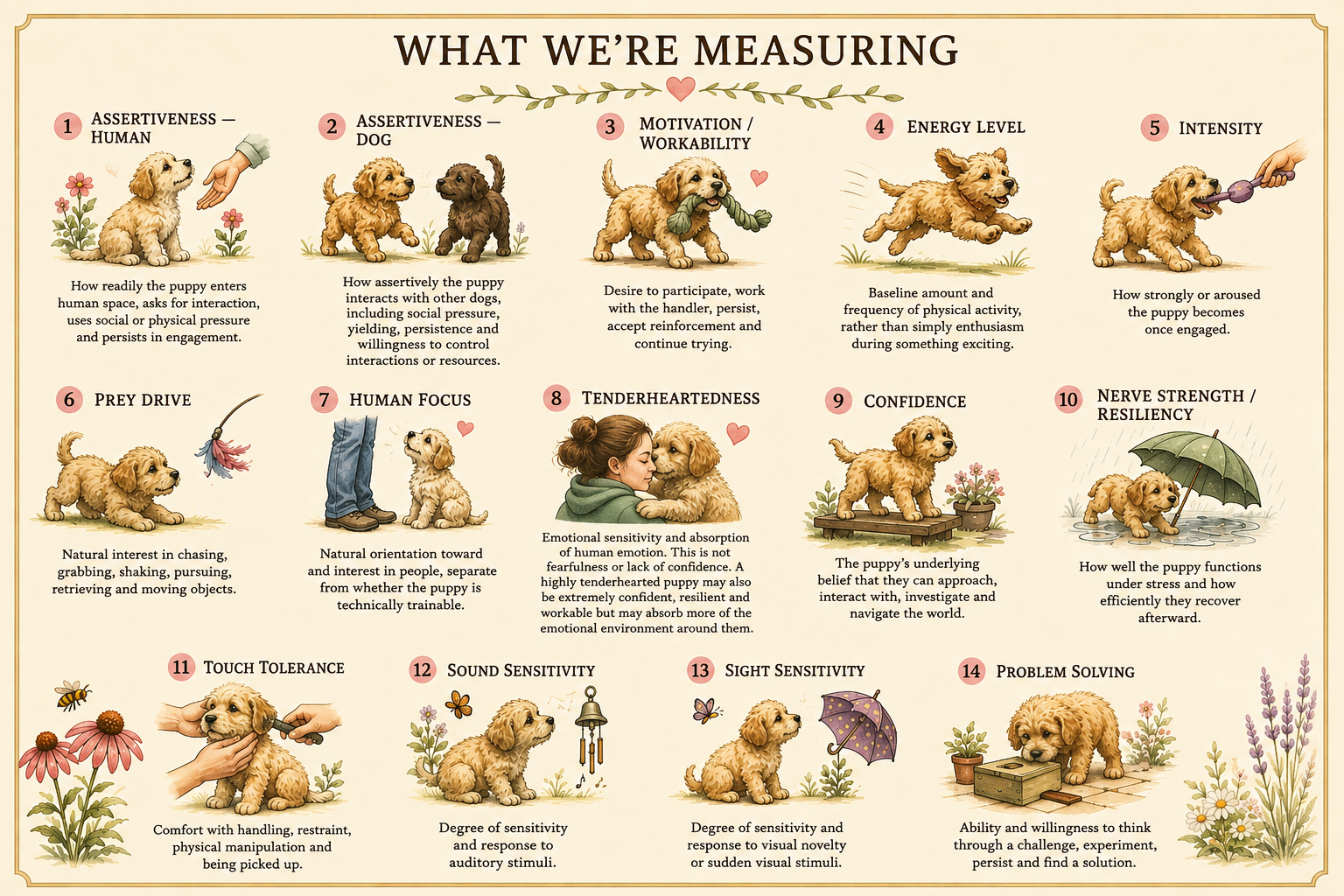
What We're Measuring
Assertiveness — Human — How readily the puppy enters human space, asks for interaction, uses social or physical pressure and persists in engagement.
Assertiveness — Dog — How assertively the puppy interacts with other dogs, including social pressure, yielding, persistence and willingness to control interactions or resources.
Motivation / Workability — Desire to participate, work with the handler, persist, accept reinforcement and continue trying.
Energy Level — Baseline amount and frequency of physical activity, rather than simply enthusiasm during something exciting.
Intensity — How strongly or aroused the puppy becomes once engaged.
Prey Drive — Natural interest in chasing, grabbing, shaking, pursuing, retrieving and moving objects.
Human Focus — Natural orientation toward and interest in people, separate from whether the puppy is technically trainable.
Tenderheartedness — Emotional sensitivity and absorption of human emotion. This is not fearfulness or lack of confidence. A highly tenderhearted puppy may also be extremely confident, resilient and workable but may absorb more of the emotional environment around them.
Confidence — The puppy's underlying belief that they can approach, interact with, investigate and navigate the world.
Nerve Strength / Resiliency — How well the puppy functions under stress and how efficiently they recover afterward.
Touch Tolerance — Comfort with handling, restraint, physical manipulation and being picked up.
Sound Sensitivity — Degree of sensitivity and response to auditory stimuli.
Sight Sensitivity — Degree of sensitivity and response to visual novelty or sudden visual stimuli.
Problem Solving — Ability and willingness to think through a challenge, experiment, persist and find a solution.
Curious how temperament testing works? Learn more about our Temperament Testing process
Temperament, Development & Training
Temperament gives us a picture of the puppy's natural tendencies, but puppies are still developing. What happens next matters.
Some characteristics we evaluate are relatively core pieces of temperament, while others can be influenced more significantly through thoughtful exposure, socialization, life experiences, training and maturity. Early experiences can build confidence, strengthen resiliency, help puppies learn how to navigate novelty and give them a larger set of skills for handling the world around them.
That is one reason we put so much emphasis on intentional exposure and socialization while our puppies are with us—and why continuing that work after they go home is so important. The goal isn't simply to expose a puppy to more things. It's to give them appropriate experiences that help them learn how to process new things successfully.
Training then helps shape how those natural traits are expressed in everyday life. A high-energy puppy can learn to settle. An assertive puppy can learn manners and boundaries. A puppy with lower natural human focus can develop wonderful engagement and recall.
We don't want families choosing a puppy based primarily on who they believe they can turn that puppy into. Start with a temperament that makes sense for your life, then use socialization, exposure and training to help that puppy become the best version of who they already are.
Meet the Autumn Harvest Puppies
The results are in! Each of our eight Autumn Harvest puppies has completed their temperament evaluation, and we're excited to introduce you to the unique personalities we've come to know and love.
Explore their individual profiles to learn about their natural strengths, temperament characteristics, and the families and lifestyles we believe will suit them best.
View Each Puppies Profile
Acorn • Chai • Cider • Cobbler • Ember • Pumpkin


Meet Acorn
The Gentle Giant
• Mobility Service Prospect
Acorn is our gentle giant, a wonderfully confident, affectionate boy with a thoughtful approach to life and a heart that loves being connected to his people. He is exceptionally steady, naturally attentive, and delightfully unhurried. Acorn isn't one to rush through life, but don't mistake his easygoing nature for a lack of motivation. This boy is willing, capable, and confident enough to tackle whatever comes his way. He simply prefers to do things at his own pace.
One of Acorn's most beautiful qualities is his natural connection with people. He offers wonderful eye contact, stays engaged with his handler, and genuinely enjoys working together. He is affectionate without being dependent, happy to share a snuggle or participate in an activity while remaining comfortable with his own independence. He is also remarkably polite, respecting boundaries even when he would prefer a different answer.
Acorn demonstrated exceptional confidence, nerve strength, and motivation during his temperament evaluation. He willingly worked through every challenge presented to him, showing very little sensitivity to unfamiliar sights or sounds. His calm, deliberate approach is not hesitation or uncertainty. Acorn is simply comfortable taking his time, and he often grows even more confident through his successes.
With his naturally lower energy level, Acorn offers a lovely balance of playful enthusiasm and relaxed companionship. He certainly has moments when he's ready for some fun, and he may happily join his family on outdoor adventures, but his everyday rhythm is easygoing. He's the kind of boy who will come when you call, just perhaps without seeing the need to hurry!
Acorn is a particularly promising mobility service dog prospect. His exceptional handler focus, environmental confidence, strong nerve strength, and naturally steady pace offer a beautiful foundation for this type of work. However, his tenderheartedness makes him unsuitable for psychiatric service work, where a dog must remain emotionally resilient in the presence of their handler's emotional distress. His naturally relaxed pace makes finding the right match especially important, ensuring his handler's lifestyle, daily activity level, and service needs align with his easygoing nature.
Acorn's gentle disposition, good touch tolerance, and polite manners also make him a promising companion for families with children. His tenderheartedness deserves consideration in households with frequent commotion, but he has many lovely qualities for family life.
Acorn's Ideal Home
Acorn's ideal home is a family that appreciates a confident, affectionate, easygoing companion and whose lifestyle naturally complements his relaxed pace. His gentle nature, polite manners, and good touch tolerance make him a promising companion for families with children, particularly those who can respect his boundaries and provide a reasonably calm emotional environment.
Acorn enjoys human connection and offers exceptional natural handler focus, but he isn't dependent on constant attention. He enjoys affection, willingly participates in activities, and is comfortable with some independence. His family should appreciate that while he's capable of enjoying adventures, he prefers to experience life at his own unhurried pace.
Acorn could also be considered for homes with cats, small animals, or livestock. His moderate prey drive and intensity don't present the same concerns as puppies with stronger chase instincts, although appropriate introductions, training, and supervision remain important.
Acorn is a promising mobility service dog prospect. His exceptional confidence, nerve strength, motivation, and handler focus provide a wonderful foundation for service work. His handler's lifestyle and daily needs should complement his naturally relaxed pace.
We are not recommending Acorn for psychiatric service work because of his tenderheartedness and sensitivity to human emotions.
Continued Development & Training Priorities
1. Building on Natural Handler Focus
Acorn already offers exceptional eye contact and engagement. Continuing to reward his natural check-ins, polite requests, and willingness to work alongside his people will strengthen these wonderful qualities.
2. Encouraging Responsiveness Without Rushing
Acorn's relaxed pace is part of his temperament. His family should continue developing reliable responses to cues while recognizing that he may not naturally move with urgency. Training should build responsiveness without creating unnecessary pressure.
3. Supporting Emotional Resilience
Acorn's tenderhearted nature deserves consideration. Continued positive exposure to everyday household emotions and experiences will help him develop coping skills while preserving his trusting relationship with his people.
Prey Drive & Small Animals
Acorn demonstrated moderate prey drive with relatively low intensity. He showed interest in chasing and catching moving toys, but his naturally relaxed approach meant he wasn't particularly driven to pursue them. He enjoyed the opportunity to engage without becoming overly focused or intense.
As with any puppy, appropriate introductions and supervision around cats, small pets, and livestock are still important. His testing did not give me a reason to automatically rule out a home with other animals, but puppy temperament testing cannot guarantee how an individual dog will respond to every species as he matures.
Working Potential
Acorn has several exceptional qualities that make him a promising working prospect: outstanding confidence, nerve strength, motivation, and natural handler focus. His willingness to work through challenges, beautiful eye contact, and very low sensitivity to unfamiliar sights and sounds provide a wonderful foundation for training.
Acorn is one of my stronger mobility service dog prospects. His naturally steady, unhurried pace, excellent environmental confidence, and strong connection with his handler could make him particularly well suited to mobility-related work. The important consideration will be matching him with a handler whose lifestyle, activity level, and specific service needs complement his naturally lower energy.
I do not recommend Acorn for psychiatric service work. Although he has exceptional nerve strength and environmental confidence, his tenderheartedness makes him more sensitive to human emotional distress than I prefer for this type of work.
Acorn could also make a lovely Emotional Support Animal (ESA) or family companion. He is affectionate, enjoys being close to his people, and offers a calm, reassuring presence without being emotionally dependent on constant interaction.
Acorn doesn't need a formal working role to thrive. Whether he's supporting someone through mobility service work or simply sharing everyday life with his family, his greatest strengths are his steady temperament, willingness to work together, and beautiful connection with his people.
Our Placement Recommendation
Best fit: A family or individual seeking a confident, affectionate, lower-energy companion whose lifestyle complements Acorn's naturally relaxed pace. Families with respectful children may be a wonderful match, as could homes with cats, small animals, or livestock when appropriate management and training are provided. He is also a promising mobility service dog prospect for a handler whose daily needs and activity level are compatible with his temperament.
Not recommended: Psychiatric service work or placements requiring a consistently fast-paced, high-energy working partner.
Acorn is a wonderfully steady, thoughtful puppy with exceptional confidence, motivation, nerve strength, and natural handler focus. His gentle nature and unhurried approach to life are defining characteristics that deserve to be appreciated rather than changed.
With the right family or handler, Acorn has the potential to become a deeply connected, dependable companion who brings a beautiful sense of calm and companionship to everyday life.
Overall Temperament Summary
Acorn is a gentle, confident, easygoing boy with exceptional nerve strength, outstanding motivation, and a beautiful natural connection with his people. He is affectionate without being dependent, wonderfully polite, and approaches life with a calm, unhurried attitude.
Don't mistake his relaxed pace for a lack of confidence or willingness. Acorn successfully worked through every challenge presented during testing, demonstrating that he is both capable and motivated. He simply doesn't see any reason to rush!
His exceptional handler focus, environmental stability, and steady temperament make him a particularly promising mobility service dog prospect, provided his handler's lifestyle and needs complement his naturally lower energy. His tenderheartedness makes him better suited to mobility work or companionship than psychiatric service work.
For a family who appreciates a gentle, affectionate companion with a relaxed approach to life, or a mobility service dog handler seeking a steady, attentive working partner, Acorn has the potential to be a truly wonderful match.
Acorn's Temperament Scores — What They Mean
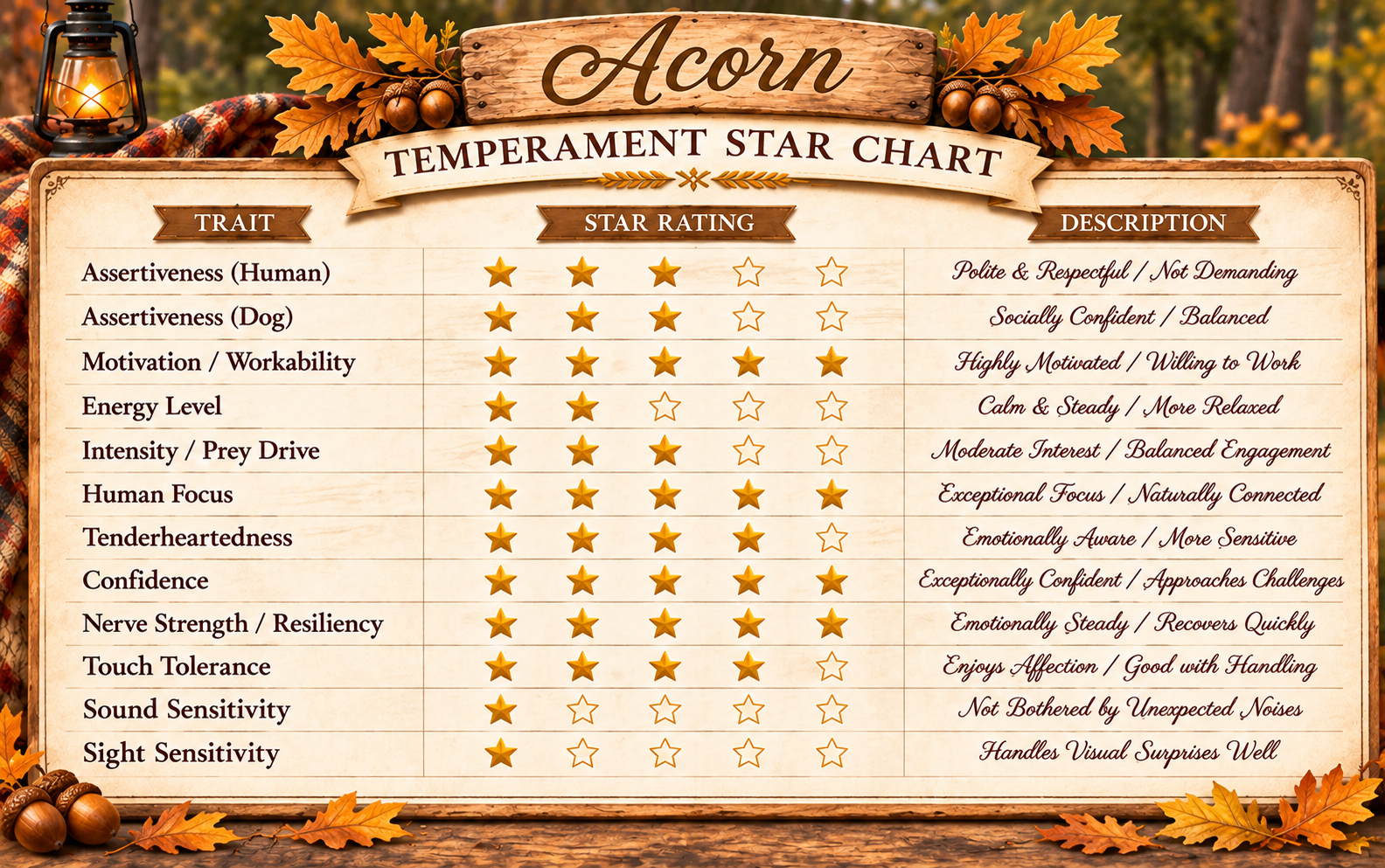
Human Assertiveness — 3/5
Acorn is exceptionally polite when interacting with people. He enjoys affection and attention but doesn't feel the need to demand it.
During testing, he demonstrated a willingness to respect boundaries even when he clearly wanted continued interaction. He may accept an invitation to be more forward, but he doesn't naturally push for what he wants.
What this means: Acorn has a lovely balance of confidence and manners. His family should continue reinforcing polite requests for attention while encouraging him to communicate his needs comfortably.
Confidence — 5/5
Acorn completed every challenge presented during his temperament evaluation. He approached new experiences with confidence, even when he chose to move through them slowly.
His deliberate pace shouldn't be mistaken for uncertainty. He demonstrated that he was comfortable taking his time and became visibly more confident after successfully completing challenges.
What this means: Acorn has an exceptional foundation of confidence. His family should allow him the time he needs to explore and complete new tasks without confusing his slower pace with reluctance.
Motivation — 5/5
Acorn demonstrated exceptional willingness to participate and complete the activities presented to him.
Even when something required extra effort, he remained willing to try. His motivation was not dependent on moving quickly or becoming highly excited.
What this means: Acorn's strong motivation is a wonderful quality for training and potential service work. He is willing to work with his handler, although his natural pace should be respected.
Nerve Strength — 5/5
Acorn demonstrated excellent emotional stability when presented with unfamiliar experiences and challenges.
He worked through the evaluation without significant stress responses and showed the ability to remain composed while completing tasks.
What this means: Acorn has excellent nerve strength, providing a strong foundation for navigating unfamiliar environments and everyday challenges. This is particularly valuable for potential service work.
Touch Tolerance — 4/5
Acorn enjoys physical affection and readily settles into snuggles with his people. He demonstrated good tolerance for handling during testing, remaining cooperative and comfortable with physical interaction.
What this means: Acorn's gentle nature and good touch tolerance make him a promising companion for families with children. However, children should be taught to respect his boundaries, recognize when he wants space, and interact gently. His tenderheartedness also makes the emotional atmosphere of the household an important consideration, particularly in homes with young children who may be loud or unpredictable.
Energy Level — 2.5/5
Acorn is one of our more relaxed puppies. He approaches everyday activities at a comfortable, unhurried pace.
He certainly has playful moments and can become enthusiastic when something captures his interest, but he doesn't naturally move through life with urgency.
What this means: Acorn's family should have a lifestyle that complements his naturally lower energy level. He may enjoy hiking, outings, and adventures, but he isn't likely to become a consistently fast-paced dog. For service work, his handler's daily routine and physical needs should align with his comfortable pace.
Prey Drive — 3.5/5
Acorn demonstrated moderate interest in moving objects and playful pursuit. He enjoyed engaging with the moving toy during testing, particularly when given the opportunity to catch it, but didn't demonstrate an overwhelming need to chase.
What this means: Acorn may be a suitable candidate for homes with cats, small animals, or livestock. His moderate prey drive, combined with his moderate intensity, is encouraging, although it doesn't guarantee that he won't chase. Appropriate introductions, supervision, and training will be important, especially around animals that run or move unpredictably.
Prey Drive Intensity — 3/5
Acorn demonstrated moderate intensity when engaging with toys.
He enjoyed catching and interacting with the toy but didn't demonstrate unusually forceful or intense behavior once engaged.
What this means: Acorn's play style appears relatively balanced. He can enjoy interactive activities without the exceptionally intense engagement seen in some of his littermates.
Sight Sensitivity — 1/5
Acorn demonstrated very little sensitivity to unfamiliar visual stimuli during testing.
What this means: Acorn is unlikely to be easily startled or distracted by ordinary visual changes in his environment. This is a desirable quality for a dog accompanying his family into unfamiliar places.
Sound Sensitivity — 1/5
Acorn showed very little sensitivity to the sounds introduced during his evaluation.
What this means: His low sound sensitivity is a wonderful foundation for navigating everyday environments, including public places where unexpected noises are common.
Human Focus — 5/5
Acorn demonstrated exceptional natural handler focus throughout his evaluation.
He maintained beautiful eye contact, frequently engaged with his evaluator, and showed a genuine interest in working together. Despite this strong connection, he isn't human dependent and remains comfortable with some independence.
What this means: Acorn's natural attention to people is one of his greatest strengths. He offers an excellent foundation for training, communication, and potential service work without requiring constant reassurance or interaction.
Tenderheartedness — 4/5
Acorn is emotionally sensitive and responsive to the people around him.
Although he has exceptional confidence and nerve strength, his tenderheartedness means he may be affected by strong human emotions.
What this means: Acorn would benefit from a household that recognizes his emotional sensitivity and provides a generally calm, dependable environment. His tenderheartedness is also the reason we are not recommending him for psychiatric service work, where we prefer a dog who is less affected by their handler's emotional distress.
Dog Assertiveness — 3/5
Acorn approached the unfamiliar dog confidently and directly during testing.
He investigated appropriately, showed no unnecessary conflict, and comfortably disengaged after satisfying his curiosity.
What this means: Acorn demonstrated balanced social confidence around another dog. He was comfortable initiating an interaction without needing to control or prolong it.

Meet Chai
The Gentle Heart
Chai is a sweet, engaging little girl with a tender heart, a playful spirit, and a wonderful capacity for connection. She enjoys human interaction, demonstrates lovely physical confidence, and has the potential to form an exceptionally deep bond with the people who earn her trust.
What makes Chai unique is the contrast between her confidence in her own physical abilities and her sensitivity to emotional pressure. She's willing to explore, investigate, and try new things, but when expectations become overwhelming, she can struggle to find her way back to feeling comfortable.
Chai isn't a puppy who needs someone to do everything for her. She's capable of independence, enjoys her toys, and has a curious mind. What she needs is someone who will patiently show her that the world is safe, challenges can be overcome, and trying something new can be wonderfully rewarding.
Her excellent touch tolerance, strong human focus, and natural interest in using her nose offer beautiful opportunities for building confidence. With thoughtful encouragement and a relationship built on trust, Chai has the potential to blossom into a deeply devoted companion.

Chai's Ideal Home
Chai will thrive with a patient, emotionally consistent family who understands that building her confidence will take time and thoughtful encouragement. When something feels difficult, she needs opportunities to work through manageable challenges and discover that she's capable of succeeding. Her family must recognize the difference between a puppy who needs a little encouragement and one who has become genuinely overwhelmed and needs a break.
She could be a wonderful companion for an older couple, a younger couple, or an individual who enjoys developing a close relationship with their dog. Chai is not inherently dependent on people, but trust is especially important to her. She needs people who will be consistent in their expectations, gentle in their corrections, and willing to celebrate her successes.
We would not recommend Chai for a household with young children. This isn't because she dislikes children, but because the unpredictable activity, emotional outbursts, and inconsistent interactions that naturally accompany family life could be difficult for her. Older children may be appropriate in the right circumstances, but emotional maturity and consistency will be especially important.
Chai needs a family who will encourage her independence without expecting her to navigate every challenge alone. The goal isn't to protect her from every uncomfortable experience, but to help her develop the skills and resilience to handle those experiences successfully. With patience, encouragement, and a relationship built on trust, Chai has the potential to become a deeply devoted and increasingly confident companion.
Areas to Continue Building
Chai's greatest opportunity for growth is developing emotional resilience. While she's physically confident and willing to explore, repeated expectations can become overwhelming. She needs opportunities to practice working through small challenges, experience success, and learn that a difficult moment doesn't mean she can't continue.
Her family should introduce new experiences gradually, allowing her to investigate at her own pace. When she hesitates, gentle encouragement and a little extra time may be all she needs. If she begins showing signs of significant stress, the activity should become easier or stop so she can recover.
Nose work will be an especially valuable activity for Chai. She demonstrated a natural interest in investigating her environment with her nose, including the wobble board. Searching for treats, finding hidden objects, and eventually participating in scent-work activities will give her opportunities to solve problems independently without the pressure of constant human direction.
Chai will also benefit from learning that people standing, moving around, and making requests are not reasons for concern. During testing, she was much more comfortable interacting with her evaluator on the floor. Her family can gradually build positive associations with everyday movement and interactions without repeatedly asking her to participate before she's ready.
Most importantly, Chai needs to develop confidence in her own decisions. Her family should encourage her to try, celebrate her initiative, and help her discover that she can handle manageable challenges. The goal is to build resilience while preserving the trust that makes her willing to try in the first place.t settling, and allowing her to work through reasonable frustration rather than immediately giving in to her protests. Ladybug needs to learn that being apart from her people is safe, temporary, and completely normal.
Children & Family Life
Chai is not our recommendation for a household with young children. This isn't because she lacks affection or enjoys people any less, but because her sensitivity to pressure makes the unpredictability of young children a concern. Running, loud emotions, sudden movements, and inconsistent interactions could easily become overwhelming for her. Even well-meaning children may unintentionally push her beyond what she's comfortable handling.Older children or teenagers may be appropriate in a particularly calm and consistent household, but their ability to recognize Chai's communication and respect her boundaries will be essential.
Chai will be happiest in a home where interactions are predictable, expectations are clear, and the people around her help her feel secure while encouraging her to become more confident.
Prey & Toy Drive
Chai demonstrated moderate prey drive and intensity, both scoring 3/5. She showed good fetch drive, enjoyed interacting with toys, and had moments of enthusiastic, playful activity.
Her interest in toys provides a wonderful opportunity to make learning enjoyable. Rather than relying on repeated requests or pressure to encourage participation, her family can use games, playful movement, and rewarding her initiative to help her approach new experiences with greater enthusiasm.
Chai's playful side deserves encouragement. Celebrating her excitement and allowing her to be a little silly may help her become more comfortable expressing herself and trying unfamiliar things.
Her moderate drive should make it possible to enjoy interactive games without needing to manage the persistent intensity associated with highly driven puppies.
Best Fit Home
Chai would be a wonderful match for a patient individual or couple who enjoys building a close relationship with their dog. An older couple, younger couple, or quiet adult household could provide the consistency and individual attention she needs.
She will thrive with people who communicate gently, maintain predictable expectations, and understand how to encourage her through manageable challenges without overwhelming her. Her family should be willing to invest time in confidence-building activities and recognize that progress may happen in small steps.
A busy household with young children, frequent emotional outbursts, or unpredictable interactions would not be our recommendation. Chai needs a home where trust is protected and her family understands the importance of helping her become more resilient rather than simply avoiding everything that makes her uncomfortable.
For the right people, Chai has the potential to develop a wonderfully close, trusting relationship and become a devoted companion who continues growing in confidence throughout her life.
Overall Temperament Summary
Chai is a sweet, playful, people-focused little girl with a tender heart and a wonderful capacity for connection. She demonstrates physical confidence, excellent touch tolerance, moderate energy, and a natural interest in using her nose to investigate the world.
Her greatest challenge is emotional resilience. Although she began her evaluation with enthusiasm and a willingness to participate, accumulated pressure eventually overwhelmed her, and she struggled to recover. This makes thoughtful placement and a patient approach to training especially important.
Chai is not inherently dependent on people, nor does she lack the desire to explore and learn. She needs a family who will protect her trust while helping her discover that she can navigate unfamiliar experiences, overcome manageable challenges, and succeed through her own efforts.
With the right guidance, Chai has the potential to become a deeply devoted companion whose confidence grows alongside the trusting relationship she builds with her family.
Chai's Temperament Scores — What They Mean
Human Assertiveness — 4/5
Chai initially approached interaction with enthusiasm, readily entering personal space and seeking engagement.
During testing, she was comfortable being close to her evaluator and showed a willingness to participate when she felt secure.
What this means: Chai has a naturally engaging, socially forward side. Her withdrawal under pressure should not be mistaken for a lack of interest in people. She wants connection, but her willingness to participate depends heavily on how safe she feels.
Confidence — 4/5
Chai demonstrated confidence in her physical abilities and willingness to investigate her environment.
She independently climbed onto an elevated block before being asked and explored unfamiliar objects without requiring extensive encouragement.
What this means: Chai believes in her ability to physically navigate her world. Her confidence score reflects this natural willingness to explore, while her separate nerve-strength score captures how she responds when emotional pressure increases.
Motivation — 3/5
Chai demonstrated moderate motivation, participating willingly when activities felt enjoyable and manageable.
She showed interest in toys, fetching, and interacting with her evaluator, but her motivation declined as pressure accumulated.
What this means: Chai has the desire to engage and learn, but her emotional state can override that motivation. Training should prioritize successful experiences and maintain her enthusiasm rather than pushing through signs of stress.
Nerve Strength — 1/5
Chai demonstrated significant difficulty recovering when emotional pressure accumulated during her evaluation.
Although she began testing with enthusiasm, repeated requests eventually resulted in avoidance, stress behaviors, and withdrawal. She stopped participating and was unable to return to normal engagement during the evaluation.
What this means: Emotional resilience is Chai's greatest area for development. She will need patient, thoughtful support to build coping skills and learn that unfamiliar or challenging experiences are manageable. This score reflects her response during testing, not a permanent limitation on her potential.
Touch Tolerance — 5/5
Chai demonstrated excellent tolerance for physical touch and handling.
She was comfortable receiving affection and physical contact, showing no meaningful resistance to the handling evaluated.
What this means: Physical affection can be a wonderful part of Chai's relationship with her family. Her comfort with touch is a genuine strength, although it should not be confused with emotional resilience or an ability to tolerate excessive training pressure.
Energy Level — 3.5/5
Chai demonstrated moderate energy with moments of increased excitement and activity.
She could become animated and playful, occasionally moving with more enthusiasm than coordination, but did not maintain that heightened activity throughout testing.
What this means: Chai is likely to enjoy a balance of play, exploration, and quieter companionship. Her family should encourage joyful activity and use play to build confidence without creating unnecessary overstimulation.
Prey Drive — 3/5
Chai demonstrated moderate interest in toys and movement, with human interaction remaining a significant priority.
She showed good fetch drive and enjoyed engaging with toys, but did not demonstrate an overwhelming fixation on chasing or pursuing objects.
What this means: Chai's moderate prey drive offers opportunities for enjoyable games and confidence-building activities. Play can be a valuable training tool, particularly when it encourages her to take initiative and experience success.
Prey Drive Intensity — 3/5
Chai demonstrated moderate intensity in her play and pursuit behaviors.
She could become enthusiastic when engaged but did not display consistently high intensity or overwhelming persistence.
What this means: Chai has enough enthusiasm to make interactive play rewarding without appearing excessively driven. Her family can use this playful energy to encourage exploration, initiative, and bravery.
Sight Sensitivity — 1/5
Chai showed little observable sensitivity to visual changes during testing.
She noticed elements of her environment without demonstrating a pronounced startle or fearful response.
What this means: Visual stimulation did not appear to be a significant source of distress during her evaluation. Her primary challenges were associated with accumulated interpersonal pressure rather than obvious environmental sensitivity.
Sound Sensitivity — 1/5
Chai showed minimal observable sensitivity to sounds during testing.
She acknowledged an unexpected sound without demonstrating a significant fear response.
What this means: Sound sensitivity was not a prominent concern during this evaluation. However, her low nerve strength means that even ordinary experiences may become challenging when stress has already accumulated.
Human Focus — 4/5
Chai demonstrated strong interest in her evaluator and remained aware of human activity even when she was reluctant to participate.
She was noticeably more comfortable engaging when her evaluator was seated or lying on the floor. When the evaluator stood, Chai became more hesitant and avoidant.
What this means: Chai genuinely wants a relationship with her people. Her human focus is strong, but it does not consistently override her emotional discomfort. Building trust and maintaining positive interactions will be essential to helping her engage confidently.
Tenderheartedness — 4/5
Chai demonstrated a sensitive, emotionally responsive nature, although her ability to respond to another person's distress was difficult to fully evaluate once she became overwhelmed.
She did make an effort to approach her evaluator when the interaction felt safe.
What this means: Chai appears to be a puppy who will be deeply affected by the emotional tone of her household. Gentle communication, consistency, and thoughtful correction will be particularly important. Her family should recognize that she may take even mild disapproval seriously.
Dog Assertiveness — 1.5/5
Dog assertiveness could not be directly evaluated during the structured portion of testing.
The evaluators suspected that Chai falls toward the lower end of the assertiveness scale, but her emotional state prevented a reliable assessment.
What this means: Chai may prefer cooperative, low-conflict interactions with other dogs. This remains an estimate rather than a confirmed temperament characteristic and should be considered alongside future observations.

Meet Cider
The Independent Gentleman
Cider is a sweet, polite little gentleman with a playful streak, a wonderful independent nature, and a very clear idea of what makes life enjoyable. He isn't the puppy who needs someone entertaining him every moment of the day. Give this boy a favorite toy, a comfortable place to settle, and the freedom to enjoy himself, and he's perfectly content.
Throughout his early development, Cider has been one of our more laid-back puppies. In fact, his temperament evaluation brought out some of the most enthusiastic play we've seen from him! When something captures his interest, particularly a favorite toy, there's a whole lot of personality hiding beneath that easygoing exterior.
Cider loves his toys. He'll shake them, growl playfully, carry them off, and settle down to enjoy his prize. While he may occasionally participate in a game of fetch, he's much more interested in keeping his treasure than bringing it back for another round. He doesn't need someone constantly throwing a ball to have a wonderful time.
He's also a puppy who appreciates having a say in his interactions. Cider enjoys people and is comfortable with physical affection, but he has never particularly enjoyed being picked up. This is an important distinction. He isn't generally uncomfortable with touch or handling; he simply prefers to keep his feet on the ground.
With Cider, the relationship matters. He has the potential to develop a lovely connection with his family, especially when his people respect his boundaries, make training rewarding, and allow trust to grow through positive experiences.
For a family who appreciates a dog with his own interests, enjoys building a relationship through shared activities, and understands that affection doesn't always mean being held, Cider could be a wonderful companion.

Cider's Ideal Home
Cider will be happiest in a home that appreciates his independent personality while making room for the close relationship he can develop with his people. He doesn't need constant attention or entertainment, but he does need a family who enjoys spending time with him, understands his preferences, and makes their interactions rewarding.
One of the most important considerations for Cider's future family is respecting his physical boundaries. He has consistently communicated that he doesn't enjoy being picked up, even though he tolerates other types of handling remarkably well. When friends or neighbors come over to meet him, we'd encourage them to get down to his level, allow him to approach, and resist the temptation to scoop up the adorable puppy.
This will be especially important during his early socialization. We want Cider to learn that meeting new people is a positive experience, not something that means losing control over his body. A family who understands this will be helping him build confidence and trust in unfamiliar situations.
Cider could do well with respectful children, particularly those around eight years and older who are capable of recognizing when a puppy wants space. He's not our first choice for a household with toddlers who may grab, carry, or physically maneuver a puppy without understanding his boundaries.
His moderate energy level makes him a nice candidate for a family who enjoys a balance of playtime and relaxation. He has plenty of enthusiasm when something interests him, but he's also perfectly capable of entertaining himself.
With his higher prey drive, we would not consider him an ideal match for a home with cats or other small animals.
Cider's ideal family will appreciate his individuality, offer consistent and rewarding guidance, and enjoy discovering the activities that make their relationship special.
Continued Development & Training Priorities
1. Respecting Physical Boundaries & Building Trust
Cider has consistently communicated that he doesn't enjoy being picked up, despite being comfortable with other types of handling. His family should respect this preference, especially when introducing him to new people. Allowing Cider to approach visitors on his own terms and continuing cooperative care training will help him maintain positive associations with human interaction.
2. Building Motivation & Frustration Tolerance
Cider responds best when training offers something he genuinely values, particularly toys. Short, rewarding sessions with clear expectations will help him develop persistence and learn to work through challenges without becoming frustrated. Teaching toy exchanges, release cues, and rewarding small successes will make training more enjoyable and productive for everyone.
3. Strengthening Relationships Through Nose Work & Enrichment
Cider is a naturally nose-oriented puppy, making scent games and recreational nose work particularly promising activities. Treat searches, simple scent trails, and beginner nose work exercises will provide mental stimulation while giving him opportunities to work alongside his people. These shared experiences can strengthen his human connection without requiring him to give up the independence that comes so naturally to him.
Prey Drive
Cider demonstrated strong prey drive during testing, particularly through his enthusiastic engagement with toys, head shaking, and desire to capture and possess his prizes.
Although toy play doesn't tell us exactly how a puppy will respond to every living animal, his higher prey drive makes us cautious about placing him in a home with cats or other small pets.
For this reason, we would prefer a home without cats, rabbits, or other small animals that could trigger chasing behavior.
Our Placement Recommendation
For Cider, the right household is one that values a respectful relationship with their dog. His family should enjoy his playful personality and independent nature while understanding that building trust is more important than expecting him to welcome every interaction.
We would especially love to see Cider with a family who appreciates his moderate energy level, enjoys enrichment activities, and understands that he can be affectionate and connected without wanting to be carried or constantly handled.
Respectful older children could be a lovely match, particularly those who understand how to recognize and honor a dog's boundaries. We would be more cautious about placing him in a home with very young children or cats.
His future family should be willing to make training rewarding, continue building his confidence and frustration tolerance, and provide positive opportunities to experience new people and environments.
With the right guidance, Cider has the potential to develop into a happy, engaging, and deeply appreciated family companion.
Overall Temperament Summary
Cider is a sweet, polite, moderately energetic little gentleman with a strong love of toys, an independent streak, and a playful intensity that comes alive when something captures his interest.
He's perfectly happy entertaining himself, but he also enjoys being near his people and has the potential to build a lovely relationship with a family who understands him.
He isn't the puppy who needs to be involved in everything, and he may not be the first to run up to every stranger looking for attention. His relationships are likely to mean more when they're built through consistent, positive experiences and mutual trust.
His preference not to be picked up is an important part of understanding who he is. Cider is comfortable with many kinds of physical interaction, but he has been remarkably consistent about wanting his feet on the ground. A family who respects that preference will be helping him feel secure in his relationships.
There is also a spirited, enthusiastic side to this otherwise laid-back boy. Give him a favorite toy, and suddenly there's head shaking, playful growling, and a puppy who is absolutely delighted with his prize.
For a family who appreciates an independent companion, enjoys rewarding training and enrichment, and believes that a good relationship begins with respecting the dog in front of them, Cider has the potential to be a truly wonderful match.
Cider's Temperament Scores — What They Mean
Human Assertiveness — 3/5
Acorn-independent reference replaced with Cider-specific interpretation.
Cider demonstrated moderate human assertiveness during his evaluation. He is naturally sweet and polite, without a strong tendency to push himself into human interactions or demand attention.
He enjoys engaging with people, but he isn't particularly insistent about getting his way through physical interaction. If an opportunity isn't available, he's often content to move along and find something else to enjoy.
What this means: Cider is unlikely to be an especially demanding puppy when it comes to human attention. His relatively polite approach may make household boundaries easier to establish, provided his family remains consistent and respectful.
Confidence — 3.5/5
Acorn demonstrated very strong confidence; Cider's confidence is more moderate and situation-dependent.
Cider demonstrated a reasonable belief in his own abilities, particularly when pursuing something he wanted. He was comfortable exploring his environment and showed confidence in his ability to acquire and enjoy his toys.
However, he wasn't equally enthusiastic about every challenge presented. While he attempted some activities, he declined others, including the slide. He didn't feel compelled to conquer every obstacle simply because someone encouraged him.
What this means: Cider has a useful foundation of confidence, but he will benefit from opportunities to experience success without being pressured. Allowing him to make choices, rewarding his efforts, and gradually introducing new challenges will help strengthen his confidence.
Motivation — 3.5/5
Acorn demonstrated exceptionally high motivation to participate and complete activities presented to him.
Cider is motivated, but he's selective about where he invests his effort. Toys are particularly rewarding to him, and he becomes enthusiastic when an activity offers something he genuinely wants.
During testing, he was willing to participate in some challenges but showed little interest in others. When the reward wasn't forthcoming or the activity no longer appealed to him, he was perfectly comfortable deciding he'd rather do something else.
What this means: Finding what Cider considers rewarding will be an important part of successful training. He isn't necessarily going to work simply because someone asks him to. Clear communication, meaningful rewards, and enjoyable training sessions will help keep him engaged.
Nerve Strength & Resiliency — 3.5/5
Acorn demonstrated excellent emotional stability and an ability to recover quickly from challenges and frustration.
Cider showed moderate resilience during his temperament evaluation. He was able to navigate much of the experience comfortably, but we also observed signs of accumulating frustration when demands increased and his preferred rewards became unavailable.
At one point, he displayed a prolonged stress scratch after being asked to participate in activities he wasn't particularly interested in, combined with frustration over the disappearance of his toy.
What this means: Cider will benefit from training sessions that are clear, rewarding, and appropriately paced. When frustration begins to build, giving him an opportunity to succeed or taking a short break will be more productive than repeatedly asking for something he isn't ready or willing to do.
Touch Tolerance — 2/5
Acorn enjoyed physical affection and readily settled into close contact with his people.
Cider's touch tolerance score requires an important explanation because the number alone doesn't accurately describe his relationship with physical affection.
Cider has demonstrated very good tolerance for ordinary and even fairly rude handling, including having his tail pulled during evaluation. What he has consistently disliked, from a very young age, is being picked up and held.
He is comfortable interacting with people. He simply doesn't enjoy having his feet lifted off the ground or being physically restrained in someone's arms.
What this means: Cider's family should respect his preference not to be picked up. This is especially important when introducing him to unfamiliar people. Visitors should be encouraged to greet him at his level and allow him to choose how he participates. Respecting this boundary will help preserve his comfort with human interaction and prevent negative associations with being approached.
Energy Level — 3/5
Acorn demonstrated a naturally moderate energy level with the ability to settle comfortably when playtime was over.
Cider has a moderate energy level, although he has generally been one of the more laid-back puppies in the litter.
His temperament evaluation revealed considerably more enthusiasm than we typically see from him, particularly when he was playing with toys. He can become quite animated when something captures his interest, but that enthusiasm isn't necessarily representative of his activity level throughout the day.
What this means: Cider should be a nice match for a family seeking a balance between activity and downtime. He will enjoy opportunities to play, explore, and engage in enrichment activities without necessarily requiring constant physical entertainment.
Prey Drive — 4/5
Acorn demonstrated moderate interest in moving objects and playful pursuit.
Cider demonstrated a strong interest in toys, particularly those he could chase, capture, shake, and possess. His playful growling and enthusiastic head shaking were especially noticeable during testing.
He showed a strong desire to keep possession of his prizes rather than repeatedly returning them for another game.
What this means: Cider's higher prey drive makes appropriate outlets for chasing, tugging, and toy play important. His family should also be mindful of his interest in moving animals. We would not consider him an ideal candidate for a household with cats or other small pets.
Prey Drive Intensity — 5/5
Acorn demonstrated moderate intensity when engaging with toys.
When Cider becomes engaged in prey-oriented play, he brings considerable enthusiasm to the experience.
His head shaking, playful growling, and determination to enjoy his toys demonstrated a high level of intensity. Although he isn't an especially high-energy puppy overall, his play can become quite animated when something excites him.
What this means: Cider's family should understand the distinction between energy level and intensity. He may be a relatively relaxed puppy much of the time while still demonstrating powerful, enthusiastic play when something captures his attention. Structured toy games and opportunities to practice releasing and exchanging objects will be valuable.
Sight Sensitivity — 1/5
Acorn demonstrated very little sensitivity to unfamiliar visual stimuli during testing.
Cider demonstrated very little sensitivity to visual stimuli during his evaluation.
We did not observe significant concern or avoidance in response to the visual elements presented during testing.
What this means: Low observed sight sensitivity is a positive foundation for navigating everyday environments. His family should continue providing thoughtful exposure to unfamiliar sights and experiences as he matures.
Sound Sensitivity — 1/5
Acorn was little affected by the sounds introduced during his evaluation.
Cider demonstrated very little sound sensitivity during testing.
The auditory stimuli presented did not produce significant concern or interfere with his ability to continue participating.
What this means: Cider's low observed sound sensitivity suggests a comfortable starting point for experiencing everyday household sounds. Continued positive exposure will help maintain that comfort as he develops.
Human Focus — 4/5
Acorn demonstrated a particularly strong desire to engage with his evaluator.
Cider demonstrated a good level of human focus, following his evaluator around the testing room and showing interest in remaining nearby.
However, his attention wasn't exclusively directed toward people. When a toy captured his interest, he was perfectly happy to pursue that activity independently.
We expect Cider's strongest human focus to develop within the relationships he builds with familiar, trusted people. He may not be the puppy who enthusiastically seeks out every stranger, and that's perfectly okay.
What this means: Cider has the potential to develop a meaningful relationship with his family without becoming overly dependent on constant human attention. Shared activities, consistent training, and respectful interactions will help strengthen that connection.
Tenderheartedness — 3.5/5
Acorn demonstrated a particularly sensitive and responsive nature toward his people.
Cider showed some interest in responding to his evaluator's emotional state, but he wasn't especially persistent in attempting to change it.
After making an effort, he was comfortable redirecting his attention toward other activities, particularly his toys.
He didn't appear overwhelmed by the emotional experience or compelled to remain involved until the situation changed.
What this means: Cider has a moderate level of emotional sensitivity. He can notice and respond to his people without necessarily becoming deeply involved in every emotional moment. This may be a nice quality for a family who appreciates a dog with some emotional independence.
Dog Assertiveness — 3/5
Acorn approached the unfamiliar dog confidently and directly during testing.
Cider demonstrated relatively neutral dog assertiveness during his evaluation.
He investigated the unfamiliar test dog with nose bumps and sniffing, including checking its rear. Once he determined that the object wasn't responding like a real dog, his behavior shifted toward treating it as a toy.
He did not demonstrate a particularly strong desire to control or challenge the unfamiliar dog.
What this means: Cider showed a fairly neutral approach during this portion of testing. Continued positive experiences with appropriate dogs will help him develop comfortable canine social skills. His response to a test dog should not be considered a guarantee of how he will interact with every living dog.

Meet Cobbler
The Spirited Sweetheart
Cobbler is a confident, outgoing, energetic little girl with a big personality! She's playful, enthusiastic, and loves being involved with her people. She enjoys tugging, retrieving, and exploring her surroundings, and she's perfectly capable of entertaining herself when her family is busy.
Cobbler is one of our most assertive puppies, and she isn't shy about demanding what she wants! She'll jump on you and insist on attention rather than patiently waiting for you to offer it. During temperament testing, she demonstrated that she can collect herself and sit politely to ask for attention, but of all her littermates, she has struggled the most with our Puppy Culture manding behavior training. Teaching Cobbler impulse control will be one of her family's most important training priorities. She needs people who will consistently reward polite requests for attention rather than giving in to demanding behavior.
Cobbler is confident in her abilities, but she isn't especially persistent when something becomes challenging. During testing, when she couldn't immediately figure something out, she was more inclined to move on and find another activity than continue trying. She'll need encouragement to work through challenges during training, but she's also less likely to be the puppy who spends hours figuring out how to open a gate or escape the yard!
Beneath Cobbler's bold personality is a surprisingly sensitive girl. During temperament testing, she became uncomfortable enough with the evaluator's emotional distress that she needed to disengage. It wasn't until the evaluator was calm and dependable again that Cobbler returned, relaxed, and offered comfort. Loud commotion, roughhousing, raised voices, or even someone enthusiastically yelling at a football game may be overwhelming for her. Cobbler needs a household that respects her sensitivity and provides a quiet, safe place where she can retreat when things become too much.
Cobbler also communicates her physical boundaries clearly. She enjoys affection, but when the handling during her evaluation became intentionally inappropriate, including pulling on her ears and tail, she objected and communicated that she wanted it to stop. She needs a family that respects those signals while continuing to build positive experiences with necessary handling and grooming.
Cobbler is one of our higher-energy puppies, with strong prey drive and high prey-related intensity. We are not recommending her for homes with small animals or livestock. She may also enjoy recreational dog sports as an outlet for her enthusiasm.
She's a lovely candidate for an active working family. Cobbler enjoys being with her people and will likely want to be in the same room as them, but she doesn't need to be the center of attention every moment. She would also love having a compatible canine companion.
Cobbler is being recommended as a family companion, rather than a service dog, therapy dog, or emotional support animal.
Cobbler's Ideal Home
Cobbler will be happiest with an active adult family that enjoys a playful, outgoing dog and is comfortable providing consistent boundaries and training. Her ability to entertain herself makes her a particularly nice match for a working household, provided her exercise, companionship, and daily needs are met.
She would love a compatible canine companion. During testing, she approached the other dog confidently, showed an interest in playing, and even sought canine reassurance when she was feeling stressed.
Her family should understand that Cobbler is both bold and sensitive. She may be demanding about attention, but she's also uncomfortable with loud emotional commotion and doesn't appreciate rude physical handling. A household with predictable expectations, respectful interactions, and a quiet place to retreat will suit her best.
We are not recommending Cobbler for homes with young children, small animals, or livestock. Her high energy, strong prey drive, lower touch tolerance, and sensitivity to household commotion make these environments a poor match for her temperament.
Cobbler is a fun, enthusiastic, assertive puppy who loves being part of the family while also being perfectly capable of entertaining herself. She has a sensitive side that deserves understanding, and she'll do best with people who appreciate her personality, respect her boundaries, and provide consistent guidance. For a family whose lifestyle complements her temperament, Cobbler will be an entertaining, affectionate, and engaging companion who brings plenty of personality and playfulness into their home.
Continued Development & Training Priorities
1. Impulse Control & Settling
Cobbler needs continued practice offering polite behavior to request attention rather than jumping or demanding interaction. Her family should consistently reward calm choices and teach her to settle, even when exciting things are happening around her.
2. Persistence & Problem-Solving
Cobbler will benefit from short, rewarding training sessions that encourage her to keep trying when something becomes challenging. The goal is to help her develop persistence rather than immediately abandoning a task when she doesn't succeed.
3. Cooperative Care & Handling
Continue building positive associations with grooming, ear examinations, paw handling, and other necessary care. Respecting Cobbler's communication while gradually increasing her comfort with handling will help develop trust.
Prey Drive
Cobbler demonstrated strong prey drive during testing, particularly through her enthusiastic engagement with toys, vigorous head shaking, retrieving, and enjoyment of tugging. She showed interest in a variety of toys and was happy to engage in interactive play.
Her combination of high prey drive and high prey-related intensity makes us particularly cautious about placing her in a home with cats, rabbits, or other small animals. While toy play cannot tell us exactly how she would respond to every living animal, her instincts suggest that chasing and capturing smaller animals could be especially rewarding for her.
For this reason, we are not recommending Cobbler for homes with cats, other small pets, or livestock. We would rather avoid these situations than expect her family to rely on training to override her natural instincts.
Our Placement Recommendation
Cobbler's ideal home is an active adult household that enjoys a playful, outgoing dog with a big personality. Her family should appreciate her enthusiasm while being comfortable establishing clear boundaries and consistently reinforcing polite behavior.
She could be a particularly nice match for a working family. Cobbler enjoys being involved with her people and will likely want to spend time in the same room as them, but she's also capable of entertaining herself when they're busy. She doesn't need constant attention to feel connected.
We would love to see Cobbler with a compatible canine companion. During testing, she showed genuine interest in interacting with another dog and even sought canine reassurance when she became uncomfortable.
Her emotional sensitivity is an important consideration. Cobbler isn't well suited to a household with frequent yelling, roughhousing, or loud commotion. She needs people who understand that she may become uncomfortable when emotions run high and will respect her need to retreat to a quiet space.
We are not recommending her for homes with young children, cats, small animals, or livestock. We also don't consider her a suitable prospect for service dog, therapy dog, or emotional support work.
Her future family should be committed to continuing her impulse control training, encouraging persistence when she encounters challenges, and building positive experiences with necessary handling and grooming.
Overall Temperament Summary
Cobbler is a confident, outgoing, highly energetic little girl with a bold personality, a tender heart, and a wonderful enthusiasm for people and play.
She's one of our most assertive puppies and isn't shy about telling you what she wants! Whether she's jumping up to demand attention or enthusiastically engaging in a game of tug, Cobbler approaches the things she enjoys with plenty of excitement.
She's also learning that good things come to puppies who ask politely. While she demonstrated the ability to sit and request attention during testing, she's had more difficulty with manding behavior training than her littermates. Consistent boundaries and impulse control training will be especially important as she matures.
Cobbler enjoys being part of family life without needing to be the center of attention every moment. She's capable of playing independently and will likely be happy simply sharing a room with her people while they go about their day.
Beneath that bold exterior is a surprisingly sensitive puppy. When her evaluator became emotionally distressed, Cobbler found the situation uncomfortable enough to walk away. It wasn't until things returned to normal that she was able to settle beside her evaluator and offer comfort. Her family needs to understand that this sensitivity is part of who she is and provide a home where she feels emotionally secure.
She's also a puppy who communicates her boundaries clearly. When handling became inappropriate during testing, Cobbler objected rather than quietly tolerating it. She'll appreciate people who understand canine body language and respect what she's telling them.
Cobbler's enthusiasm for toys, strong prey drive, and love of active play make her an entertaining companion, while her ability to amuse herself gives her a nice balance between wanting to participate and being comfortable when her people are occupied.
For an active family that appreciates a spirited personality, understands her emotional sensitivity, and is committed to consistent training and respectful handling, Cobbler will be a wonderfully entertaining, affectionate, and engaging family companion.
Cobbler's Temperament Scores — What They Mean
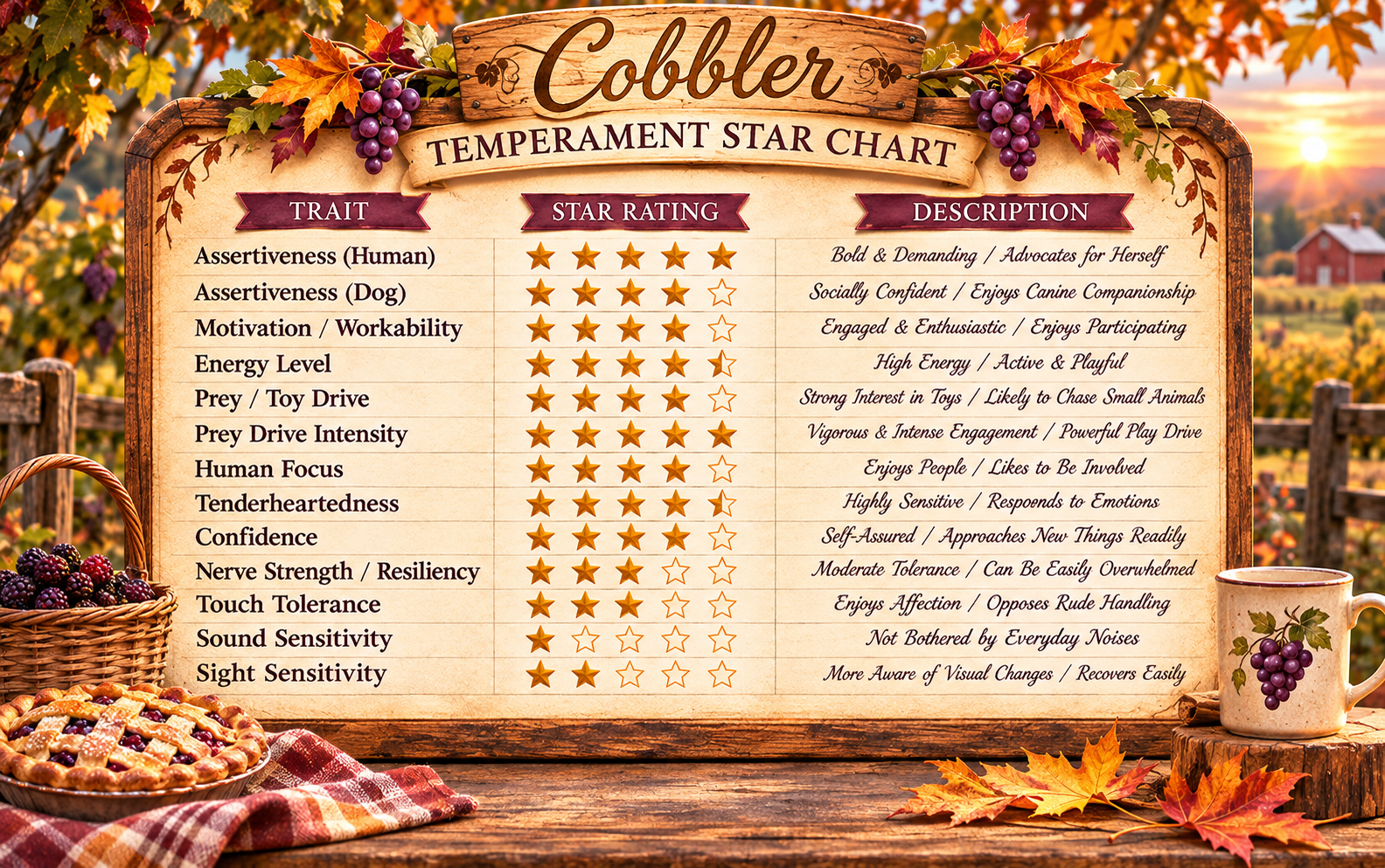
Human Assertiveness — 5/5
Cobbler is very comfortable demanding interaction from people. She jumps up, pushes for attention, and makes it clear when she wants something.
During testing, she demonstrated that she can sit politely to request attention, but this isn't yet her consistent choice. She's struggled more with manding behavior training than any of her littermates.
What this means: Cobbler needs consistent boundaries and impulse control training. Her family must be prepared to avoid rewarding demanding behavior and consistently reinforce polite requests.
Dog Assertiveness — 4/5
Cobbler approached the other dog confidently and assertively, showing a willingness to initiate interaction.
She wasn't excessively physical or pushy and showed genuine interest in canine companionship. During a stressful moment, she even sought out the other dog for reassurance.
What this means: Cobbler would likely enjoy having a compatible canine companion. She's socially confident and interested in relationships with other dogs.
Motivation — 4/5
Cobbler is enthusiastic about activities she enjoys, particularly toys, tugging, retrieving, and interacting with people.
When a task becomes difficult or she doesn't see a reason to continue, she may choose another activity that she finds more rewarding.
What this means: Training will be most successful when Cobbler understands what's in it for her. Her family should use rewards she values while gradually building her willingness to work through challenges.
Energy Level — 4.5/5
Cobbler is one of the most energetic puppies in the litter. She enjoys active play and has plenty of enthusiasm for exploring and interacting with her environment.
She also tends to match the energy around her. Excitement in the household is likely to increase her own excitement.
What this means: Cobbler needs an active family that can provide daily exercise, enrichment, and structured play. Equally important will be teaching her how to settle and relax.
Prey Drive — 4/5
Cobbler demonstrated a strong desire to pursue and engage with moving toys during testing.
Prey drive describes the desire to chase, and this instinct can also extend to cats, small animals, and livestock.
What this means: Cobbler may be strongly inclined to chase smaller animals. Because these instincts can be difficult to reliably override through training, we are not recommending her for homes with small animals or livestock. Avoiding situations where she has access to animals she may pursue is the safest approach.
Prey Drive Intensity — 5/5
Intensity measures how strongly a dog engages with something once it has caught it, rather than simply how motivated it is to chase.
Cobbler demonstrated vigorous toy engagement, including strong tugging and head shaking.
What this means: Cobbler's combination of high prey drive and high intensity reinforces our recommendation against placement in homes with small animals or livestock.
Human Focus — 4/5
Cobbler enjoys people and wants to be part of family activities. She actively seeks interaction and engagement.
However, she's also capable of entertaining herself when her people are occupied. She doesn't need constant physical contact or attention to be content.
What this means: Cobbler is likely to enjoy being in the same room as her family, participating when something interesting is happening, while remaining comfortable playing independently. This makes her a potentially good fit for a working household.
Tenderheartedness — 4.5/5
Cobbler is highly sensitive to the emotional atmosphere around her.
During testing, the evaluator's emotional distress made Cobbler uncomfortable enough that she disengaged. Once the evaluator returned to a calm, dependable emotional state, Cobbler was able to re-engage, settle beside her, and offer comfort.
What this means: Cobbler may find loud arguments, roughhousing, raised voices, or excited yelling during sporting events stressful. She needs a family that recognizes her sensitivity and provides a quiet, safe retreat where she can remove herself from the commotion. Her emotional sensitivity is part of who she is, not a problem to correct.
Confidence — 4/5
Cobbler is confident in herself and comfortable exploring her environment. She approaches people and new experiences with enthusiasm.
However, when something becomes difficult, she may choose to disengage rather than continue working through the challenge.
What this means: Cobbler has a solid foundation of confidence but will benefit from encouragement and opportunities to overcome manageable challenges.
Nerve Strength — 3/5
Cobbler showed several stress responses during testing. When situations became challenging or uncomfortable, she sometimes chose to disengage rather than work through them.
She completed the evaluation without needing the test stopped, but her responses showed a more limited tolerance for stress than some of her littermates.
What this means: Cobbler needs a family that understands and respects her limits. When she's uncomfortable, she should be allowed to step away rather than being pushed to tolerate situations that overwhelm her.
Touch Tolerance — 3/5
Cobbler enjoys affection and is comfortable with normal, respectful interaction.
During temperament testing, we intentionally introduced inappropriate handling, including pulling on her ears and tail. Cobbler objected, grumbled, and communicated that she wanted the handling to stop.
What this means: Cobbler is not a puppy who will quietly tolerate rude or uncomfortable handling. Her family needs to respect her communication and continue developing her comfort with necessary grooming, veterinary care, and handling through positive experiences.

Meet Ember
The Thoughtful Flame
Ember is an affectionate, playful little girl with exceptional human focus, a lovely independent streak, and a growing sense of confidence. She loves being involved with her people, but she's equally happy to entertain herself with a favorite toy. She enjoys connection without needing constant attention, and she has a wonderful ability to settle when the excitement is over.
One of Ember's most endearing qualities is how thoughtfully she communicates with her people. She has absolutely blossomed with her Puppy Culture manding training, consistently offering a polite sit and beautiful eye contact when she wants attention. Rather than becoming demanding, she patiently waits to be acknowledged. It's a wonderful demonstration of her natural human focus, impulse control, and willingness to work cooperatively with her people.
Ember is a girl whose confidence grows through experience. During temperament testing, we watched her approach unfamiliar challenges with some initial hesitation, but with encouragement and a few successful attempts, she began tackling those same challenges independently. She doesn't need someone to rescue her from every uncertainty. She needs someone who believes in her ability to figure things out and gives her opportunities to succeed.
She also has a playful side! Ember loves chasing toys, carrying them away, and settling in for a good chew. She has plenty of energy for play and adventure, but she doesn't become frantic when things get exciting. She can match the energy around her and then bring herself back down when it's time to settle.
Ember is sensitive to unexpected sounds and can become uncomfortable when situations feel overwhelming. When she's had enough, she prefers to remove herself rather than escalate. She's a puppy who communicates her boundaries clearly, and she does best when those boundaries are respected.
With encouragement, consistency, and a family that understands the difference between supporting confidence and creating dependence, Ember has the potential to become a wonderfully connected, playful, and devoted companion.
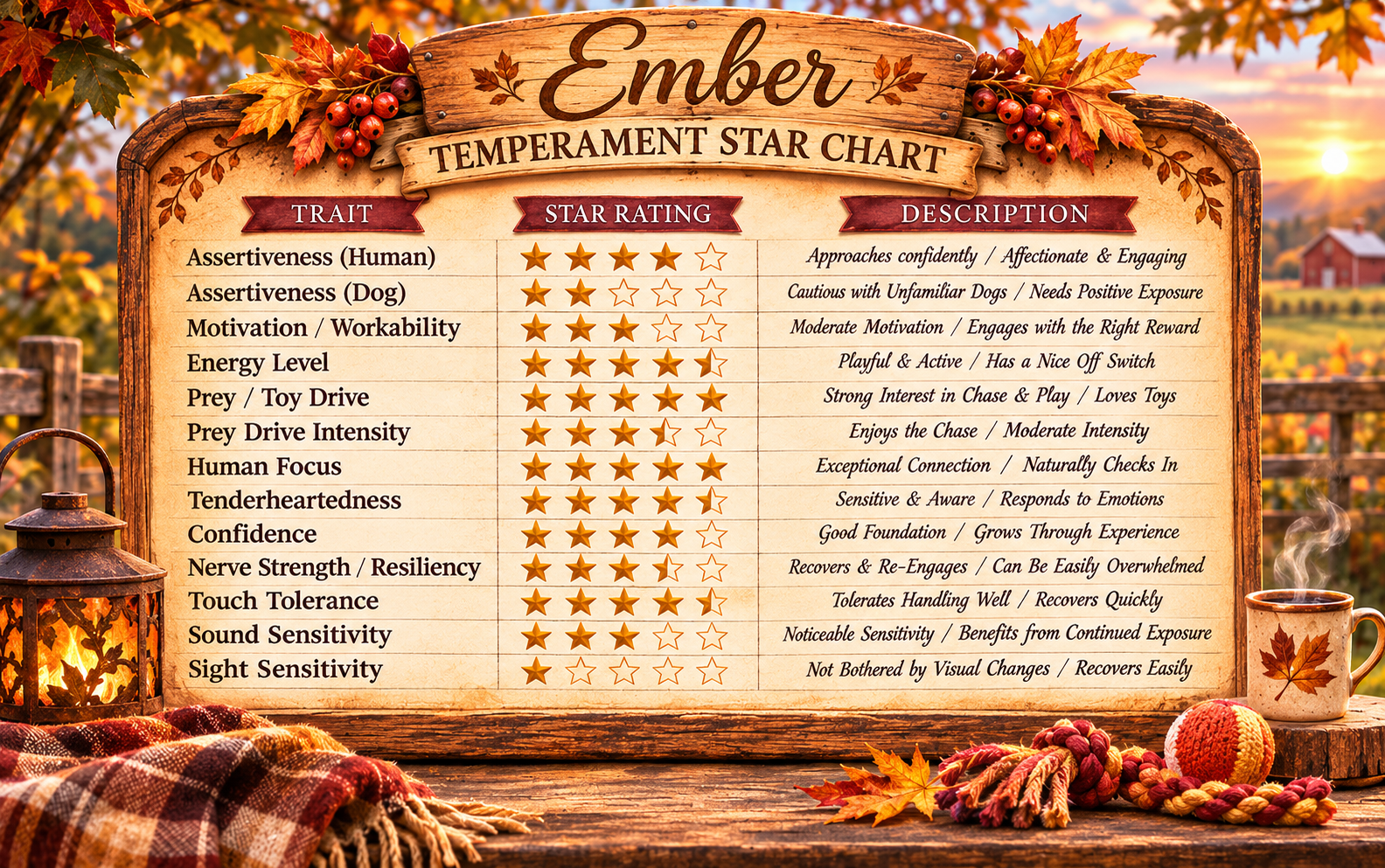
Ember's Ideal Home
Ember will thrive with a family that enjoys an affectionate, interactive companion while appreciating a dog who can also entertain herself. She wants to be included in family life, whether that's playing together, learning something new, or simply enjoying time near her people.
Her ideal family will encourage independence and confidence through positive experiences. Ember responds beautifully to successful learning opportunities, and her people should be willing to introduce unfamiliar situations thoughtfully without rushing to rescue her from every moment of uncertainty.
Ember could do very well with respectful children. During our puppy party, she voluntarily chose to interact with a four-year-old, showing us that she enjoys children when she can approach on her own terms. She needs a family that teaches children to respect her boundaries and provides a designated space where she can retreat without being disturbed. A household with frequent screaming, chaotic play, or unpredictable commotion may be more challenging for her.
She may also do well in a home with cats, although her strong prey drive means a running cat is likely to trigger a chase. Families should be prepared to manage those interactions and teach appropriate boundaries.
Ember would benefit from continued positive experiences with unfamiliar dogs. She was hesitant around other dogs during testing and will need opportunities to develop confidence without being overwhelmed.
Above all, Ember needs consistency. She responds well to clear expectations and respectful boundaries. Her family should continue rewarding calm behavior rather than encouraging escalating excitement.
For the right family, Ember offers a beautiful combination of affectionate companionship, playful enthusiasm, independence, and thoughtful communication.
Continued Development & Training Priorities
1. Building Confidence Through Independence
Ember responds beautifully to encouragement and successful experiences. Continue introducing new challenges in manageable steps, allowing her to work through uncertainty and discover her own capabilities rather than immediately stepping in to help.
2. Sound Confidence & Environmental Resilience
Provide thoughtful, positive exposure to unfamiliar sounds, unpredictable household activity, and new environments. Watch for stress signals and allow her time to recover, helping her develop greater comfort without overwhelming her.
3. Consistent Boundaries & Calm Communication
Continue reinforcing Ember's excellent manding behavior, rewarding polite requests for attention, and maintaining clear expectations. Respect her need for personal space while preserving her natural ability to settle and entertain herself independently.
Prey Drive & Small Animals
Ember has strong prey drive and enjoys chasing moving objects, although her play intensity is more moderate than her desire to pursue.
A running cat may trigger a chase, even if Ember has no intention of harming it. Families with cats or other small animals should use careful introductions, supervision, appropriate management, and consistent training to establish respectful interactions.
Her lower prey drive intensity is encouraging, but it does not eliminate the possibility of chasing.
Working Potential
Ember has several qualities that could make training particularly rewarding, including exceptional human focus, good toy interest, a willingness to learn, and a natural ability to settle.
Her responsiveness to Puppy Culture manding training demonstrates how readily she can learn to offer appropriate behaviors and patiently wait for reinforcement.
She could enjoy recreational obedience, trick training, interactive games, and other activities that strengthen her relationship with her people while allowing her to build confidence.
Ember is not recommended as a public-access service dog or therapy dog prospect. Although she has excellent human engagement, her sound sensitivity, moderate nerve strength, and tendency to withdraw when overwhelmed make the demands of unpredictable public environments a poor match for her current temperament.
She may, however, make a lovely emotional support companion for someone whose lifestyle and environment suit her needs.
Our Placement Recommendation
Ember is best suited to a family seeking an affectionate, playful, people-oriented companion who enjoys connection without requiring constant attention.
She would do particularly well with people who appreciate her natural human focus, enjoy teaching new skills, and understand the importance of helping a thoughtful puppy develop confidence through experience.
Ember could be a lovely match for a family with respectful children, provided she has a quiet place to retreat when she's finished interacting. She may also adapt well to a household with cats when introductions and interactions are appropriately managed.
Her family should be comfortable continuing her confidence development, particularly around unfamiliar sounds and dogs, while maintaining clear and consistent boundaries.
With the right family, Ember has the potential to become a deeply connected, playful, affectionate companion who brings a beautiful sense of calm and companionship to everyday life.
Overall Temperament Summary
Ember is a sweet, affectionate, energetic little girl with exceptional human focus, a wonderful independent streak, and a thoughtful approach to unfamiliar experiences. She loves engaging with her people but is equally comfortable entertaining herself, and her ability to settle is a lovely complement to her playful energy.
Her confidence is still developing, particularly around unexpected sounds and unfamiliar dogs. She responds well to encouragement and quickly gains confidence through successful experiences, making her a puppy who will benefit tremendously from patient, consistent guidance.
Ember is sensitive to her environment and communicates clearly when she needs space. She isn't looking for a family to protect her from every challenge, but rather one that will help her discover how capable she can be.
For a family that appreciates her affectionate nature, respects her boundaries, and enjoys helping a thoughtful puppy grow into herself, Ember has the makings of a truly wonderful companion.
Ember's Temperament Scores — What They Mean
Human Assertiveness — 4/5
Ember approached her evaluator confidently and affectionately, readily entering her personal space and offering plenty of sweet kisses without excessive mouthing or demanding physical interaction.
She enjoys initiating contact and isn't shy about letting her people know she'd like some attention.
What this means: Ember is socially engaging and comfortable approaching people. She will enjoy a family that welcomes her affection while continuing to reinforce polite greetings and respectful boundaries.
Confidence — 4/5
Ember demonstrated a good foundation of confidence, although unfamiliar challenges sometimes required encouragement.
During testing, she initially hesitated with some of the physical obstacles. Once she experienced a few successful attempts, however, she began repeating those challenges independently. She even climbed onto the slide, although she chose not to go down it.
What this means: Ember has excellent potential to build confidence through successful experiences. Her family should encourage her to try new things, allow her to problem-solve, and celebrate her accomplishments without coddling her.
Motivation — Moderate
Ember demonstrated a willingness to work through unfamiliar challenges when we discovered something she found rewarding.
Toy motivation was particularly useful during testing. Once she understood the game and found the reward worthwhile, she was willing to attempt activities she had initially avoided.
What this means: Ember is capable of being an enthusiastic learner when her family identifies what motivates her. Keeping training enjoyable, rewarding, and appropriately challenging will help her continue building confidence.
Nerve Strength & Resiliency — 3.5/5
Ember showed several signs of stress during testing, including stress scratches and shakes when situations became uncomfortable.
Although she was willing to recover and re-engage, she was affected by unfamiliar experiences and occasionally needed time to process what had happened.
When Ember reaches her threshold, her preferred response is to leave the situation rather than confront it.
What this means: Ember needs a family that recognizes her stress signals, respects her need for space, and continues building resilience through positive, manageable experiences. She should be encouraged to develop confidence without being pushed beyond what she can comfortably handle.
Touch Tolerance — 4.5/5
Ember tolerated physical handling well, although some of the more uncomfortable portions of testing produced stress responses.
Importantly, she recovered quickly and returned to positive interaction with her evaluator rather than holding onto the unpleasant experience.
What this means: Ember has a very good foundation for grooming, veterinary care, and everyday handling. Her family should continue practicing cooperative handling while respecting her communication and rewarding her willingness to participate.
Energy Level — 4–4.5/5
Ember is a playful, energetic puppy who readily responds when the energy around her increases.
When her evaluator became more animated, Ember happily joined in. However, she remained in control of herself rather than becoming frantic or excessively aroused.
She also demonstrated a lovely ability to settle when the activity ended.
What this means: Ember will enjoy an active, engaging family that provides opportunities for play, training, and exploration. Her natural off switch is a wonderful quality worth preserving through consistent expectations and by rewarding calm behavior.
Prey Drive — 5/5
Ember demonstrated a strong interest in chasing moving toys and engaging in play.
She enjoys pursuing toys, catching them, and carrying them away to enjoy independently. Her interest in moving objects was clear throughout testing.
What this means: Ember will likely enjoy fetch, interactive toy games, and other activities that allow her to chase and play appropriately. Her strong prey drive also means that running cats or other small animals may trigger chasing behavior, making management and training important.
Prey Drive Intensity — 3.5/5
Although Ember has strong prey drive, her intensity during play was considerably more moderate.
She enjoyed chasing and catching toys but did not demonstrate vigorous shaking, relentless pursuit, or highly intense possession. Once she caught a toy, she was often content to carry it away and chew.
What this means: Ember enjoys the chase without becoming excessively intense during the interaction. Her family should provide appropriate outlets for her prey drive while reinforcing impulse control and respectful play.
Sight Sensitivity — 1/5
Ember demonstrated very little concern about visual changes or movement in her environment.
Visual stimuli were not a significant source of stress during her evaluation.
What this means: Ember is unlikely to be particularly bothered by ordinary visual activity or changes in her surroundings. Her environmental sensitivity is much more closely associated with sound than sight.
Sound Sensitivity — 3/5
Ember demonstrated noticeable sensitivity to unfamiliar or unexpected sounds.
The sound of the fireplace appeared to make her uncomfortable, and additional sound-related challenges required some recovery afterward.
What this means: Ember will benefit from continued thoughtful exposure to a variety of sounds. Familiar household noises may become easier with experience, but sudden, unpredictable sounds deserve particular attention. Her family should help her build positive associations without overwhelming her.
Human Focus — 5/5
Ember demonstrated exceptional natural human focus throughout her evaluation.
She frequently checked in with her evaluator, enjoyed opportunities to engage, and showed a strong interest in participating when interaction was offered.
Her continued progress with Puppy Culture manding behavior has reinforced this observation. Ember consistently offers a polite sit and beautiful eye contact when she wants attention, patiently waiting for someone to acknowledge her.
Importantly, this connection does not come with excessive human dependence. Ember is perfectly comfortable playing independently when her people aren't actively engaging with her.
What this means: Ember has a wonderful foundation for training and companionship. She enjoys working cooperatively with people while maintaining a healthy ability to entertain herself.
Tenderheartedness — 4.5/5
Ember demonstrated sensitivity and concern in response to her evaluator's emotional distress.
She initially attempted to engage but eventually stopped trying to resolve the situation herself. Rather than appearing frightened or completely disengaged, she sought out another person, seemingly looking for help when her own efforts weren't successful.
What this means: Ember is emotionally aware and responsive to her people. Her family should be mindful of how emotional intensity affects her while appreciating her affectionate, connected nature.
Dog Assertiveness — 2/5
Ember approached unfamiliar dogs cautiously and showed some avoidance during testing.
When Siren appeared, Ember chose to hide. She also appeared reluctant to approach Sparkles, preferring to continue playing independently rather than initiate an unfamiliar canine interaction.
What this means: Ember will benefit from positive, carefully managed experiences with other dogs. She should be allowed to approach at her own pace rather than being pressured into interactions before she's comfortable.

Meet Pumpkin
The Confident, People-Loving Gentleman
Pumpkin is a socially generous, friendly, outgoing boy who genuinely enjoys being part of whatever his people are doing. He's confident, playful, and wonderfully engaged, with beautiful eye contact and an enthusiastic “What are we doing next?” attitude. He doesn't need much encouragement to participate, and his natural enthusiasm for working with people makes him a particularly enjoyable puppy to interact with.
One of Pumpkin's greatest strengths is the combination of his confidence, excellent motivation, and strong nerve strength. He's willing to approach unfamiliar experiences, enjoys learning, and has the resilience to recover when something challenges him. He also has a lovely emotional steadiness. He notices what's happening around him without becoming particularly burdened by the feelings of the people he's with.
I see promising potential for Pumpkin as a service dog prospect, therapy dog prospect, or emotional support animal (ESA). His strong human focus, workability, confidence, and emotional resilience give him several qualities I appreciate in dogs being considered for supportive roles. His strong prey drive and intensity will need careful consideration when determining which environments and responsibilities would be appropriate for him, but there is a lot here worth exploring.
Pumpkin also appreciates a relationship built on mutual respect. He's happy to participate, eager to connect, and willing to work with his person, but he wants that relationship to be cooperative. I think he'll thrive with someone who appreciates his enthusiasm, respects his communication, and provides the clear, consistent expectations that help a bright, motivated puppy succeed.
For a family looking for a confident, affectionate companion who genuinely enjoys sharing life with his people, Pumpkin has the makings of a wonderful partner.
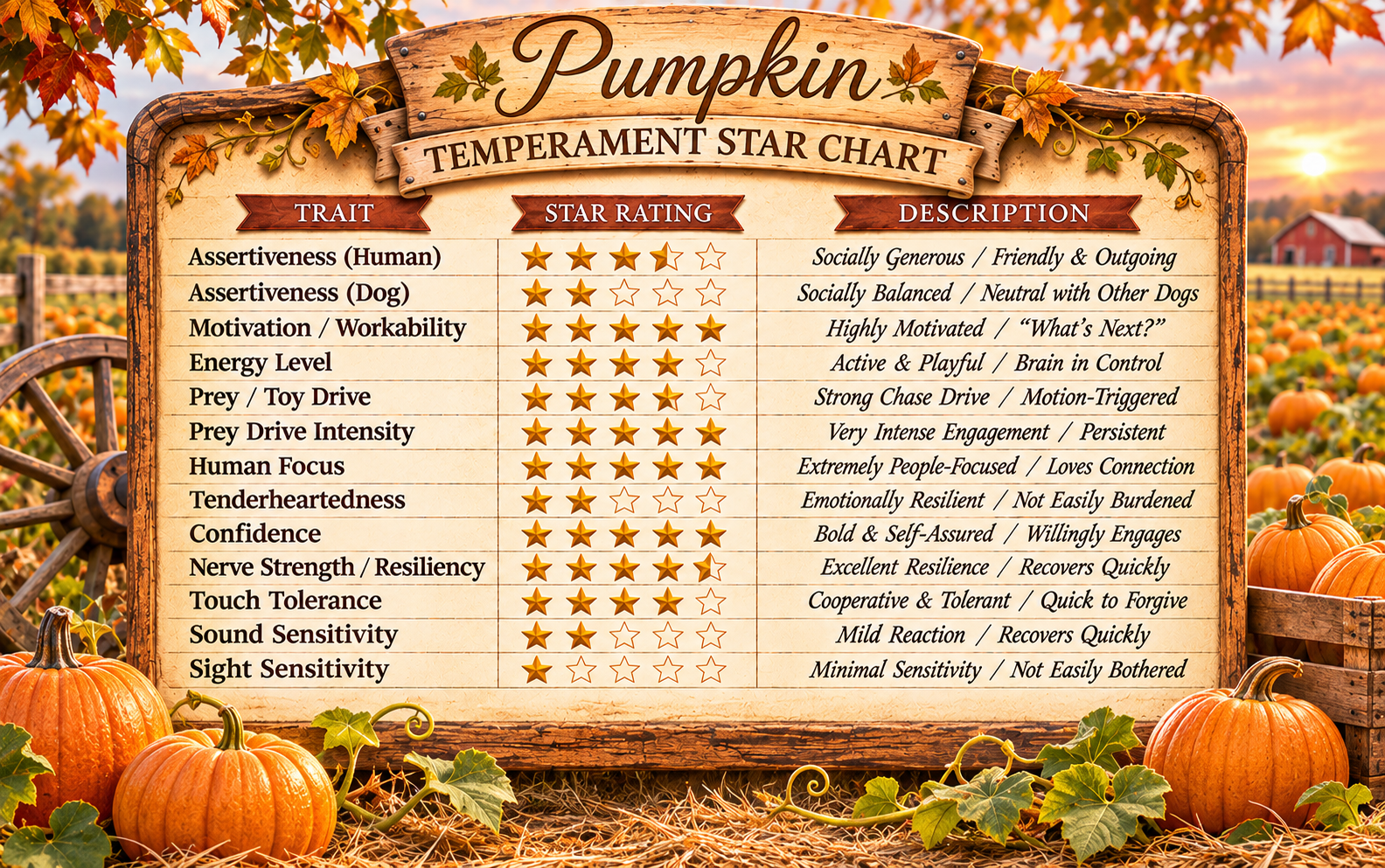
Pumkin’s Ideal home
Pumpkin would be happiest in a home where his people enjoy an active, engaged relationship with their dog. He has a wonderful desire to participate, whether that's learning something new, playing together, practicing good manners, or simply being included in everyday activities.
His motivation is exceptionally high, and I would love to see that natural willingness to work put to good use. He doesn't need someone who plans to compete in dog sports or pursue advanced training, but he does need a family that genuinely enjoys interacting with their dog. He's going to appreciate having things to learn and opportunities to use his brain.
Pumpkin's confidence and emotional resilience make him a promising companion for a variety of lifestyles, including some first-time dog owners who are willing to establish clear boundaries and invest in training. He is socially outgoing without being excessively demanding, and he has the nerve strength to recover from experiences that don't go exactly as planned.
One important consideration is his strong prey drive and intensity. Pumpkin is not my choice for a household with cats, small animals, livestock, or young children whose running and unpredictable play could trigger his chase instinct. A home with older, dog-savvy children who understand appropriate interactions may be worth considering, depending on the family's lifestyle and expectations.
For someone who enjoys an enthusiastic, people-focused dog and is prepared to manage his natural chase instincts, Pumpkin could be a truly rewarding companion.
Continued Development & Training Priorities
1. Building Impulse Control Around Movement
Pumpkin's strong prey drive and high intensity make this an important priority. His family should focus on developing reliable responses to cues, practicing disengagement from movement, and providing safe, structured outlets for his chase instincts.
2. Cooperative Handling & Respectful Boundaries
Pumpkin will benefit from continued positive experiences with grooming, restraint, and veterinary handling. Building cooperation rather than forcing compliance will help him develop trust while learning to accept the necessary handling that comes with everyday life.
3. Channeling His Motivation & Developing an Off Switch
Pumpkin genuinely enjoys participating with people, and I would love to see that enthusiasm encouraged through training, games, and shared activities. Just as importantly, he should learn that relaxing and doing nothing are also valuable skills.
Prey Drive & Small Animals
Pumpkin's prey drive and intensity are important considerations when evaluating his ideal home.
He has a strong desire to chase movement, and his intensity means he may remain highly engaged after reaching a target. This combination requires more than simply teaching a recall cue.
A family with Pumpkin will need to understand that chase instincts are part of his underlying temperament. Training can help him develop better impulse control, but it won't fundamentally change those instincts.
For that reason, I would not recommend Pumpkin for a home with cats, small animals, livestock, or frequent running-child environments. I would much rather place him where his natural temperament fits comfortably into the family's lifestyle than ask everyone to spend their lives managing situations that could have been avoided through thoughtful placement.
Working Potential
Pumpkin has several qualities that could make training genuinely enjoyable. His excellent motivation, strong human focus, confidence, and resilience give him a wonderful foundation for learning and participating alongside his person.
He enjoys engaging with people, offers beautiful eye contact, and seems genuinely interested in what his handler is going to ask of him next.
I could see Pumpkin enjoying structured obedience, trick training, interactive games, and activities that allow him to work cooperatively with his person. His strong toy interest could also be a valuable training reward.
Because of his prey drive and intensity, I would be thoughtful about choosing activities that encourage controlled engagement rather than uncontrolled chasing.
Service Dog Potential
I see promising potential for Pumpkin as a service dog prospect, particularly for psychiatric service work. One of his most valuable qualities is his emotional resilience. With tenderheartedness scoring a 2, Pumpkin can recognize that something is happening emotionally without becoming burdened by his person's distress.
For someone experiencing anxiety, panic attacks, depression, or other significant emotional challenges, this can be especially important. We want a dog who can remain emotionally steady and available to perform trained tasks, rather than becoming anxious or overwhelmed alongside their handler.
Pumpkin also brings exceptional human focus, motivation, confidence, and strong nerve strength. These are qualities that support his potential to develop into a capable working partner.
His prey drive of 4 and intensity of 5 remain important considerations, particularly for public-access work around moving distractions. I would want to carefully consider the handler's needs, working environment, and continued training before recommending him for a specific placement.
What makes Pumpkin particularly interesting for psychiatric service work is the combination of his strong connection to people and his ability to remain emotionally unaffected by their distress. He wants to be involved with his person without needing to take on their emotional burden.
Therapy Dog Potential
Pumpkin's outgoing personality, confidence, human focus, and emotional steadiness give him several promising qualities for therapy work.
He's comfortable engaging with people and doesn't appear easily burdened by their emotions, which may be beneficial in settings where people are experiencing sadness, anxiety, or other difficult feelings.
His touch tolerance is encouraging, although his preferences around restraint will need continued development. His prey drive and intensity also make the specific therapy environment an important consideration.
Emotional Support Animal Potential
I think Pumpkin has particularly appealing qualities for someone seeking an emotional support animal.
His strong desire for human companionship, friendly personality, and emotional resilience could make him a comforting presence without requiring him to absorb or respond to every difficult emotion his person experiences.
He may be especially enjoyable for someone who finds connection through training, play, and having a dog actively participate in everyday life.
As with any ESA placement, the person's lifestyle and ability to meet Pumpkin's activity, training, and management needs must also be considered.
Our Placement Recommendation
For Pumpkin, I would prioritize finding a family that appreciates his confidence, enthusiasm, and natural desire to participate in life alongside his people.
He has several wonderful qualities for a companion home and promising potential for service, therapy, or emotional support work. His motivation and human focus are exceptional, and his confidence and resilience give him a strong foundation for continued development.
At the same time, his prey drive and intensity are not characteristics I would overlook. I want Pumpkin in a home where those instincts can be understood and managed without creating unnecessary challenges for the family or the animals and people around him.
I think he could be a lovely match for a committed first-time owner or an experienced family that enjoys training, establishes consistent boundaries, and wants an enthusiastic, interactive companion.
What matters most is finding the environment where Pumpkin can be appreciated for exactly who he is.
Overall Temperament Summary
Pumpkin is a confident, socially generous, friendly, outgoing boy with exceptional motivation, wonderful human focus, and strong emotional resilience. He genuinely enjoys people and has an enthusiastic willingness to participate in whatever his person has planned.
He's playful and active without being chaotic, and he has the nerve strength to recover when an experience becomes uncomfortable. He appreciates a respectful relationship and responds well to opportunities for cooperative engagement.
I see promising potential for Pumpkin as a service dog, therapy dog, or emotional support animal, particularly in roles where his strong handler orientation and emotional steadiness would be valuable. His high prey drive and intensity will be important factors in determining the right placement and any future working responsibilities.
For a family who enjoys an engaged, enthusiastic companion and is prepared to manage his natural chase instincts, Pumpkin has the potential to be a truly wonderful partner.
He's a boy who wants to share life with his people, and I think the right family is going to find a great deal of joy in that relationship.
Pumpkin's Temperament Scores — What They Mean
Human Assertiveness — 3.5/5
Pumpkin falls between socially balanced and socially bold when it comes to interacting with people. He is friendly, outgoing, and comfortable initiating engagement without needing encouragement.
During testing, he showed us that he enjoys interacting with people and is comfortable expressing his preferences. He isn't an extremely demanding puppy, but he has enough natural assertiveness that consistent expectations will be important.
What this means: Pumpkin should do well with a family that enjoys an outgoing, interactive dog and is comfortable establishing polite manners and clear boundaries. He doesn't need a heavy-handed approach, but he will benefit from people who mean what they say and follow through consistently.
Confidence — 5/5
Pumpkin demonstrated exceptional confidence throughout his evaluation. He approaches unfamiliar experiences with boldness and self-assurance, showing a natural willingness to engage with the world around him.
He's a puppy who believes he can handle what's in front of him, and that gives us a wonderful foundation for continued learning and environmental exposure.
What this means: Pumpkin is naturally comfortable approaching new experiences, which can be particularly valuable for families who enjoy including their dogs in everyday activities. Continued opportunities to explore, make choices, and experience success will help preserve and strengthen that confidence.
Motivation — 5/5
Pumpkin's motivation is one of his standout qualities. He genuinely enjoys participating with his person and is enthusiastic about having something to do.
His beautiful eye contact was especially noticeable during testing. He frequently looked toward his evaluator, ready for the next opportunity to engage.
He also showed excellent toy interest, giving us another rewarding way to build interaction and training.
What this means: Pumpkin is a puppy who will appreciate regular opportunities to learn and work with his family. His natural motivation could make training particularly enjoyable, provided his people are willing to offer consistent engagement. He isn't necessarily asking for constant physical exercise; he's asking to be included and given something meaningful to do.
Nerve Strength — 4.5/5
Pumpkin demonstrated excellent resilience throughout his evaluation. He was able to experience something uncomfortable, recover, and continue engaging with his evaluator.
We observed a brief de-stress scratch following handling, which tells us that the experience created some stress. What impressed me was his ability to move forward afterward rather than remaining emotionally affected.
What this means: Pumpkin has strong environmental resilience, which is valuable in an active family home and particularly important when considering service or therapy work. His confidence helps him approach challenges, while his nerve strength helps him recover when those experiences become stressful.
Touch Tolerance — 4/5
Pumpkin generally accepted handling, although he made it clear that restraint wasn't his favorite part of the evaluation. He was comfortable with other physical handling and was willing to return to positive engagement once the uncomfortable experience ended.
What I appreciate is his willingness to forgive and reconnect. He didn't allow one unpleasant experience to interfere with his relationship with the evaluator.
What this means: Pumpkin will benefit from a respectful, cooperative approach to grooming, veterinary care, and everyday handling. His family should continue helping him become comfortable with necessary restraint while listening to his communication and building trust through positive experiences.
Energy Level — 4/5
Pumpkin is an active, playful puppy who enjoys movement and engagement, but he also demonstrated the ability to pause and observe what was happening around him.
His activity level is high without being chaotic. His brain remains in control of his body, which is an important distinction in our energy scoring.
What this means: Pumpkin will appreciate an active lifestyle with regular opportunities for exercise, play, and mental engagement. He also has the foundation for developing good settling habits, although his family should expect him to remain a naturally active dog as he matures.
Prey Drive — 4/5
Pumpkin has a strong, motion-triggered chase instinct. When something runs, he wants to chase it.
This isn't simply an interest in toys or playful enthusiasm. Prey drive is a natural response to movement, and Pumpkin demonstrated a strong desire to pursue moving targets.
What this means: Running children, squirrels, cats, livestock, and other fast-moving animals may trigger Pumpkin's chase instinct. His family will need to be proactive about supervision, management, and impulse-control training. Recall and self-control can improve, but his natural desire to chase should not be expected to disappear.
Prey Drive Intensity — 5/5
Pumpkin demonstrated very high intensity once engaged with a target. During testing, we saw vigorous toy engagement, including strong head-shaking behavior.
Intensity is different from prey drive. Prey drive tells us how strongly a puppy wants to chase something. Intensity tells us what happens after the puppy catches it.
With Pumpkin, this combination deserves particular attention because he has both a strong desire to chase and a very high level of engagement once he reaches his target.
What this means: Pumpkin needs a family that understands how to manage chase behavior and arousal. I would not recommend him for homes with cats, small animals, livestock, or young children whose running could trigger this instinct. Appropriate outlets, clear boundaries, and impulse-control training will be important throughout his life.
Sight Sensitivity — 1/5
Pumpkin demonstrated minimal sensitivity to unusual visual stimuli during testing.
He was comfortable with the visual challenges presented and did not show meaningful concern or avoidance.
What this means: Pumpkin's low visual sensitivity is encouraging for a dog who may encounter unfamiliar objects and changing environments. This is a particularly useful characteristic when considering public-access training, although continued positive exposure remains important.
Sound Sensitivity — 2/5
Pumpkin showed mild awareness of unexpected sounds. He reacted to the popper and gave a more noticeable startle when the umbrella closed with an unexpected click.
He was able to recover and continue participating in the evaluation.
What this means: Pumpkin may notice or briefly startle at sudden, unfamiliar noises, but he did not demonstrate prolonged distress. Continued positive experiences with everyday sounds will help him develop familiarity and confidence in different environments.
Human Focus — 5/5
Pumpkin is extremely people-focused, and his beautiful eye contact was one of the most memorable parts of his evaluation.
He naturally looks toward his person and enjoys being involved in whatever is happening. He doesn't need to be persuaded to engage; that connection is something he actively seeks.
Importantly, we did not identify Pumpkin as human-dependent during testing. He has a strong preference for human companionship without having demonstrated an inability to function independently.
What this means: Pumpkin will likely enjoy being a close companion who participates in his family's activities. His natural handler orientation is especially appealing for training and potential working roles. I would still encourage his family to continue practicing healthy independence so he learns to feel comfortable when his people aren't immediately available.
Tenderheartedness — 2/5
Pumpkin is emotionally resilient and relatively unaffected by the emotions of the people around him.
During our evaluation, when his handler simulated emotional distress, Pumpkin observed the situation but wasn't particularly compelled to intervene. He was comfortable returning his attention to other activities rather than becoming emotionally involved.
This doesn't mean Pumpkin isn't affectionate or connected to people. It means their emotional distress doesn't automatically become his distress.
What this means: Pumpkin may be particularly well suited to families where emotions sometimes run high. His emotional steadiness is also a promising quality for psychiatric service work, therapy work, and emotional support, where we often want a dog who can remain comfortable and functional when a person is experiencing difficult feelings.
Dog Assertiveness — 3/5
Pumpkin demonstrated a relatively neutral approach to the other dog during testing.
He wasn't particularly driven to initiate interaction, but he was willing to engage when encouraged. We didn't observe strongly submissive or socially forceful behavior.
What this means: Pumpkin's evaluation suggests a socially balanced approach to other dogs. As with any puppy, continued positive social experiences and appropriate introductions will be important as he matures.
Finding the Right Harvest
Every puppy deserves a home where they can truly thrive.
Now that you've gotten to know the puppies, it's time to consider your own household just as carefully.
Is your home busy or quiet? Do you have young children or other pets? How much time and energy do you enjoy putting into training? What kind of relationship do you envision sharing with your dog?
It's easy to fall in love with a sweet face, a beautiful coat, or a favorite puppy photo. But when those preferences conflict with what your household needs, temperament should always come first.
The most important question is simple:
Does this puppy's whole temperament, including the traits that may challenge us, make sense for the life we actually live?
A Good Match Is Still a Puppy
Even the best temperament match will still be a puppy! There will be chewing, potty accidents, excitement, boundary testing, and plenty of learning along the way.
A good match doesn't eliminate puppyhood. It means you're starting with a puppy whose natural temperament makes sense for your family and the life you'll build together.
Wondering what those first weeks and months will look like? Learn more about What to Expect During Puppyhood.
Which Autumn Harvest Puppy Fits Your Family?
It's time for our Autumn Harvest puppies to find their families!
When your turn arrives, review the profiles of the puppies available to you and consider which temperaments best suit your household. There may be more than one wonderful match!
We're here to answer questions, share our observations, and help you recognize any significant compatibility concerns. If none of the available puppies meets an important need for your family, waiting for another litter is always an acceptable choice.
Every puppy deserves the right home, and every family deserves the right puppy.
Now it's time to bring them together!