
Honey & Pippin’s “Summer Bugs” - Petite Goldendoodles
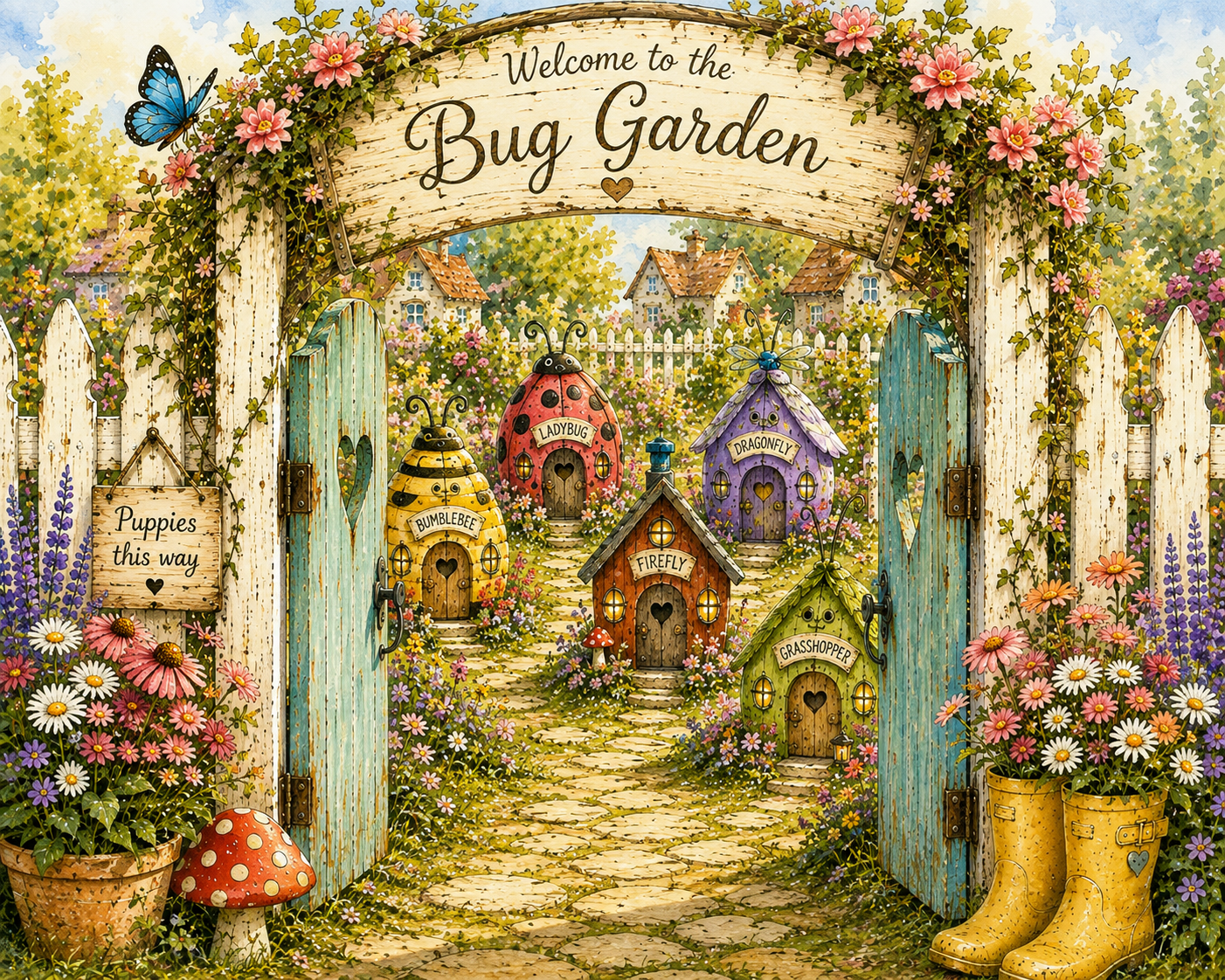
The Summer Bugs are ready to spread their wings.
Jump to a Summer Bug:
Bumblebee • Ladybug • Firefly • Dragonfly • Grasshopper
Born June 27, 2026
The Summer Bugs have grown from five tiny newborns into five very individual little dogs, and we've reached one of our favorite milestones: temperament testing is complete, puppy profiles are ready, and it's time to start thinking about which puppy makes sense for your family.
This page is here to help you understand what we learned during testing, what those results may look like in everyday life, and what we see as the strengths, needs and best-fit home for each Summer Bug.
How We Evaluate the Summer Bugs
Our puppy profiles are based primarily on each puppy's individual temperament test. The test gives us a structured way to evaluate how a puppy responds to people, pressure, novelty, challenges, handling, movement, sound and other experiences without their littermates influencing their responses.
We then interpret those results using what we know about that puppy. When weeks of consistent observation give us additional information or a testing response doesn't appear representative of the puppy we know, we take that into consideration and may adjust our interpretation accordingly.
The result isn't simply a record of what happened during a test. It's our assessment of the puppy's temperament and what those characteristics may mean for the family who takes them home.
Understanding the Temperament Charts
Each puppy's chart scores 14 temperament parameters from one to five stars. The stars indicate how much of that particular trait we observed: fewer stars mean less of the trait and more stars mean more of it.
So ★★★★★ Energy means a lot of natural energy, while ★★★★★ Human Focus means very strong natural orientation toward people. The meaning depends entirely on the trait being measured.
There is no total score. The chart is meant to be read as a profile, with the written evaluation explaining how those characteristics come together in that puppy.
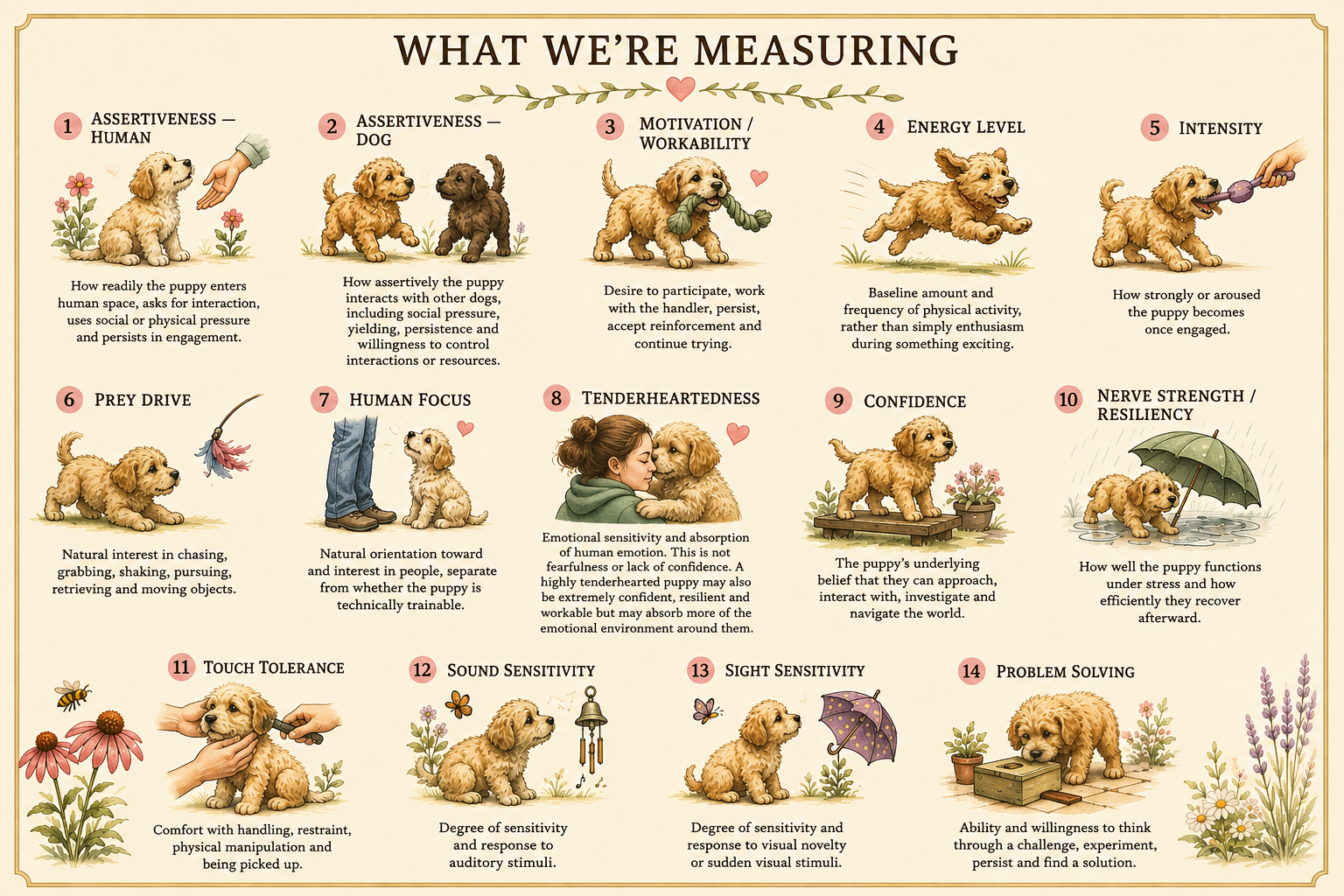
What We're Measuring
Assertiveness — Human — How readily the puppy enters human space, asks for interaction, uses social or physical pressure and persists in engagement.
Assertiveness — Dog — How assertively the puppy interacts with other dogs, including social pressure, yielding, persistence and willingness to control interactions or resources.
Motivation / Workability — Desire to participate, work with the handler, persist, accept reinforcement and continue trying.
Energy Level — Baseline amount and frequency of physical activity, rather than simply enthusiasm during something exciting.
Intensity — How strongly or aroused the puppy becomes once engaged.
Prey Drive — Natural interest in chasing, grabbing, shaking, pursuing, retrieving and moving objects.
Human Focus — Natural orientation toward and interest in people, separate from whether the puppy is technically trainable.
Tenderheartedness — Emotional sensitivity and absorption of human emotion. This is not fearfulness or lack of confidence. A highly tenderhearted puppy may also be extremely confident, resilient and workable but may absorb more of the emotional environment around them.
Confidence — The puppy's underlying belief that they can approach, interact with, investigate and navigate the world.
Nerve Strength / Resiliency — How well the puppy functions under stress and how efficiently they recover afterward.
Touch Tolerance — Comfort with handling, restraint, physical manipulation and being picked up.
Sound Sensitivity — Degree of sensitivity and response to auditory stimuli.
Sight Sensitivity — Degree of sensitivity and response to visual novelty or sudden visual stimuli.
Problem Solving — Ability and willingness to think through a challenge, experiment, persist and find a solution.
Curious how temperament testing works? Learn more about our Temperament Testing process
Temperament, Development & Training
Temperament gives us a picture of the puppy's natural tendencies, but puppies are still developing. What happens next matters.
Some characteristics we evaluate are relatively core pieces of temperament, while others can be influenced more significantly through thoughtful exposure, socialization, life experiences, training and maturity. Early experiences can build confidence, strengthen resiliency, help puppies learn how to navigate novelty and give them a larger set of skills for handling the world around them.
That is one reason we put so much emphasis on intentional exposure and socialization while our puppies are with us—and why continuing that work after they go home is so important. The goal isn't simply to expose a puppy to more things. It's to give them appropriate experiences that help them learn how to process new things successfully.
Training then helps shape how those natural traits are expressed in everyday life. A high-energy puppy can learn to settle. An assertive puppy can learn manners and boundaries. A puppy with lower natural human focus can develop wonderful engagement and recall.
We don't want families choosing a puppy based primarily on who they believe they can turn that puppy into. Start with a temperament that makes sense for your life, then use socialization, exposure and training to help that puppy become the best version of who they already are.
Meet the Summer Bugs
Five little bugs. Five wonderfully individual personalities.
Now that you know how to read their results, let's meet the puppies behind the bug names.

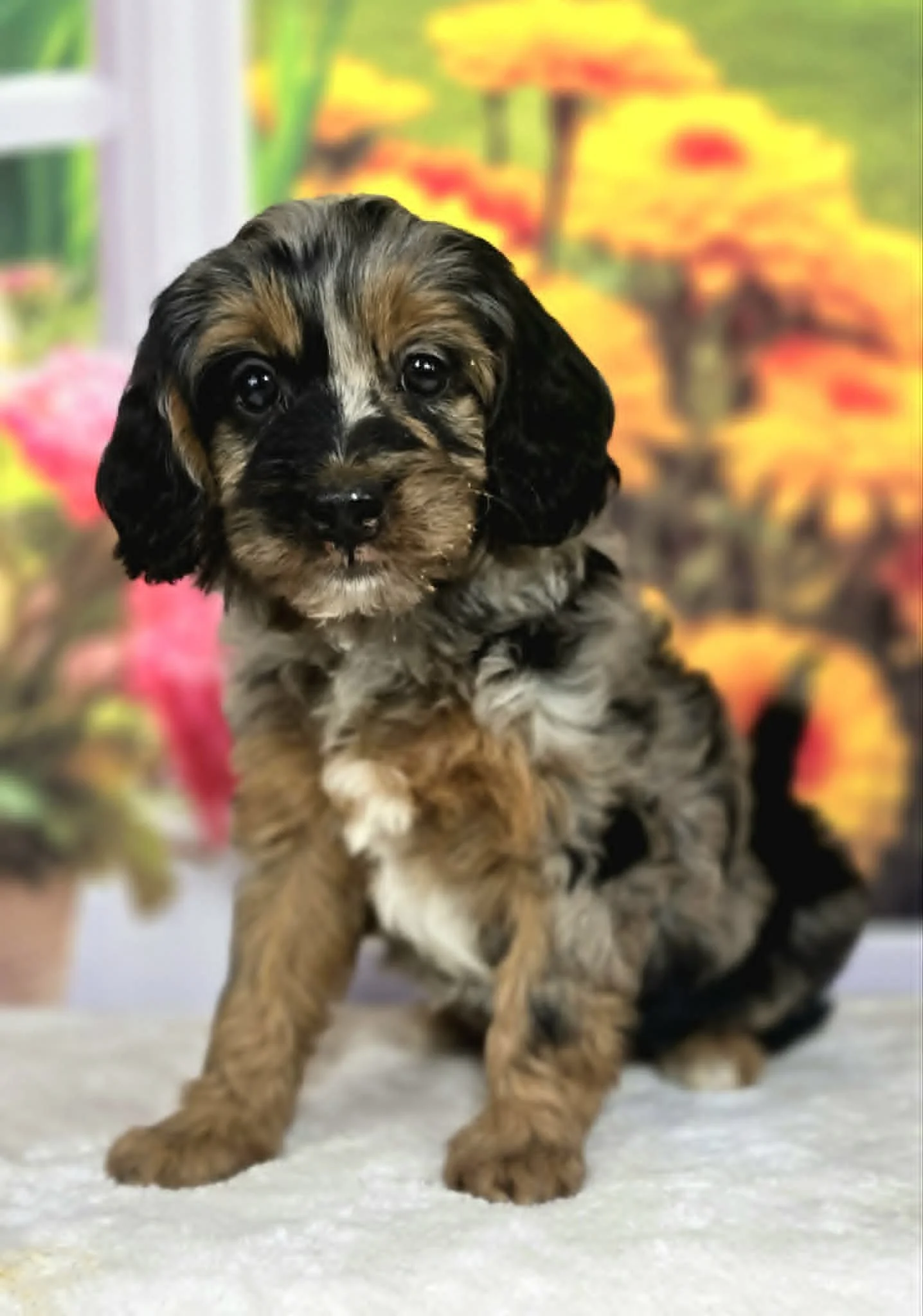
Meet Bumblebee
Reserved
Bumblebee is a sweet, mild-mannered little girl with a thoughtful way of approaching the world. She likes to take things in before deciding what she thinks, and in a brand-new environment she may spend some time watching, sniffing and gathering information before fully settling in. Once she does, her affectionate, playful side comes out and she is happy to engage with her people.
She has a wonderful moderate energy level and isn't a puppy who needs to be constantly entertained. Bumblebee can play with you, enjoy a toy, explore with her nose and then happily spend some time entertaining herself. She has a particularly good nose and genuinely enjoys using it. When she finds an interesting scent, she can become very absorbed in what she's doing.
She has a wonderful moderate energy level and isn't a puppy who needs to be constantly entertained. Bumblebee can play with you, enjoy a toy, explore with her nose and then happily spend some time entertaining herself. She has a particularly good nose and genuinely enjoys using it. When she finds an interesting scent, she can become very absorbed in what she's doing.
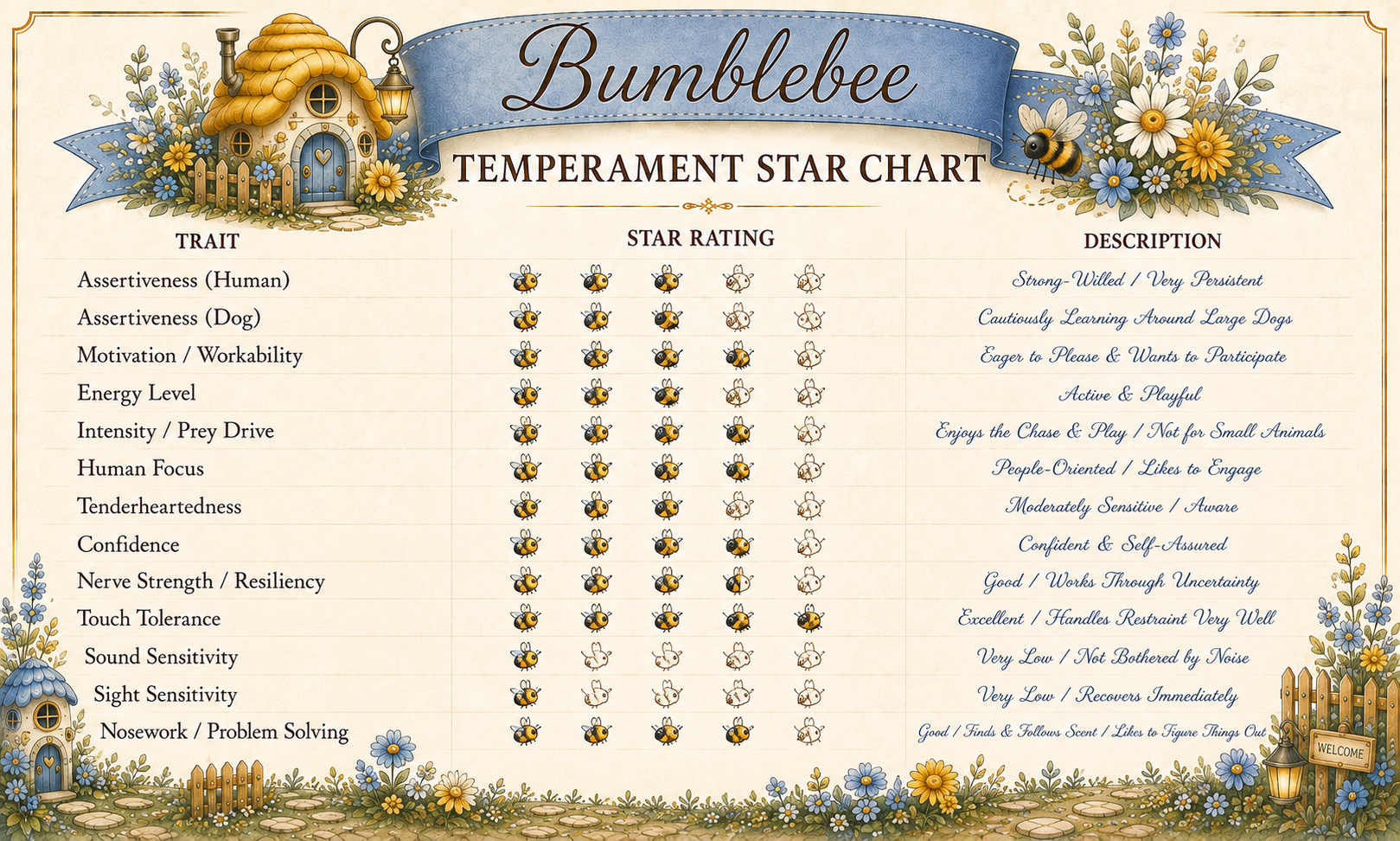
Strengths
Sweet and easy to handle: Bumblebee has excellent touch tolerance and was very accepting of being held, touched and physically handled. She is naturally affectionate without needing to be attached to someone every second.
Thoughtful confidence: She is confident, but she isn't reckless. Bumblebee tends to assess something unfamiliar before deciding to participate. With encouragement, she was willing to work through several things that initially made her unsure.
Toy motivated: Toys are meaningful to Bumblebee and were useful for encouraging her through challenges. She enjoys playing and has enough motivation to make training fun without being overwhelmingly driven.
Excellent nose: Bumblebee naturally uses scent to investigate and problem-solve. She searched for toys with her nose and can become completely absorbed in an interesting smell. Scent games, nose work and "find it" activities could be especially enjoyable outlets for her.
Able to self-entertain: She doesn't require constant interaction to be content. Bumblebee can enjoy her own toys and exploration, which is a nice quality for a family companion.
Moderate energy: Bumblebee has a nice middle-of-the-road activity level. She will enjoy playing, exploring, walks and adventures, but she doesn't appear to need a household built around keeping up with an extremely high-energy dog.
Areas to Continue Building
Environmental exposure: Bumblebee can be very aware of unfamiliar sights, sounds and situations. She may stop, watch or alert bark while she figures out what she's seeing. Continued positive exposure to different environments, noises, people and everyday life will be important for helping her learn that unusual things don't always require concern.
Unstable surfaces: Wobbly or shifting footing was harder for her than solid obstacles. She could work through some of this with encouragement and motivation, but this is an area where continued confidence-building would benefit her.
Working through uncertainty independently: Bumblebee responds well to calm encouragement when something feels questionable. Her family should give her opportunities to investigate and succeed rather than immediately rescuing her from everything that makes her hesitate. She needs support without being taught that uncertainty means something is dangerous.
Engagement around interesting smells: Bumblebee likes people, but her nose can occasionally win. If she discovers something fascinating, she may become very focused on investigating it. Building recall, check-ins and engagement around distractions will be important.
Other Dogs
Bumblebee is not naturally pushy with other dogs. When she was uncertain about another dog, she was more likely to observe, alert and keep some distance than confidently march in and take over.
She should benefit from positive experiences with calm, socially appropriate dogs that allow her to approach and investigate at her own pace. She does not need another dog to make decisions for her, but a stable canine companion could be a nice match.
Prey Drive & Small Animals
Bumblebee showed a moderate level of prey and toy drive. She enjoys chasing and engaging with toys, but this did not appear to dominate everything she did during testing.
As with any puppy, appropriate introductions and supervision around cats, small pets and livestock are still important. Her testing did not give me a reason to automatically rule out a home with other animals, but puppy temperament testing cannot guarantee how an individual dog will respond to every species as she matures.
Working Potential
Bumblebee has several qualities that could make training genuinely enjoyable: good motivation, excellent touch tolerance, toy interest, curiosity and a particularly useful nose. I could see her having a lot of fun with recreational nose work, scent games or other activities that allow her to investigate and problem-solve.
Bumblebee could also make a very nice Emotional Support Animal (ESA). She is affectionate, enjoys physical closeness and has a softer, companionable nature without needing constant attention. Her moderate energy and ability to self-entertain are also nice qualities for someone looking for a dog who can provide companionship and emotional support while still being comfortable simply hanging out alongside their person.
I do not consider Bumblebee one of my stronger service-dog prospects. Her environmental awareness and tendency to need time to process unfamiliar situations are more significant considerations for work requiring a dog to remain consistently neutral across unpredictable environments.
She doesn't need a formal job, though. For the right family, simply being a wonderful companion may be exactly the job she is best suited for.
Best Fit Home
Bumblebee should do especially well with a family that wants a moderate-energy, affectionate companion who isn't constantly demanding attention.
She would appreciate people who enjoy walks, play, training and exploring with their dog while also valuing a dog who can entertain herself and settle into everyday family life.
Her ideal family will be willing to continue thoughtful socialization and exposure rather than either forcing her through uncertainty or avoiding everything she finds questionable. Calm encouragement, opportunities to investigate and lots of successful experiences should help her continue building confidence in the world around her.
A very loud, unpredictable or constantly chaotic household may not bring out her best. She is likely to appreciate a home with some consistency and people who understand that she sometimes needs a moment to look at something before deciding it's okay.
Overall Temperament Summary
Bumblebee is a sweet, moderate-energy, observant little girl with an affectionate nature, a great nose and a nice independent streak. She enjoys her people but doesn't need them to entertain her every second, and she has enough motivation and toy interest to make training rewarding.
She isn't the puppy who blindly assumes everything new is wonderful. Bumblebee notices her environment. She thinks about unfamiliar things, and sometimes she needs a little encouragement before deciding she's willing to try.
Once she feels comfortable, however, there is a playful, curious and engaging puppy underneath that initial watchfulness.
For a family willing to continue building her environmental confidence while appreciating her softer, thoughtful personality, Bumblebee has the makings of a really lovely companion.
Meet Ladybug
Available as a Guardian placement
• Service Prospect
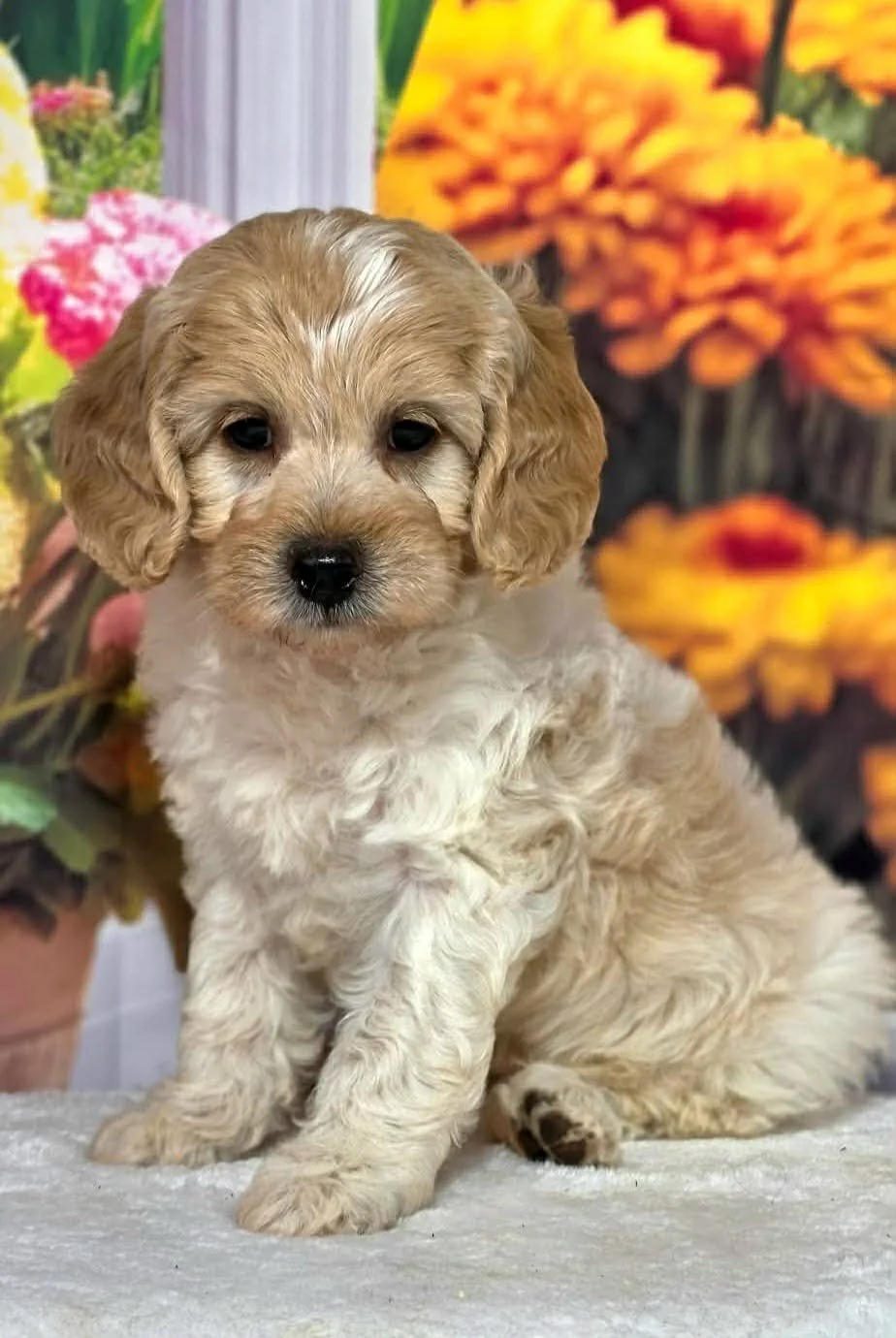
Ladybug is a confident, outgoing, highly people-focused little girl who wants to be right in the middle of whatever her people are doing. She is playful, enthusiastic, socially forward, and very eager to participate. Ladybug isn't looking to sit back and watch life happen—she wants to be part of it.
She approaches people very directly and happily, readily climbing into a lap and engaging in play. She has a fun, expressive personality and brings a lot of enthusiasm to interaction. She loves toys, enjoys tugging and chasing, and has a very “Golden” tendency to pick things up and proudly carry them around.
Ladybug also has a lot of energy. Right now, her “go” button works considerably better than her “off” switch. Once she's excited, she can have a hard time bringing herself back down, particularly when the people around her are also animated. Fast movement and exciting play can send her energy higher very quickly.
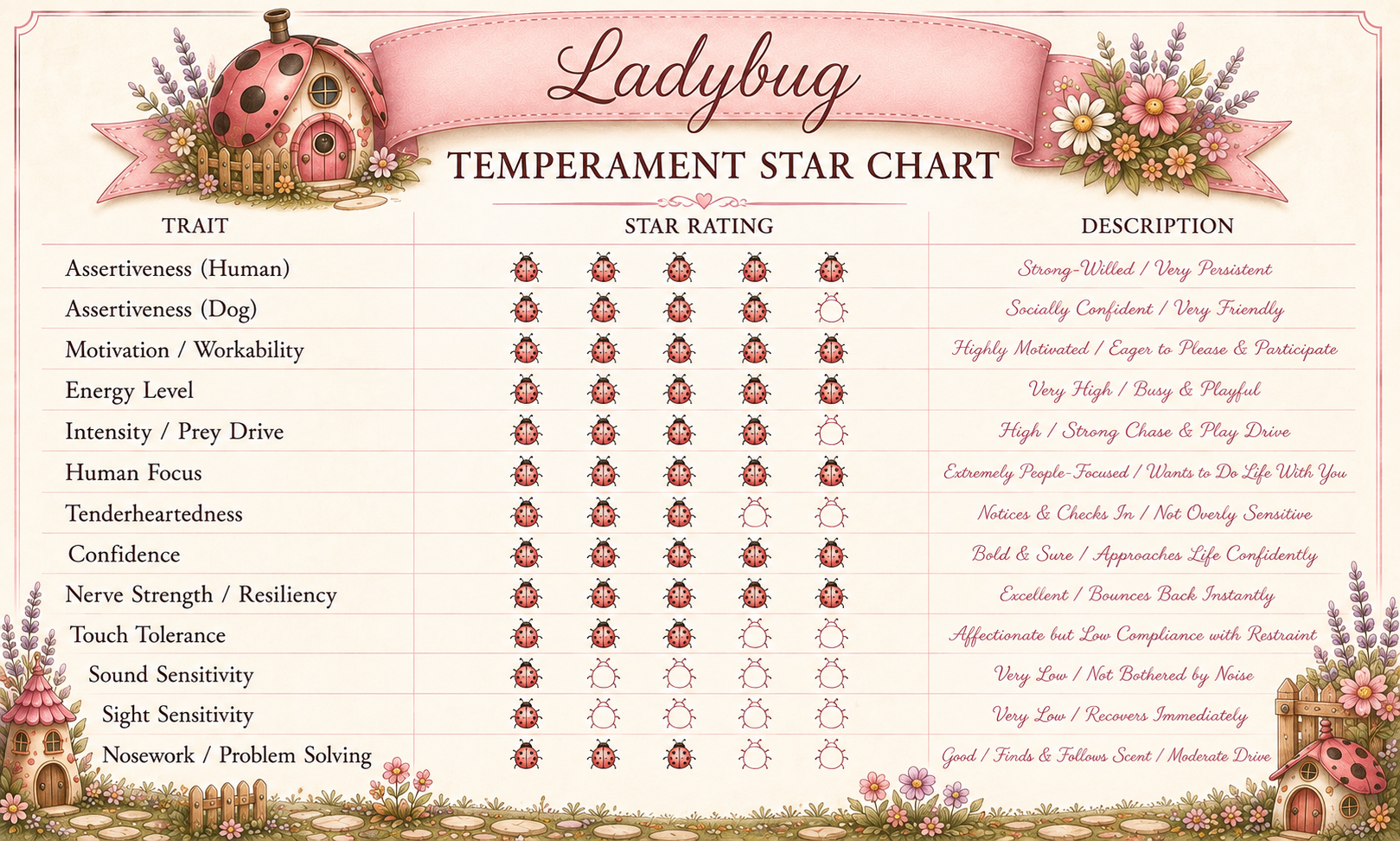
Despite all that enthusiasm, Ladybug is environmentally confident and resilient. When something startled her significantly during testing, she recovered almost immediately, reengaged, and went back to investigate. She isn't a puppy who appears inclined to remain worried about something after the moment has passed.
Strengths
Extremely human-focused: Ladybug genuinely wants to do things with her people. She follows interaction readily, checks in, responds to engagement, and wants to know, “What are we doing?” Her interest in people is one of her strongest qualities.
Confident and resilient: Ladybug approaches life boldly. She showed excellent recovery when startled and was willing to immediately return and investigate rather than avoiding what had surprised her.
Eager to learn and participate: She is enthusiastic about interaction and readily engages when someone asks something of her. That combination of motivation and human focus gives her a lot to work with in training.
Social and affectionate: Ladybug seeks people out and is comfortable getting physically close. She readily comes into a lap and enjoys being involved with her humans.
Playful and toy-motivated: She enjoys chasing, tugging, carrying toys, and interactive play. She can become frustrated when she can't take possession of something she wants, but her toy interest provides another useful avenue for training and enrichment.
Emotionally aware without being overly sensitive: Ladybug notices what is happening with her people and showed that she will check in when something seems wrong. At the same time, she doesn't appear to become heavily emotionally affected by normal human emotion.
Areas to Continue Building
Off switch and arousal regulation: This is probably Ladybug's biggest developmental priority. She is a high-energy puppy who gets excited easily, and excitement tends to create more excitement. She will need to intentionally learn how to settle, disengage, and come back down after play.
Her family should reward calm behavior just as intentionally as they reward engagement. Not every interaction needs to become bigger, faster, or more exciting.
Impulse control and frustration tolerance: Ladybug has opinions about what she wants to be doing. During testing, she became frustrated when prevented from taking a toy and when physical restraint interrupted what she wanted to do. She needs continued practice learning that she won't always immediately get what she wants and how to handle her frustration
Handling and restraint: Ladybug is affectionate and enjoys physical interaction, but affection and restraint are not the same thing. When she was held in place while she wanted to continue participating, she showed clear signs that she wanted to be released.
This isn't a puppy who doesn't want to be touched. It is a busy puppy who doesn't particularly appreciate being told, “You're staying here now,” when she has other plans. Calm, positive handling exercises will help her learn to relax during grooming, veterinary care, being held, and other situations where cooperation is necessary.
Independence and alone-time skills: Ladybug loves being with her people and wants to be included in whatever is happening. That strong human focus is one of her wonderful qualities, but it also means independence needs to be intentionally taught.
Her family should be comfortable practicing age-appropriate crate time, short periods of separation, independent settling, and allowing her to work through reasonable frustration rather than immediately giving in to her protests. Ladybug needs to learn that being apart from her people is safe, temporary, and completely normal.
Children & Family Life
Ladybug can become very excited around animated people. During her interaction with a child, simply having someone moving quickly and enthusiastically around her brought her energy level up significantly. Running, chasing, squealing, wrestling, and highly animated play are likely to encourage her to become even more wound up.
That doesn't mean Ladybug can't live with children. It means she needs a family where adults will actively manage puppy/child interactions and teach both the puppy and the children appropriate boundaries. Children who can participate in training, structured play, and calm interaction could be a lot of fun for her.
A household that encourages constant chasing and rough, escalating puppy play would make it much harder for Ladybug to develop the self-regulation she needs.
Prey & Toy Drive
Ladybug has a good amount of chase and toy drive. She enjoys following moving toys, tugging, and carrying her treasures around, and movement is likely to catch her attention. She can also become frustrated when she isn't allowed to take possession of something she wants, so “drop,” “leave it,” trading games, and appropriate tug rules will be useful skills to develop early.
Around cats, small pets, poultry, or livestock, we would still expect her chase instinct to come into play—particularly if an animal runs. Her family should plan to supervise introductions carefully, prevent rehearsing chase behavior, and teach appropriate boundaries from the beginning. Based on what we've observed, however, I would not label Ladybug as automatically unsuitable for a home with small animals. Her test showed chase interest and play drive, but not enough for me to make that stronger claim.
Her drive gives her family plenty of opportunities for interactive training and enrichment while still allowing her to remain very connected to her person.
Best Fit Home
Ladybug will do best with a family who genuinely enjoys an enthusiastic, interactive puppy. She isn't the puppy for someone specifically wanting naturally low energy or a puppy who is content to spend most of her time entertaining herself.
She would thrive with people who enjoy training, playing, taking their dog places, and making their dog part of everyday life—but who also understand that one of the most important things they can teach her is how to not be involved every minute of the day.
Her ideal family will provide structure without dampening her wonderful enthusiasm. They'll teach calmness, independence, impulse control, appropriate play, and frustration tolerance while giving her plenty of healthy outlets for her social and playful personality.
Service Potential
Ladybug has several qualities that can be very desirable in a potential service prospect: excellent human focus, confidence, environmental resilience, strong recovery, social engagement, and an eagerness to participate with her handler.
Her biggest developmental considerations would be her current arousal level, off switch, frustration tolerance, restraint tolerance, and ability to become comfortable working independently from her people when appropriate. Those are skills that would need to be developed rather than assumed.
She has service potential, but as with any young puppy, temperament testing identifies promising traits rather than guaranteeing an adult outcome.
Overall Temperament Summary
Ladybug is a confident, resilient, playful, highly social puppy who wants to do life with her people.
She brings enthusiasm to almost everything she does. She wants to participate, she wants to play, she wants to know what everyone is doing, and she isn't shy about inserting herself into the action. She has excellent human engagement and recovers quickly when something surprises her.
The flip side of that wonderfully social nature is that Ladybug needs to learn that she doesn't have to participate in everything. Settling, waiting, tolerating frustration, being calmly handled, and spending comfortable time away from her people will be especially important parts of her development.
With a family willing to put as much effort into teaching her calm and independence as they put into playing and engaging with her, Ladybug has the foundation to grow into an incredibly fun, connected, trainable companion.
Meet Firefly
Reserved
•Great for kids
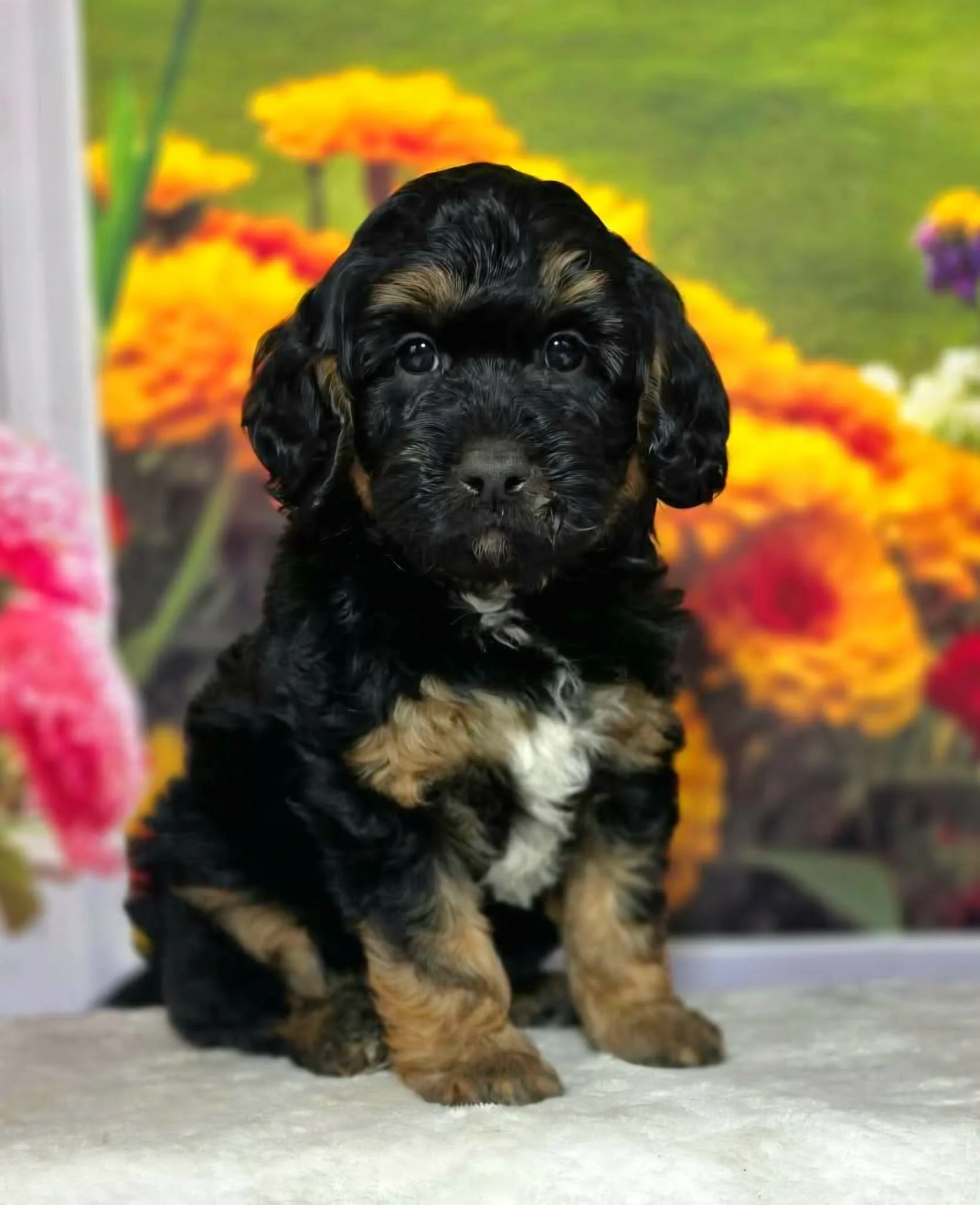
Firefly is a confident, playful, high-energy boy who approaches life like there is always something fun waiting to happen. He is curious, highly motivated, and loves having something to chase, carry, investigate, or figure out. Toys are a big deal to him, and he is perfectly capable of grabbing one and entertaining himself when everyone else is busy.
That independence doesn't mean Firefly isn't people-oriented. He enjoys interaction, stays engaged when someone is working or playing with him, and actively seeks people out when he wants to be social. When we observed him with two unfamiliar children, ages three and four, he followed them around, remained involved in what they were doing, and continued seeking their attention. He seemed genuinely interested in being part of their little world.
Firefly is also emotionally sturdy. He isn't a puppy who appears likely to absorb every big feeling happening around him, which may make him particularly comfortable in an active family where kids occasionally cry, yell, get excited, or have a meltdown. He can participate in family life without feeling like he needs to manage everyone's emotions.
There is a lot of enthusiasm packed into this boy. Firefly will need help learning an off switch, impulse control, and when it's time to settle, but underneath all that puppy energy is a confident, resilient, socially interested dog with plenty of motivation to work with.
Strengths
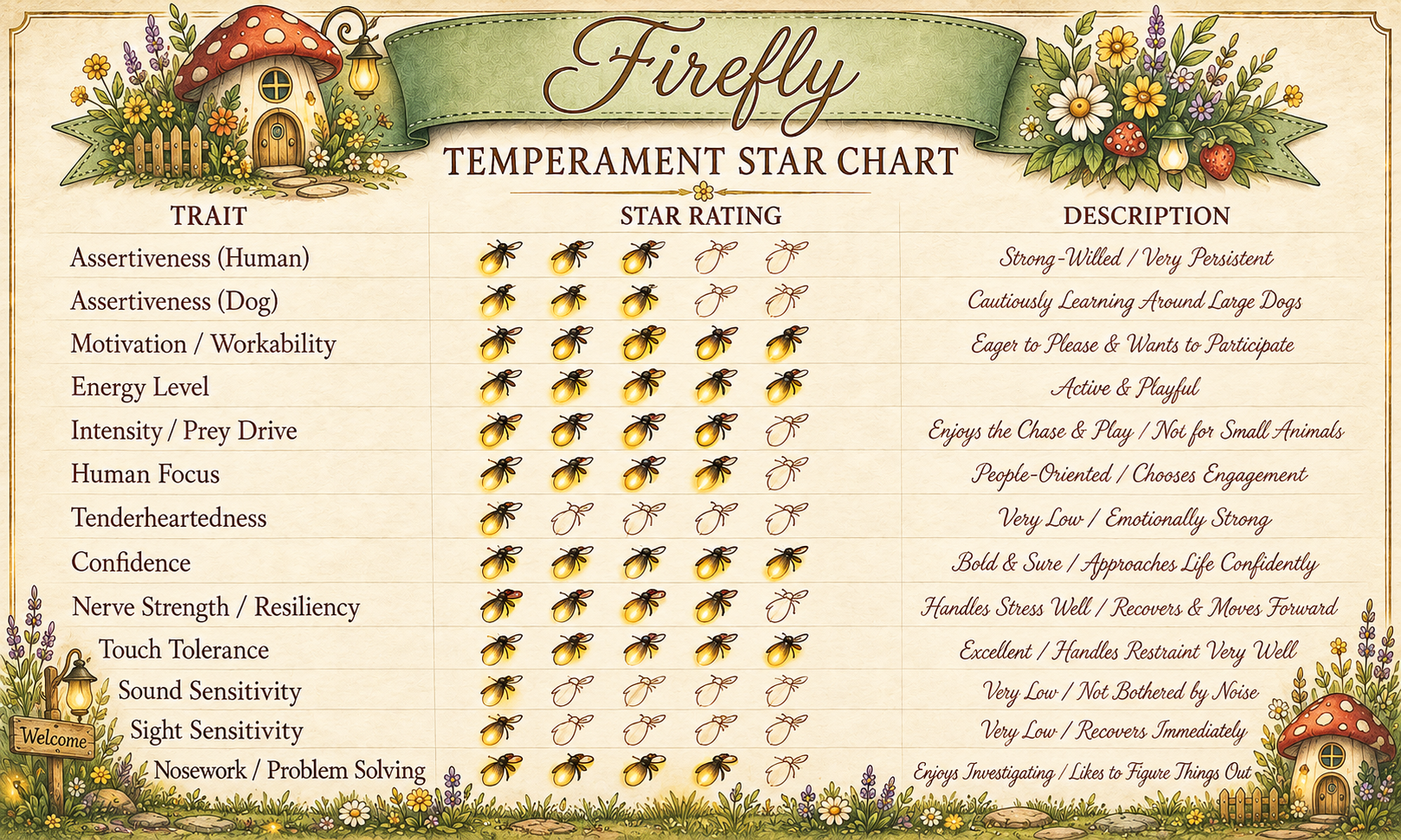
Confident and resilient: Firefly approaches new experiences with confidence. When something does create a little stress, he is able to process it and move forward rather than remaining worried about it.
Highly motivated: Firefly wants things and is willing to work for them. Toys are especially valuable to him, which gives his family a great tool for training, engagement, and play.
Social while still able to self-entertain: Firefly enjoys people, but he doesn't require constant interaction to be happy. He can grab a toy and entertain himself, then readily reengage when something social is happening.
Excellent touch tolerance: Firefly remained playful and socially connected throughout handling. Even while being physically manipulated, his response was generally to continue interacting rather than shut down or disengage.
Promising with young children: We were able to observe Firefly naturally with two unfamiliar children, ages three and four. He remained engaged with them, followed them around, and repeatedly sought their attention. Combined with his low tenderheartedness, he may be an especially nice match for a family wanting a puppy who can comfortably participate in the activity and emotions that often come with young children.
Emotionally sturdy: Firefly isn't particularly inclined to absorb the emotions happening around him. Crying, frustration, excitement, or an occasional childhood meltdown are less likely to become something he feels responsible for fixing. He can care about his people without needing to carry their emotions for them.
Areas to Continue Building
An off switch: Firefly has a lot of energy and enthusiasm. Learning that life isn't always go-go-go will be important. His family should intentionally teach settling, downtime, and the ability to relax even when something more exciting might be available.
Impulse control: With high energy, strong motivation, and good toy/prey drive, Firefly will benefit from learning to think before immediately acting on what he wants. Waiting, releasing toys, calm greetings, and transitioning out of exciting play will all be valuable skills.
Appropriate outlets for drive: Firefly likes to play, chase, retrieve, investigate, and use his body. He will do best when those instincts are given productive outlets rather than simply being expected to suppress them.
Prey Drive
Firefly has a strong interest in toys, movement, chasing, retrieving, and carrying things around. He enjoys the entire game and can stay interested in a toy even when no one else is participating. This gives his family some great natural outlets for play and training.
That interest in movement may also extend to animals that run. If a home includes cats, poultry, livestock, or other small animals, introductions and management should be thoughtful. His prey drive does not automatically mean he cannot live successfully with other species, but we would not assume compatibility without considering the individual animals, appropriate training, and supervision.
Working Potential
Firefly has several qualities that are valuable in a working or training-oriented dog: excellent motivation, confidence, resilience, strong toy interest, good human engagement, and a willingness to investigate and problem-solve.
He may be especially enjoyable for someone interested in training beyond basic manners, dog sports, scent games, retrieving, or other activities that give him something productive to do with his brain and body.
He has some qualities we like to see in therapy-oriented dogs as well, particularly his confidence, excellent touch tolerance, social interest, and low emotional absorption. His biggest consideration would be his current energy level and ability to develop a reliable off switch. As he matures, that will tell us more about where his strengths are best used.
Best Fit Home
Firefly should thrive with an active family that enjoys an involved, playful dog and is willing to provide both physical activity and training.
He may be a particularly nice option for a family with young children. He would also be a fun choice for someone who enjoys training and wants a puppy with plenty of motivation and personality.
He is not the best choice for someone specifically wanting a naturally low-energy puppy who requires very little intentional exercise, enrichment, or training.
Overall Temperament Summary
Firefly is a confident, energetic, highly motivated, socially engaged boy with a wonderfully sturdy emotional temperament. He enjoys his people without needing constant reassurance, can entertain himself, recovers well from stress, and approaches the world with enthusiasm.
His combination of confidence, motivation, playfulness, and human interest gives his family a lot to work with. His biggest developmental priorities will be teaching him how to regulate all that enthusiasm: settling, impulse control, calm behavior, and productive outlets for his energy and drive.
For the right family, Firefly has the potential to be an incredibly fun, interactive companion who is ready to participate in whatever his people are doing—and then, with some practice, learn when it's time to turn it off.
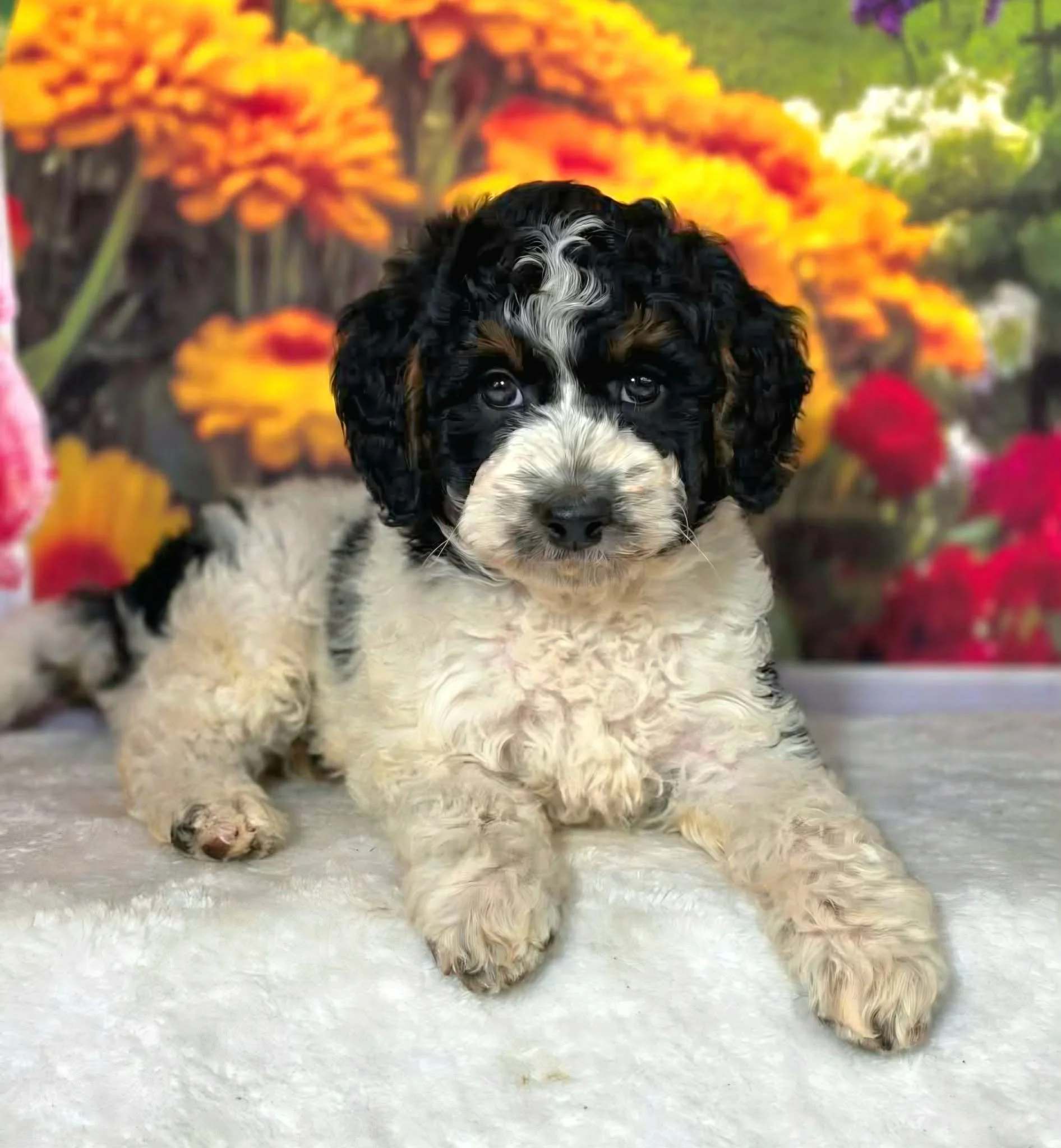
Meet Dragonfly
•Eager to Learn
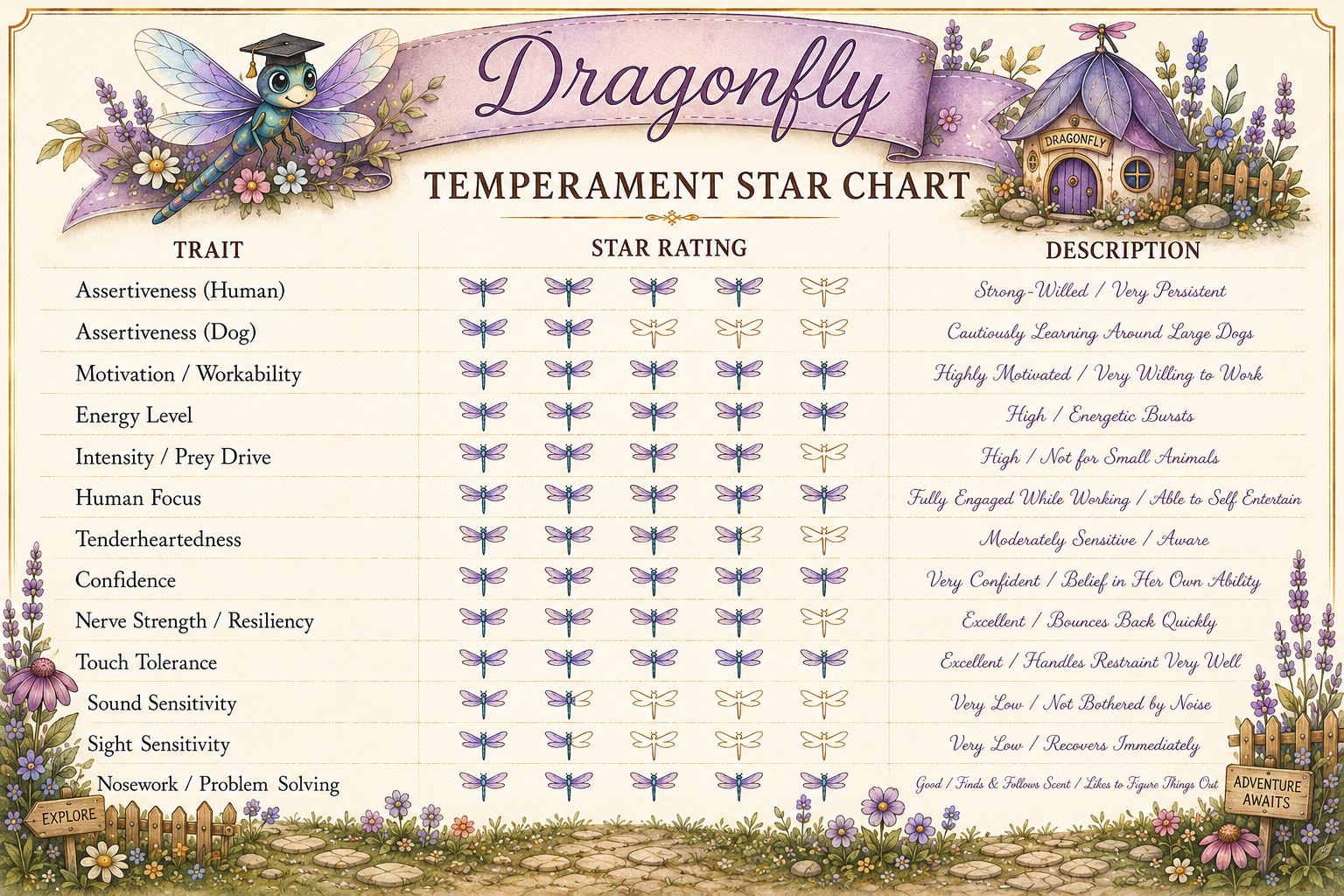
Dragonfly is a confident, playful and highly motivated puppy with a fun combination of strong human engagement and independence. She enjoys interacting with her people and is very responsive when something catches her interest, but she is also perfectly capable of taking a toy off and entertaining herself.
Her energy has an on/off quality. When Dragonfly is excited or highly motivated, she can become fast, enthusiastic and very driven. She also has plenty of naturally calmer periods and isn't a puppy who needs to be busy every second of the day. Her intensity is most noticeable when she finds something she really wants rather than being her constant everyday state.
During temperament testing, toys brought out a tremendous amount of motivation in her. Dragonfly wanted to tug, carry her toy away to enjoy it, search for it when it disappeared and repeatedly returned to the area where she knew it was hidden. She also showed very good natural use of her nose while searching for it.
Dragonfly was eager to tackle the physical challenges in front of her, including unstable surfaces and slides. When something gave her pause, she generally stopped to look at it, processed what she was seeing and then moved forward. She showed excellent recovery and was very willing to trust her person when working through something unfamiliar.
Strengths
Highly motivated and engaged — when Dragonfly is interested in something, she is enthusiastic and ready to participate.
Strong toy and play motivation — toys are highly rewarding to her and should be an excellent tool for training and enrichment.
Strong resiliency — she can pause when something surprises her, process it and move forward quickly, particularly with support from someone she trusts.
Strong connection with her person while still being independent — she enjoys working and interacting with people but can also entertain herself.
Confident with physical challenges — she willingly tackled unstable surfaces, climbing and movement during testing.
Good natural nose use — she repeatedly used scent while searching for her hidden toy and remained aware of where it was located.
Areas to Continue Building
Dragonfly's biggest developmental need is continued confidence-building around unexpected sights and sounds.
There is an important distinction here: Dragonfly has excellent confidence in her own abilities. She willingly climbs, explores, problem-solves and tackles physical challenges. At the same time, we have observed some startle responses to unexpected environmental sights and sounds, particularly when she is not actively working with someone she trusts.
When she does have a trusted person working with her, she becomes much less concerned about what is happening around her. She processes uncertainty quickly and places a tremendous amount of trust in her handler.
Her family should continue thoughtful socialization and exposure without making a big production out of the things that surprise her. She needs someone who can calmly help her investigate and move forward rather than either protecting her from everything unfamiliar or overwhelming her in an attempt to make her “get over it.”
Dragonfly is also a strong-willed, persistent puppy who isn't shy about invading your personal space. When she's excited or wants something, that can look like jumping on you, mouthing, grabbing clothing or continuing to try until she gets a response.
She will need a family who is comfortable setting expectations early and sticking with them. Dragonfly is motivated enough to remember what works. If becoming increasingly wild or persistent gets her what she wants, she's likely to try it again. Her family will want to be intentional about not rewarding the crazy and instead teach her which behaviors successfully earn attention, play and access to the things she wants.
The upside is that the same persistence that can make her push boundaries is also part of what should make her so much fun to train. She is eager, responsive and highly motivated. Give that determination somewhere productive to go and there is a lot to work with.
Children
Dragonfly could live successfully with children, but the overall environment of the home matters more than simply whether children are present.
She is assertive and physical in her interactions. Jumping, mouthing, grabbing clothing and getting directly into someone's space are all behaviors her family should expect to work on during puppyhood. Children living with Dragonfly need to be comfortable around an enthusiastic puppy, and the adults need to be willing to actively supervise interactions and teach both puppy and children appropriate boundaries.
We would be more cautious about placing her in a home where children create a consistently loud, chaotic or highly rowdy environment. Frequent screaming, rough indoor play, people racing through the house and other unpredictable commotion could be difficult for her while she is still developing confidence around unexpected sights and sounds.
A home with children does not automatically rule Dragonfly out. A calmer, structured family with dog-savvy children and adults who will actively manage puppy behavior could be a very different fit from a household with constant high-energy chaos.
Prey Drive & Small Animals
Dragonfly has a high prey drive and a strong instinct to chase movement. Small animals that run are likely to trigger that chase response.
Because of this, we would not recommend Dragonfly for a home where she would have access to chase small livestock or other small animals.
Cats require a little more nuance. Dragonfly is expected to be around 20 pounds as an adult, and a confident, dog-savvy cat that stands its ground and establishes boundaries early on may be very different for her than a cat that runs and invites a game of chase.
A home with a fearful or flighty cat would not be our preferred placement for Dragonfly. A confident cat experienced with dogs may be possible with appropriate introductions, management and clear boundaries, but families should expect that Dragonfly will be inclined to chase if the cat runs.
Training can help develop impulse control, recall and appropriate behavior around other animals, but her natural desire to chase movement should be considered part of her temperament rather than something a family should expect to completely train away.
That same drive can be a lot of fun when given an appropriate outlet. Dragonfly's enthusiasm for chasing, toys, tug and searching could translate beautifully into training games, retrieving, scent activities and dog sports.
Working Potential
Dragonfly has a lot of qualities that make her exciting from a training and working standpoint.
She is highly motivated, eager to participate, resilient and fully engaged with her person while working. She has excellent toy motivation, good natural nose use and enough persistence to keep trying when she wants something. She also trusts her handler tremendously and is very responsive when someone gives her direction.
For someone interested in dog sports, scent work, trick training, retrieving or simply doing a lot of training with their companion dog, Dragonfly could be especially fun. She wants to participate and has plenty of natural rewards available to use in training.
On paper, many of her temperament scores are also qualities we look for in service and therapy prospects. However, Dragonfly is not our recommendation for the average family specifically seeking a puppy for service or therapy work.
Her current environmental startle responses create enough uncertainty that we would not want a family whose success depends on their puppy eventually being comfortable working in unpredictable public environments. She may continue to develop beautifully with thoughtful socialization, and an experienced handler may be able to take her much further, but we would rather place her based on the puppy she is showing us today than promise a working outcome based on what she could potentially become.
Best Fit Home
Dragonfly's best match is a confident, engaged family who genuinely enjoys training and interacting with their dog.
She needs someone who appreciates a puppy with opinions. Her persistence and assertiveness aren't going to be the right fit for a person who wants a naturally passive puppy who rarely pushes boundaries. Dragonfly will benefit from someone who can set an expectation, remain consistent and move on without turning everyday puppy behavior into a battle.
She also needs a family committed to continuing thoughtful exposure and socialization. When something catches her off guard, her person should be able to remain calm and help her work through it rather than coddling the response or forcing her through something overwhelming.
Dragonfly has recently had opportunities to spend time loose in the house around adult dogs. That has included being accidentally trompled by much larger dogs as well as receiving appropriate corrections from adults when her puppy behavior crossed a boundary. She has learned to approach larger dogs with some caution and respect.
We don't currently interpret that as generalized fear of other dogs. She appears to be cautiously learning how to navigate relationships with larger dogs based on her recent experiences. She may enjoy living with a calm, socially appropriate canine companion who communicates well without repeatedly overwhelming or physically bowling her over.
Her ideal home does not need to provide nonstop activity. Dragonfly has plenty of calmer periods and can entertain herself. What she needs is appropriate engagement when she does switch on—training, play, enrichment, exploring and opportunities to use that very motivated little brain.
We would not choose her for a consistently loud, chaotic or highly rowdy household, nor would we choose her for a home with small animals she would regularly have the opportunity to chase.
Overall Temperament Summary
Dragonfly is a confident, determined, highly trainable little dog with a lot of personality.
She believes in herself. She is willing to tackle challenges, recovers extremely well and becomes fully engaged when someone asks her to work. When she discovers something she really wants, she can bring an impressive amount of persistence and enthusiasm to getting it.
She is also not “on” all day. Dragonfly can enjoy her people, work enthusiastically and then take something off to entertain herself. Her family gets both the puppy who can become completely invested in a game and the puppy who is capable of having genuinely calmer periods.
Her assertiveness will require boundaries. Her prey drive needs appropriate outlets and realistic management. And her current sensitivity to unexpected sights and sounds means continued socialization should be a priority rather than an afterthought.
Those pieces are important, but they shouldn't overshadow what makes Dragonfly exciting for the right family: she is extraordinarily willing. She wants to participate. She responds to her person. She has motivation that can be turned into training. And when she trusts the person beside her, she is remarkably willing to follow their lead.
Dragonfly's best family isn't looking for the easiest puppy or the busiest puppy. They're looking for a smart, persistent, interactive companion and genuinely enjoy the process of teaching a puppy how to become a great adult dog.
For that family, Dragonfly should be an incredibly fun little partner.
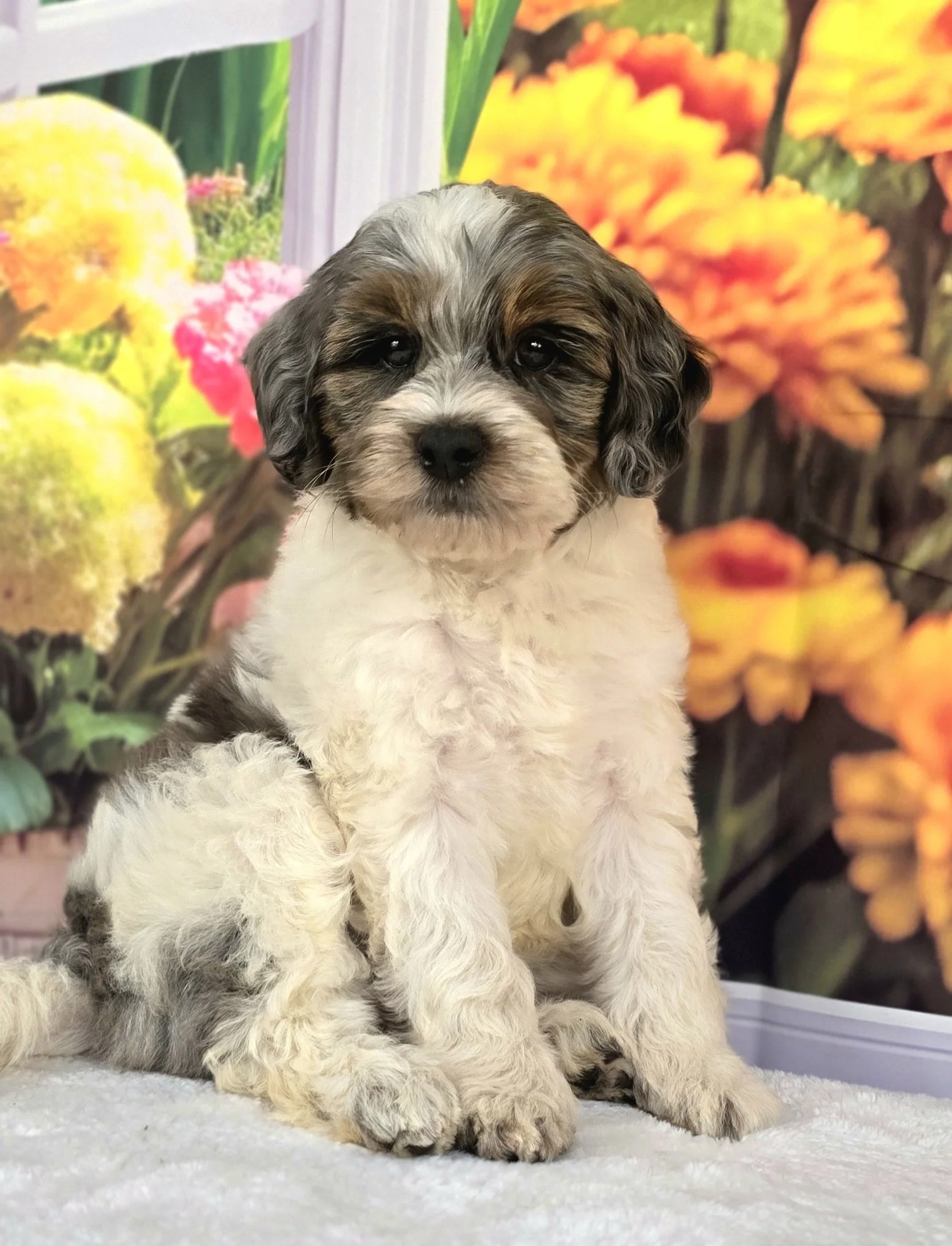
Meet Grasshopper
• Service / Therapy / ESA prospect
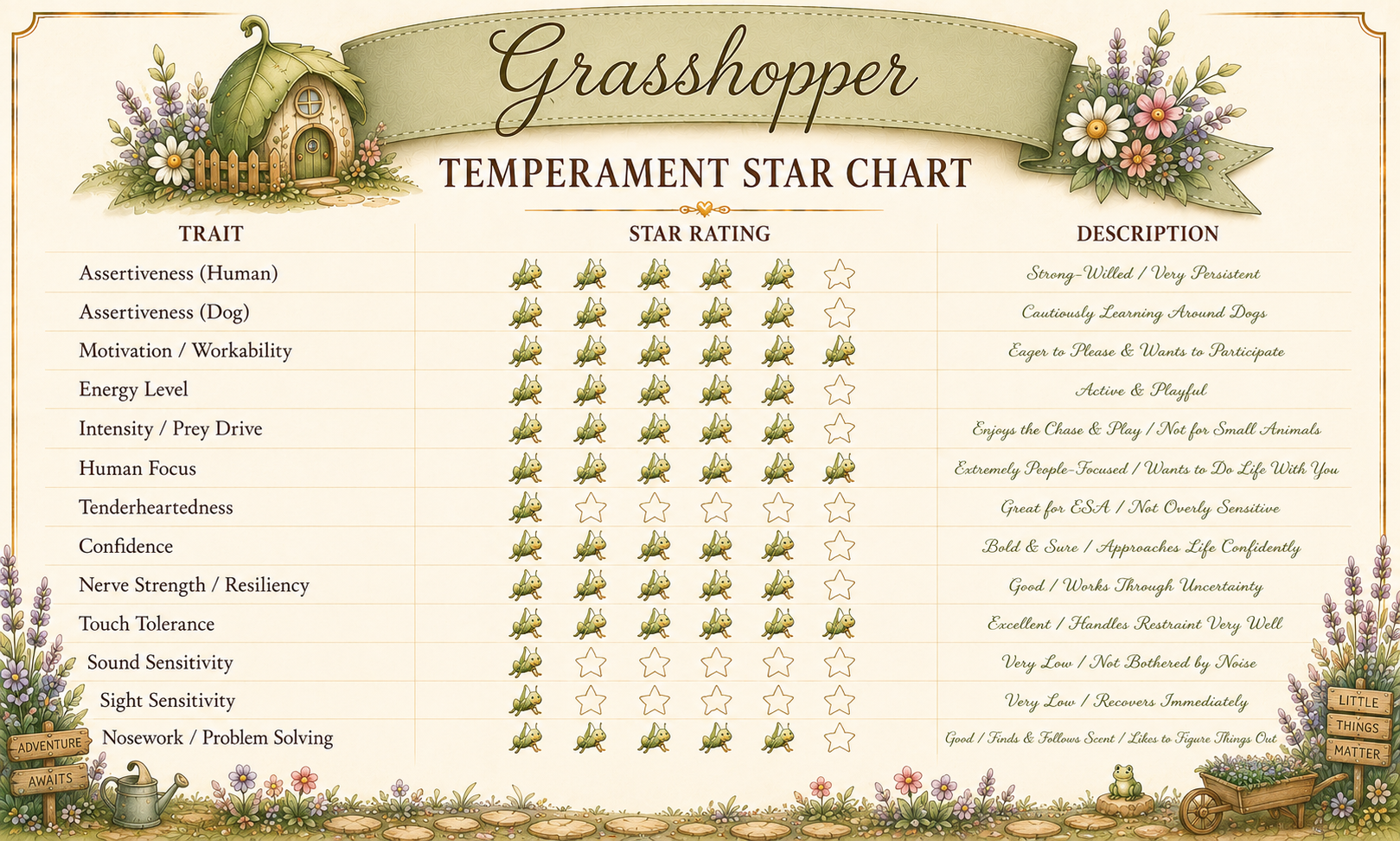
Grasshopper is a sweet, playful, highly people-oriented puppy with a polite social approach and a fun, mischievous side that comes out as he gets comfortable. He loves engaging with his people and showed lovely natural retrieving behavior, good toy motivation, and a strong desire to participate without being overwhelmingly intense.
He has good overall confidence and is willing to work through uncertainty, but new or startling experiences can affect him more than they do some puppies. He benefits from encouragement and opportunities to figure things out rather than being pushed or rescued. Once he succeeds, you can see that confidence build.
Despite how much Grasshopper loves his people, he is also capable of entertaining himself and playing independently. That independence is something we want his future family to intentionally preserve as he grows.
Strengths
Extremely human-focused: Grasshopper genuinely wants to do things with his people. He follows interaction readily, responds strongly to engagement, and naturally brings play back to his humans.
Playful and naturally retrieving: He showed lovely fetching behavior and enjoys chasing, carrying, and bringing toys back. Much of the fun for him comes from playing the game with a person.
Good confidence and resilience: Grasshopper can have moments of uncertainty, but he wants to figure things out. With appropriate encouragement and time to process, he is willing to try again and make progress.
Able to play independently: Despite how much he enjoys people, Grasshopper can entertain himself. He was comfortable continuing to play when a person walked away, which is an important skill to preserve.
Very good handling tolerance: Grasshopper tolerates physical handling well while remaining socially connected. Even when he would prefer something to stop, he moves right back into happy interaction once it's over.
Areas to Continue Building
Environmental confidence and socialization: Grasshopper had a significant startle when something unexpected happened and showed some lingering stress afterward. He was able to investigate and continue, but he didn't immediately forget that something had worried him. Continued exposure to new places, sounds, surfaces, people, objects, and experiences will be particularly important for him.
This is a puppy who needs to finish his socialization checklist. Keeping his world small during puppyhood could allow uncertainty to grow as he matures. He should be regularly and thoughtfully exposed to the world while those experiences are still new and flexible.
Working through uncertainty: When Grasshopper isn't sure about something, he may genuinely want to do what is being asked but have difficulty making himself take that next step. He does best when given encouragement, time to think, and an opportunity to succeed rather than being forced through the situation or immediately rescued from it.
Independence: Grasshopper currently has a nice ability to entertain himself, but because people are so rewarding to him, his family needs to protect that independence. If every request for attention is answered and he is rarely expected to be alone, he could become overly dependent on having his people nearby.
Independent naps, crate or pen time, self-directed play, and short positive separations should be normal parts of his life from the beginning. We see this as a puppy with some potential for separation anxiety if independence isn't intentionally encouraged, rather than a puppy who currently struggles to be alone.
Impulse control: Once Grasshopper gets comfortable, his mischievous side comes out. Pant legs, shoes, and other moving or interesting things can quickly become part of his game. He'll benefit from early boundaries, redirection, and teaching appropriate ways to ask for interaction.
Children
Grasshopper showed us that he enjoys people and interaction, but he also has a limit when activity becomes extremely unpredictable or chaotic.
During his interaction with a child, he participated willingly at first but moved away and briefly hid when the activity became especially physical and erratic. He wasn't looking to join in with that level of chaos.
That doesn't mean he shouldn't live with children. He could do very well with respectful kids who understand how to interact appropriately with a puppy and adults who supervise those interactions. He should always be allowed to move away when he's had enough rather than being expected to tolerate being chased, crowded, grabbed, or continually pulled back into play.
Prey Drive & Small Animals
Grasshopper enjoys chasing, grabbing, carrying, and retrieving toys, but his drive appeared strongly connected to interactive play rather than becoming intensely fixated on the object itself.
He still has enough natural interest in movement that a running small animal could absolutely trigger a chase.
A calm, dog-savvy cat that stands its ground may be very different for Grasshopper than a cat that runs and repeatedly gives him an opportunity to chase. He may be able to live successfully with an appropriate cat with thoughtful introductions, boundaries, and training, but we would not assume that he will automatically ignore a running cat.
More vulnerable small animals such as rabbits, guinea pigs, rodents, birds, or similar pets should be physically protected rather than relying on training alone.
The same caution applies to chickens and other small livestock. Chasing can become rewarding very quickly, so Grasshopper should not have unsupervised access to animals that could be injured if he decides that pursuing them is a game.
Working Potential
Grasshopper has strong working potential. He is extremely human-focused, motivated to participate, naturally engaged with his person, and showed lovely retrieving behavior. He wants to work with someone and seems to genuinely enjoy figuring out what is being asked of him.
Service work is absolutely on the table for Grasshopper. His human focus, workability, excellent handling tolerance, natural retrieving interest, and willingness to keep trying are all qualities we like to see in a potential service prospect. His biggest question mark is environmental confidence. He can be affected by something that genuinely startles him and may carry some of that stress forward, so we would want to see continued growth in that area as he matures.
He is also looking like a strong therapy prospect. Grasshopper is affectionate, socially engaged, comfortable with handling, and genuinely enjoys interacting with people. His low tenderheartedness may actually work in his favor here—he can connect closely with people without appearing likely to absorb or become overwhelmed by their emotions.
Grasshopper could also make an excellent ESA. He is deeply people-oriented and naturally seeks connection and interaction while still showing the ability to entertain himself. He offers companionship without appearing emotionally fragile or dependent.
Overall, Grasshopper has one of those temperaments where there are several directions he could successfully go. Service prospect, therapy prospect, ESA, or highly engaged family companion are all realistic possibilities for him based on what he is showing us now.
Best Fit Home
Grasshopper would be a great fit for a family looking for a highly people-oriented, playful, affectionate companion who genuinely enjoys doing things with his humans.
His best family will continue getting him out into the world and building his confidence rather than assuming that socialization ends when he comes home. He needs opportunities to experience new places, sounds, surfaces, people, and situations while learning that uncertainty is something he can work through.
He could do well with respectful children and an active family, but he isn't the puppy we would choose for a household where constant physical chaos is simply part of everyday life.
His family should also be comfortable encouraging independence from the beginning. Grasshopper can currently play by himself and handle a person walking away, and we want to keep that skill. A home where someone is constantly available and responds to his every request for interaction could unintentionally create dependence that isn't currently there.
Grasshopper will thrive with people who enjoy how connected he is while still giving him opportunities to discover, “I can do this myself.”
Overall Temperament Summary
Grasshopper is a sweet, playful, highly human-focused puppy who combines a polite social style with a fun little mischievous streak. He loves interacting with people, naturally brings play back to his humans, and showed some lovely retrieving behavior.
He has good confidence and resilience, but environmental confidence is an area his family needs to continue developing. When something genuinely worries him, he may carry some of that stress forward and need a little time and encouragement before he's ready to tackle it. The encouraging part is that he wants to try, and when given the opportunity to work through something successfully, he can make meaningful progress.
His strong human connection is another important part of who he is. Grasshopper loves his people, but he currently also knows how to entertain himself. Preserving that balance between connection and independence will be important as he grows.
Grasshopper's family shouldn't shelter him from the world because something occasionally makes him uncertain. They should thoughtfully help him experience it, work through it, and discover how capable he really is.
With continued socialization, confidence-building, independence practice, and normal puppy training, Grasshopper has the foundation to grow into a deeply connected, playful, and enjoyable family companion.
Finding the Right Garden
Every little bug needs the right garden to thrive.
Once you've gotten to know the puppies, it's time to look at your own household just as carefully.
Think about what an ordinary weekday actually looks like. How active are you now? Is your home generally quiet or busy? How much training do you genuinely enjoy? What are your children like around dogs? Do you have cats or other dogs? What kind of relationship do you want with your dog? Are there behaviors that would be particularly difficult for your household? Does your puppy need to eventually perform a specific job?
Color, sex, markings and the puppy you've fallen in love with through photographs can absolutely be part of your decision. But when a preference conflicts with an important household need, the need should come first.
A useful question to ask yourself is:
Does this puppy's whole temperament—including the things that may challenge us—make sense for the life we actually live?
A Good Match Is Still a Puppy
Temperament matching doesn't eliminate puppyhood. Even a puppy who fits your family beautifully may bite, chew, have potty accidents, become overstimulated, test boundaries, need help settling and require plenty of training.
A good match means the puppy's underlying temperament makes sense for your household. You still get the wonderfully messy job of raising them.
Wondering what those first weeks and months will really look like? Learn more about What to Expect During Puppyhood
Which Summer Bug Fits Your Family?
It's time for our little bugs to find their families.
Hicks
Breeder - OLG
When your turn approaches, review the complete profiles of the puppies available to you and consider which temperaments make sense for your household and priorities. There may be more than one puppy who fits your family beautifully.
We're here to answer questions and to discuss anything we see that may create a significant mismatch. And if none of the available puppies truly meets an important need for your family, waiting for another litter is always an acceptable choice.
Every little bug needs the right garden to thrive.
And now it's time to find theirs.